

Auto Dialer vs Predictive Dialer vs Power Dialer: Which Is Best for Your Business?
An agent who dials by hand spends most of the hour not talking. Industry benchmarks put manual talk time at roughly 10 to 15 minutes per hour; the rest disappears into ringing, busy tones, voicemail and typing numbers. The right dialer can win back 30 minutes or more of that hour. The wrong one can burn through your lead list, annoy prospects with dead air, or put you on the wrong side of telemarketing rules.
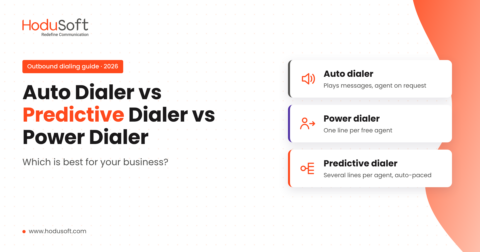
That is why the auto dialer vs predictive dialer question (and its cousin, power dialer vs predictive dialer) matters more than the jargon suggests. The three terms get used interchangeably on vendor sites, but they behave very differently on a live floor.
This guide is written from the floor up. It explains how each dialer actually paces calls, shows the talk-time and compliance numbers behind each one, and ends with a simple decision path by team size and campaign goal.
Quick answer: which dialer should you choose?
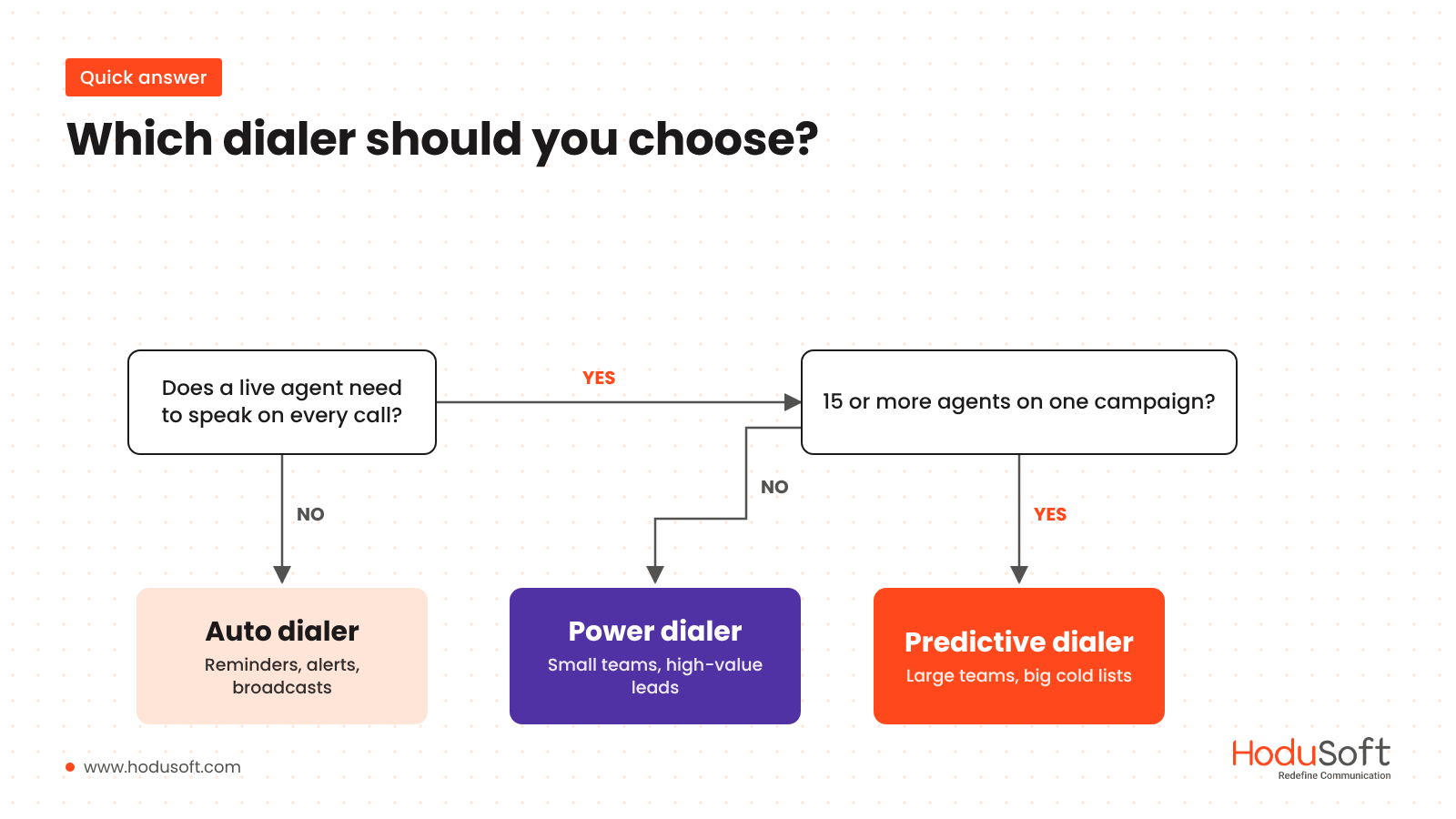
Choose a predictive dialer if you have a large calling list and roughly 15 or more agents on one campaign. Choose a power dialer if you have a smaller team, high-value leads, or strict rules on dropped calls. Choose a basic auto dialer if most of your calls are reminders, alerts or recorded messages that do not need a live agent.
That is the short version of the auto dialer vs predictive dialer debate. The longer version depends on one number: how many lines the system dials for each free agent.
| If your situation is… | Pick this | Why it fits |
|---|---|---|
| 15+ agents, 10,000+ contacts, low answer rates | Predictive dialer | Keeps agents talking 40 to 50 minutes an hour by dialing ahead of them |
| 2 to 15 reps, warm or high-value leads | Power (progressive) dialer | One line per agent, so no dead air and no dropped prospects |
| Payment reminders, appointment confirmations, alerts | Auto dialer / voice broadcasting | Plays a recorded or IVR message; agents join only if the contact presses a key |
| Complex B2B calls where reps must research first | Preview dialer | Rep sees the record and decides when to dial |
One caution before going further. “Auto dialer” is used in two ways. Vendors often use it as the umbrella term for every automated dialer, including predictive and power. In everyday sales talk, it usually means the simplest type: a system that works through a list and plays a message or hands off to an agent. This article uses the second meaning, and flags the difference where it matters.
Not sure which dialer fits your campaigns?
Talk to a HoduSoft dialer specialist. We'll map auto, power and predictive modes to your team size, lead lists and compliance needs.
What is an auto dialer?
An auto dialer is software that dials numbers from a list automatically, then either plays a recorded message or connects the answered call to an agent. Its job is to remove the typing, waiting and redialing that eats most of a manual caller’s day.
Why use an auto dialer?
Most outbound lists are full of numbers that will never pick up. When a person dials by hand, every unanswered ring costs them 20 to 30 seconds. Multiply that by a few hundred calls and a full shift vanishes. An auto dialer absorbs that waste, so people only spend time on calls that need a human, or no human at all.
How an auto dialer works
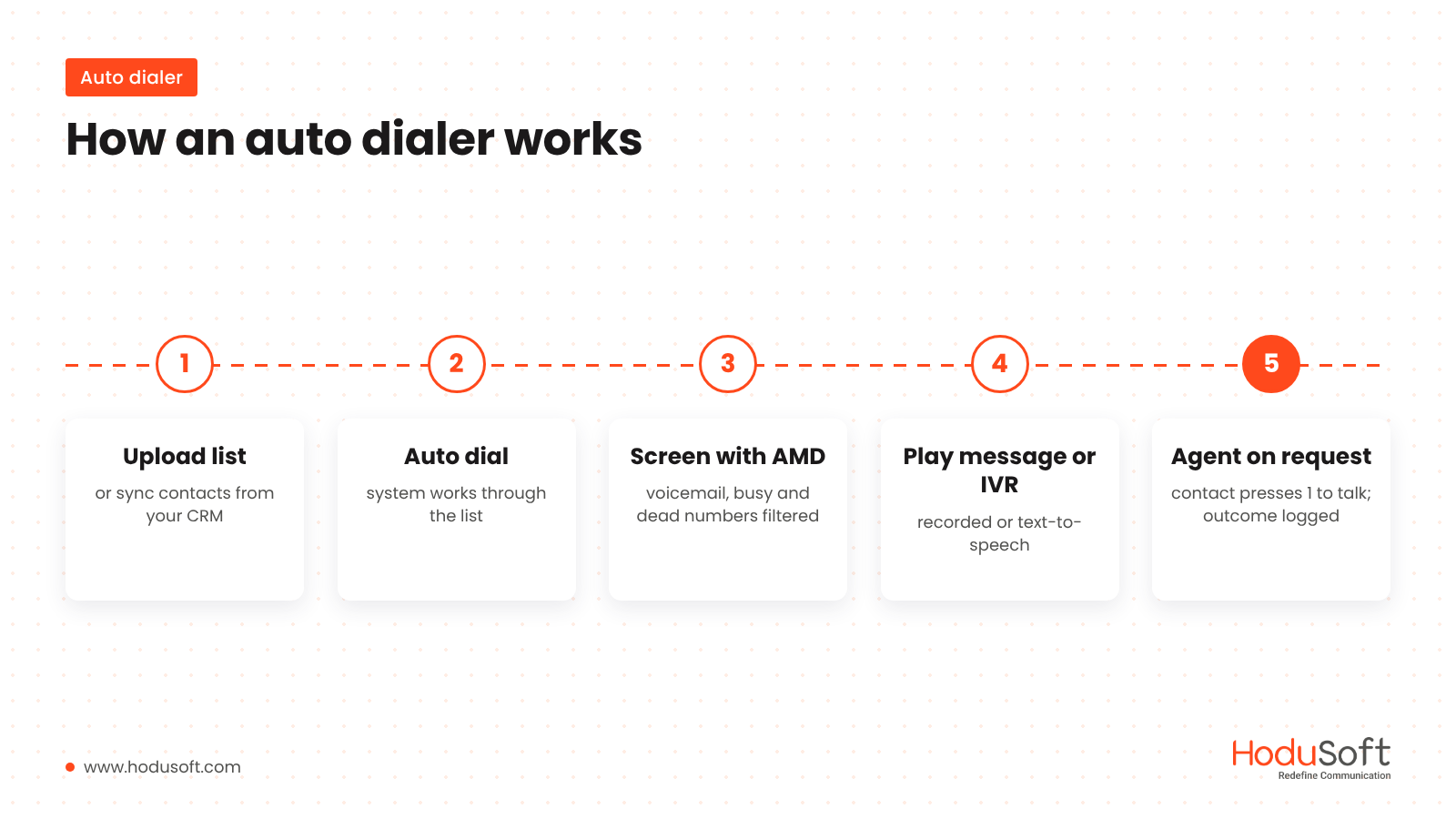
- You upload a contact list or sync it from your CRM.
- The system dials each number in sequence, often several at once for message-only campaigns.
- Answering machine detection (AMD) screens out voicemail, busy tones and dead numbers.
- On a live answer, it either plays a pre-recorded or text-to-speech message, or routes the call to an available agent.
- Outcomes (answered, no answer, busy, opted out) are logged so the list can be retried on a schedule.
The message-only mode is often called voice broadcasting. It shines when the content is the same for everyone: “Your EMI is due on the 5th, press 1 to pay now.” HoduCC’s auto dialer software pairs this with IVR, so a contact can press a key to reach a live agent only when they want one.
Auto dialer use cases
- Payment and renewal reminders
- Appointment confirmations for clinics, salons and service centres
- Delivery, outage and emergency alerts
- Event invitations and survey calls
- Simple lead qualification (“Press 1 if you’d like a callback”)
Auto dialer limitations
- Low personal touch. Recorded messages convert poorly for complex or high-value sales.
- Consent rules are strict. In the US, prerecorded marketing calls to mobile phones generally require prior express written consent, and the TCPA allows statutory damages of $500 per call, up to $1,500 if willful.
- Answer rates are falling. In India, promotional calls must come from TRAI’s 140 number series, and Truecaller’s CEO has claimed users ignored about 81% of 140-series calls over an eight-month period. List hygiene and the right number series matter as much as the dialer.
From the floor: auto dialers earn their keep on volume and repetition. A clinic chain that phones 3,000 patients a week to confirm appointments does not need 3,000 agent conversations. It needs the 200 people who want to reschedule to reach a person quickly.
[Video embed: HoduCC auto dialer / voice broadcasting walkthrough, 2 to 3 minutes. Editor to insert the official HoduSoft YouTube link.]
What is a predictive dialer?
A predictive dialer uses an algorithm to dial several numbers per agent before anyone is free, timing it so a live answer arrives just as an agent finishes their last call. It is the fastest of the three, and the one that needs the most care.
Why use a predictive dialer?
On a cold list, most calls fail. If only one call in four reaches a person, a dialer that rings one number at a time leaves the agent waiting through three dead calls for every live one. Predictive dialing bets on the odds instead, usually dialing 1.5 to 3 lines per agent. Industry benchmarks put the result at a 200 to 300 percent gain in talk time over manual dialing, roughly 40 to 50 minutes of conversation an hour instead of 10 to 15.
How predictive dialing paces calls
The dialer watches a handful of live numbers and recalculates every few seconds:
- Answer rate on this list right now
- Average handle time, including wrap-up
- Agents available and about to become available
- Abandon rate so far in the campaign
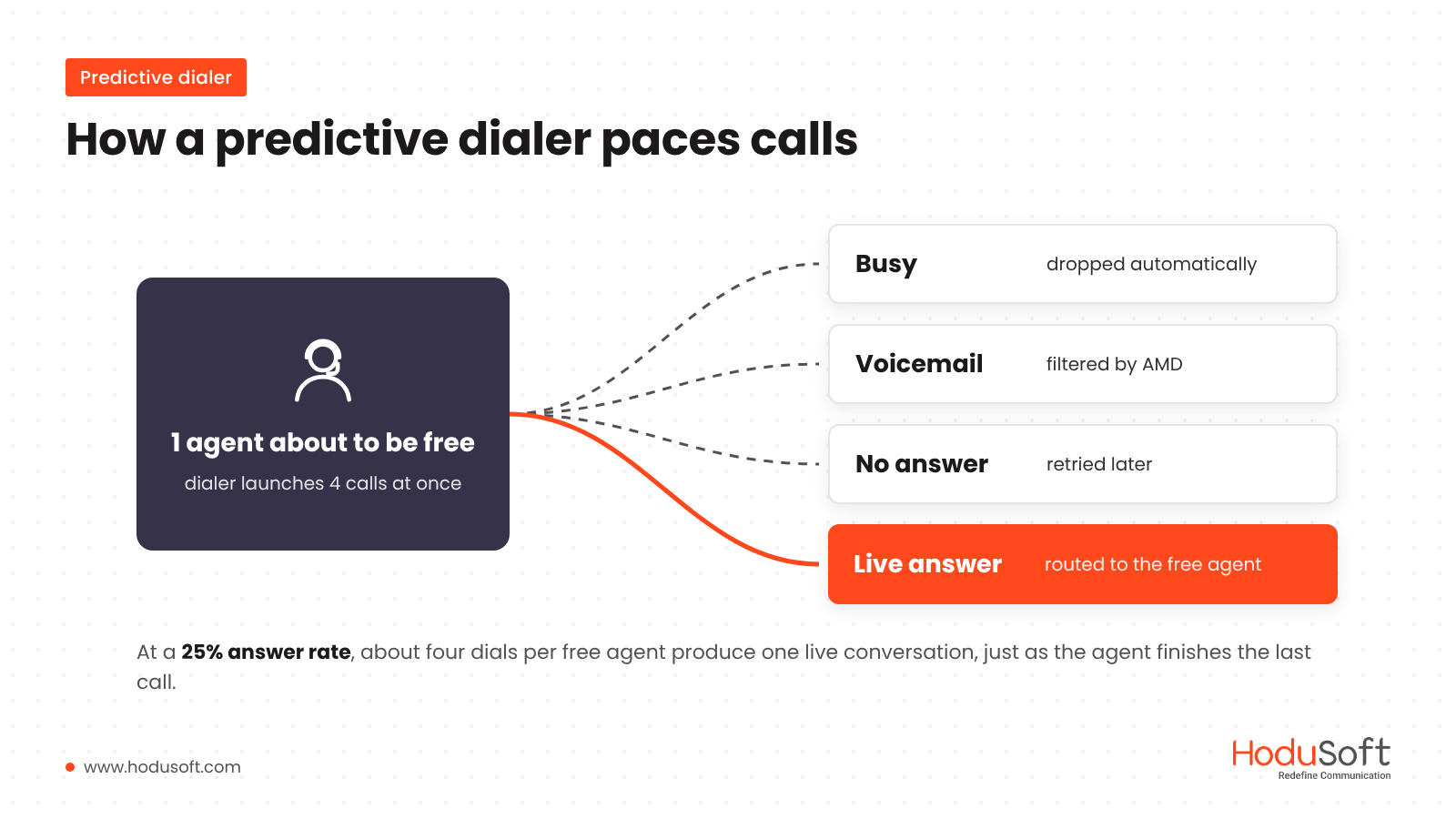
A simple example: if 25% of calls are being answered and 10 agents will be free in the next 15 seconds, the dialer launches about 40 calls. Answering machine detection filters voicemail, and live answers are routed to the first free agent with the contact’s details on screen.
An adaptive predictive dialer adjusts that ratio on its own as conditions change. A static one dials a fixed number of lines per agent set by a supervisor, which is closer to a power dialer with extra lines.
Predictive dialer compliance: the 3% rule
When the dialer guesses wrong, two people answer and only one agent is free. The other hears silence, and the call counts as abandoned. Regulators cap this:
- US (FTC Telemarketing Sales Rule): no more than 3% of live-answered calls may be abandoned, measured per campaign or per 30-day period. An agent must be on the line within two seconds of the person’s completed greeting, or a recorded message must identify the caller and give a callback number.
- Ring time: under the FCC’s telemarketing rules, unanswered calls must ring for at least 15 seconds or four rings before the dialer hangs up.
- Rule under review: the FCC has opened a rulemaking that questions the 3% cap. Until a final rule is published, the current cap applies.
A good predictive dialer lets you set a target abandon rate and throttles itself to stay below it. If you want to understand how that metric is measured, see our guide to call abandonment rate.
Predictive dialer use cases
- Large BPO and outsourced telemarketing campaigns
- Collections and payment recovery
- Insurance, loans and credit card cross-sell on big lists
- Political, survey and market research calling
- Lead lists where answer rates sit below 30%
Predictive dialer limitations
- Needs scale. With fewer than about 10 to 15 agents on one campaign, the statistics get noisy and the dialer either drops calls or slows to a crawl.
- No prep time. Agents hear “hello” before they have read the record, so scripts and CRM pop-ups must be strong.
- Burns lists fast. A small, carefully built list can be exhausted in hours.
- Spam risk. Short calls and silent connects can get your numbers flagged by carriers. Branded caller ID and STIR/SHAKEN attestation help; our post on why calls get marked as spam explains the fix.
Recognition: HoduCC’s predictive dialer was ranked No. 1 in GetApp’s Category Leaders for predictive dialers and named on Software Advice’s FrontRunners 2025 list, both based on verified user reviews.
Customer example: Travelopod, a travel company with offices in the USA and India that sells low-cost US–India fares and custom holidays, runs its sales floor on HoduCC with the predictive dialer, ACD and skill-based routing. High call volumes on fare enquiries are exactly where predictive pacing pays off.
See HoduCC's predictive dialer in action
Adaptive pacing, answering machine detection and abandon-rate controls on one platform, ranked No. 1 in GetApp's predictive dialer category.
What is a power dialer?
A power dialer automatically dials the next number the moment an agent finishes a call and is marked ready. It dials one line per agent (some systems allow a small fixed ratio), so every answered call already has a person waiting for it. Many platforms, HoduCC included, call this mode a progressive dialer.
Why sales teams use power dialers
A power dialer removes the busywork of manual dialing without the risk of predictive dialing. Because a call is placed only when an agent is free, there is never a live answer with nobody on the line. Abandoned calls are zero by design, which makes compliance far simpler. For a team working expensive leads, never wasting a “hello” matters more than squeezing out the last few minutes of talk time.
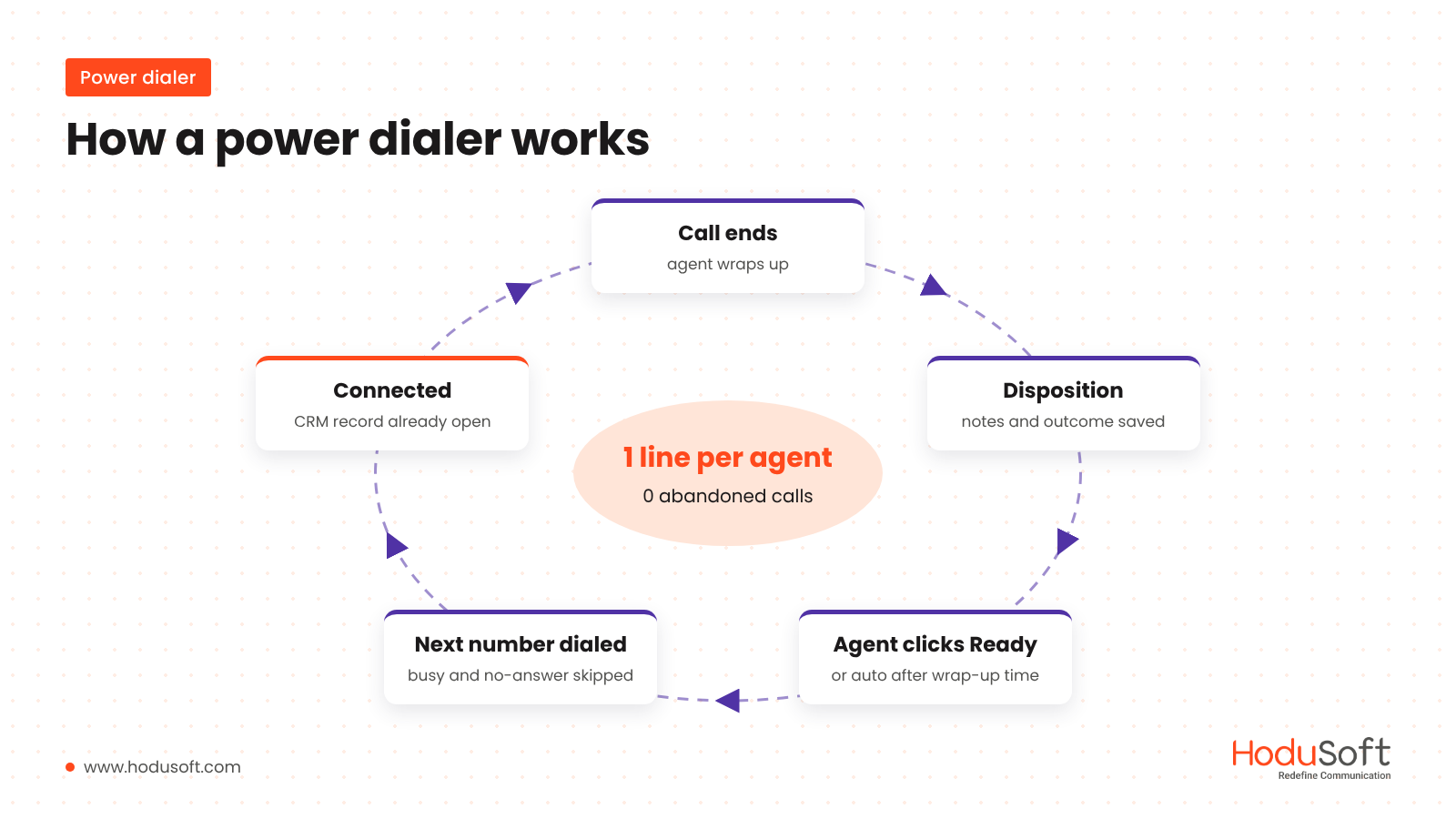
How a power dialer works
- The agent finishes a call and adds notes and a disposition (interested, callback, not interested).
- They click “ready”, or the system moves on after a set wrap-up time.
- The dialer calls the next contact, skipping busy and unanswered numbers.
- The agent hears the call connect with the CRM record already open.
- Callbacks and retries are scheduled automatically, by time zone where needed.
The pause between calls is small but real. That gap is what gives a rep a few seconds to glance at the account history before the next conversation, and it is why power dialers suit consultative selling.
Power dialer use cases
- Inside sales and SDR teams of 2 to 15 people
- Warm leads, inbound enquiries and webinar follow-ups
- Renewal, upsell and win-back campaigns on existing customers
- Real estate, education counselling and high-ticket B2C sales
- Any campaign where a dropped call would damage the brand
Power dialer limitations
- Lower throughput than predictive. Agents still wait through ringing and failed attempts on each call.
- Agent-driven pace. Long wrap-up times slow the whole campaign, so disposition discipline matters.
- Less efficient on cold lists. When answer rates are very low, much of the hour goes to ringing.
If reps need to read a record before choosing whether to dial at all, the next step down is a preview dialer. For most sales floors, though, HoduCC’s progressive (power) dialer is the sweet spot between speed and control.
Auto dialer vs predictive dialer vs power dialer: side-by-side comparison
The real difference between these three is not speed alone. It is how much control the agent keeps, and how much risk the business accepts in exchange for volume.
| Criteria | Auto dialer | Power dialer | Predictive dialer |
|---|---|---|---|
| How it dials | Works through a list; often many lines at once for messages | One line per free agent (or a small fixed ratio) | Several lines per agent, paced by an algorithm |
| Live agent on every call? | No; message first, agent on request | Yes | Yes, when the prediction is right |
| Agent control | Low; agents only take transferred calls | High; agent sets pace and sees the record | Low; calls arrive back to back |
| Prep time before “hello” | Not applicable | A few seconds | Almost none |
| Abandoned-call risk | Low if messages play on answer | Zero by design | Real; must be kept under 3% in the US |
| Ideal team size | Any, even zero agents | 1 to 15 agents | About 15+ agents per campaign |
| Best for | Reminders, alerts, broadcasts, surveys | Sales, renewals, warm leads, high-value accounts | BPOs, collections, large cold lists |
| Key limitation | Impersonal; consent rules for recorded messages | Lower throughput on cold lists | Needs scale; burns lists; compliance tuning |
| Setup effort | Low | Low | Medium; needs pacing and abandon targets |
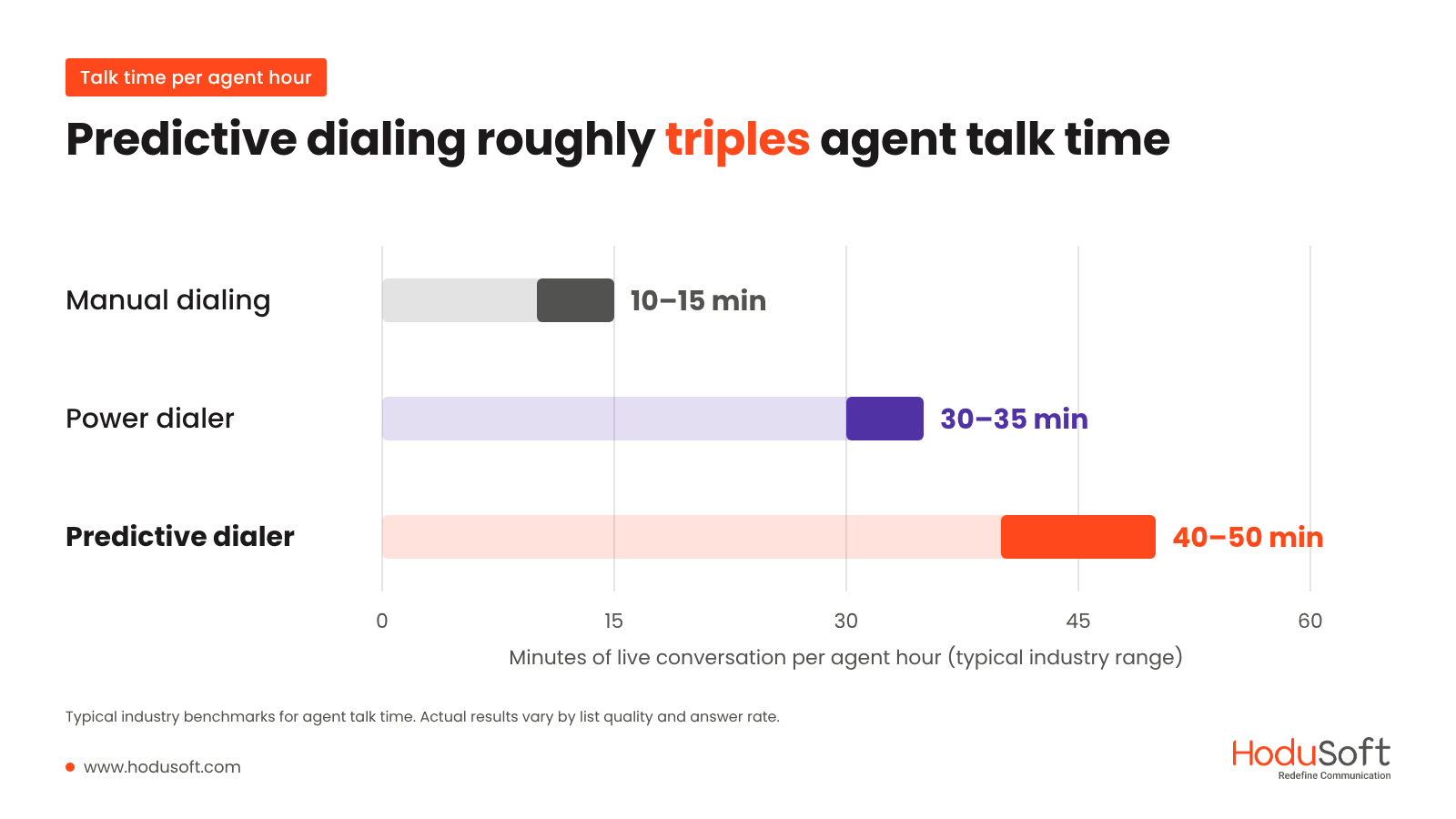
The gap between power and predictive looks small on paper, about 10 to 15 minutes an hour. Across a 50-seat floor working 8-hour shifts, that is roughly 65 to 100 extra hours of conversation every day. For a five-person sales team, the same gap is worth far less than the risk of dropping a warm lead.
Which dialer is best for small businesses, enterprises, BPOs and sales teams?
There is no single winner in the auto dialer vs predictive dialer question. Most growing teams end up using two or three modes on one platform, matched to each campaign.
Best dialer for small businesses
Small teams rarely have the agent count a predictive algorithm needs. With three agents, one wrong guess means a third of the floor is suddenly double-booked. A power dialer gives them most of the time savings with none of the dropped calls. Add auto dialer campaigns for reminders and follow-ups, and a five-person team can cover the outreach of a much larger one.
Cost matters as much as features at this size. Gautam Singh, Project Manager at D D Motors, says the team especially likes HoduCC’s built-in WebRTC webphone because it “saves cost of IP phones”, with support available whenever they need it.
What to check: pay-per-agent pricing, browser-based softphone, CRM integration and quick setup. Our guide on choosing call center software for a small business covers the full checklist.
Best dialer for sales teams
Sales calls are about relevance. A rep who sees the last email, the open deal and the prospect’s role before saying hello will sound prepared. Power and preview dialing protect that moment. Predictive dialing makes sense only for top-of-funnel calling on large, cold lists, where the goal is to find interested people fast.
What to check: CRM click-to-call and auto logging, local presence caller ID, call recording for coaching, and dispositions that update the pipeline automatically. HoduCC’s outbound call center software brings these together with every dialer mode.
Best dialer for BPOs
BPOs are paid per hour, per contact or per outcome. Idle agent time is pure margin loss, and campaigns often run on lists of tens of thousands. This is where predictive dialing pays for itself. The best BPO floors still switch specific campaigns to power mode for premium clients or sensitive verticals like healthcare and finance.
Customer example: Infinity Infoway, an IT services and outsourcing company, handles almost 5,000 calls a day on HoduCC. At that volume, every second of agent idle time shows up on the margin.
What to check: adaptive pacing with a configurable abandon target, multi-tenant or multi-client separation, real-time wallboards, and client-level reporting. See how HoduCC supports BPO contact centers.
Best dialer for enterprises
An enterprise usually runs collections, retention, sales and service notifications side by side. Each needs a different dialer. Running them on separate tools splits data and makes compliance audits painful. A single platform lets supervisors assign the mode per campaign and see one set of reports.
Case studies: YAXXA used HoduCC to scale its contact center into new territories while cutting operational costs. UNICEF replaced manual processes with HoduCC to streamline monitoring and quality assurance across its field operations in Afghanistan.
What to check: role-based access, DNC and consent management, audit trails, high-availability hosting and APIs for internal systems. HoduCC’s enterprise call center software is built for that scale.
| Business type | Primary dialer | Secondary dialer | Main reason |
|---|---|---|---|
| Small business | Power | Auto dialer | Too few agents for predictive pacing |
| Sales team | Power / preview | Predictive for cold prospecting | Prep time drives conversion |
| BPO | Predictive | Power | Talk time is revenue |
| Enterprise | All three | — | Different campaigns, one platform |
One platform for small teams, BPOs and enterprises
Run auto, power and predictive campaigns side by side, with CRM integrations, call recording and real-time reports.
How to choose the right dialer based on campaign goals and team size
Pick the dialer per campaign, not per company. Two questions settle most cases: how many agents work this campaign, and how much is each conversation worth?
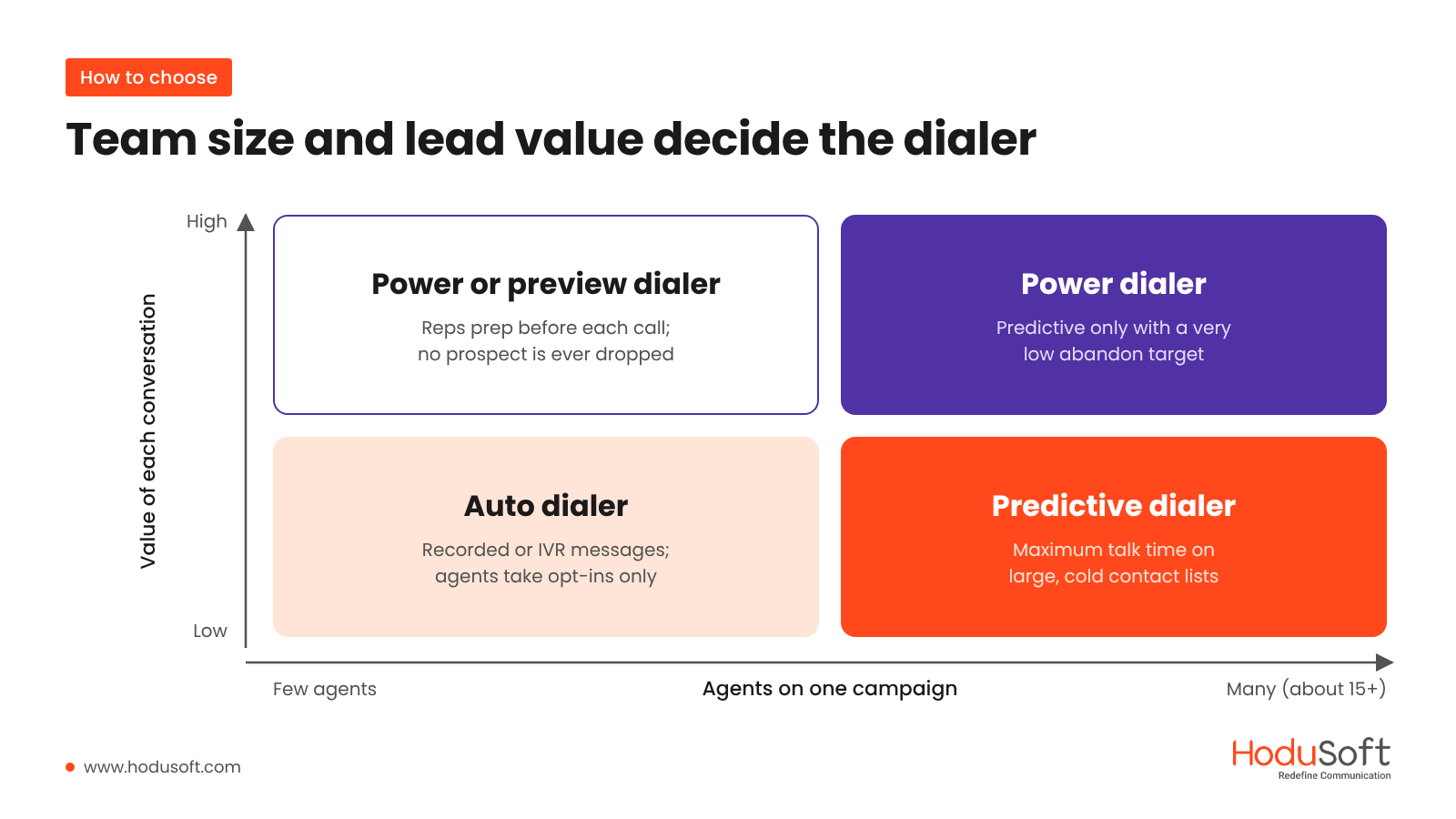
The matrix gets you to a shortlist. These six checks confirm the choice:
- Name the goal of the call. If the message is the same for everyone (a reminder, an alert), an auto dialer is enough. If every call needs a conversation, you need power or predictive.
- Count agents per campaign, not in total. Forty agents split across five campaigns is five teams of eight. Predictive pacing works on the eight, not the forty.
- Check your answer rate. Run a few hundred calls and measure. Below about 30% live answers, predictive dialing gains the most. Above about 50%, a power dialer already keeps agents busy.
- Put a value on a lead. If a lead cost you ₹2,000 or $50 to generate, dropping it to save 20 seconds is a bad trade. Cheap, bought lists tolerate more aggression.
- Map the rules in every market you call. In the US, plan for the 3% abandon cap, the two-second rule and consent for recorded messages. In India, promotional calls go out on the TRAI 140 series and must respect DND preferences, while BFSI service and transactional calls use the 1600 series. Make sure your platform enforces these, not just your team.
- Pilot before you commit. Run two weeks side by side and compare talk time per agent hour, contacts per hour, abandon rate, conversion per contact and cost per call. Our list of call center KPIs worth tracking shows how to measure each.
Whatever you choose, accurate answering machine detection does more for real talk time than almost any other setting. A dialer that hands agents voicemails or misreads a live “hello” as a machine erases most of its own advantage.
A practical setup for a growing team: start with power dialing for sales and auto dialer campaigns for reminders. Turn on predictive mode only for the campaigns that cross roughly 15 agents and a few thousand contacts. On a platform that offers all modes, this is a settings change, not a migration.
Conclusion: match the dialer to the campaign, not the hype
The best answer to the auto dialer vs predictive dialer question is the one that fits each campaign. Predictive dialing wins on raw volume when you have the agents and the list size to feed it. Power dialing wins when every conversation is valuable and a dropped call costs you a lead. Auto dialing wins when a recorded message can do the work on its own.
The numbers make the stakes clear. Moving from manual dialing to the right automated mode can take an agent from about 15 minutes of conversation an hour to 40 or more. Choosing the wrong mode can waste that gain through dropped calls, burned lists or compliance trouble.
Start with the two questions from the matrix above: how many agents work the campaign, and what each conversation is worth. Pilot the choice for two weeks, measure talk time, abandon rate and conversion, then scale what works. If your platform offers every mode, you can change course with a setting instead of a new vendor.
Frequently asked questions
Is an auto dialer the same as a predictive dialer?
Not exactly. “Auto dialer” is often used as the umbrella term for any automated dialing system, and a predictive dialer is one specific type. In everyday use, an auto dialer usually means a simpler system that dials through a list and plays a message or connects to an agent, without predicting agent availability.
Auto dialer vs predictive dialer: which is better?
Neither is better in general. A predictive dialer is better for large teams making live calls on big, low-answer lists. An auto dialer is better for reminders, alerts and broadcasts where a recorded message does the job. If your team is small and every lead matters, a power dialer usually beats both.
What is the difference between a power dialer and a predictive dialer?
A power dialer places one call per available agent, so there is never a live answer without an agent. A predictive dialer places several calls per agent based on an algorithm, which raises talk time but can produce abandoned calls when its forecast is wrong.
Is a progressive dialer the same as a power dialer?
In practice, yes. Both dial the next contact automatically once an agent is free, usually at one line per agent. Some vendors use “power dialer” for a version that allows a small fixed ratio, such as two lines per agent.
How many agents do you need for a predictive dialer?
Most practitioners suggest at least 10 to 15 agents on the same campaign. Below that, the dialer has too little data to predict well, so it either drops more calls or slows down until it behaves like a power dialer.
Are predictive dialers legal?
Yes, when used within the rules. In the US, the FCC and FTC limit abandoned calls to 3% of live-answered calls per 30-day campaign and require a caller-identifying message when no agent connects within two seconds. In India, promotional calls must go through registered telemarketers on the TRAI 140 series and respect DND preferences. This is general information, not legal advice; check with counsel for your campaigns.
What is a good abandoned call rate for outbound campaigns?
For US telemarketing, the legal ceiling is 3% of live-answered calls. Well-run floors usually target 1 to 2% to leave a safety margin and protect caller reputation. Power and preview dialers sit at zero by design.
Can a small business use a predictive dialer?
It can, but it rarely makes sense. With only a few agents, pacing errors are frequent and each dropped call is a lost lead. A power dialer plus auto dialer campaigns gives a small team most of the benefit with far less risk.
Which dialer is best for cold calling?
For high-volume cold calling with a large team, a predictive dialer delivers the most conversations per hour. For targeted B2B cold outreach, where research and personalisation matter, a power or preview dialer usually converts better.
Do dialers integrate with CRMs like Salesforce or Zoho?
Most modern cloud dialers do. Look for click-to-call, screen pops with the contact record, and automatic logging of calls, recordings and dispositions. HoduCC, for example, offers a native Salesforce integration alongside other CRM connectors.
Can I use auto, power and predictive dialing on one platform?
Yes, and it is usually the better choice. A single contact center platform lets you assign a dialing mode per campaign, share one contact database and DNC list, and report on all campaigns together.
Get every dialing mode on one platform with HoduCC
You do not have to pick one dialer forever. Campaigns change, teams grow, and the right mode for a renewal drive is wrong for a cold list. HoduCC contact center software gives you manual, preview, progressive (power), predictive and auto dialing in one place, so each campaign runs in the mode that fits it.
HoduSoft serves 300+ customers across 55+ countries, from Travelopod’s sales floor to UNICEF’s field operations.
What that looks like on a live floor:
- Switch modes per campaign without moving data or retraining agents
- Adaptive predictive pacing with a configurable abandon-rate target
- Answering machine detection, IVR and text-to-speech for auto dialer campaigns
- CRM screen pops, call recording and real-time reports for every mode
- Cloud or on-premise deployment, built for teams from five seats to several hundred
Explore the full range of HoduCC advanced dialers, or book a free demo and we’ll map the right dialing mode to each of your campaigns.

Sources
- 16 CFR § 310.4, FTC Telemarketing Sales Rule (3% abandonment safe harbor, two-second rule)
- 47 CFR § 64.1200, FCC telemarketing rules (15-second or four-ring rule)
- 47 U.S.C. § 227, Telephone Consumer Protection Act (statutory damages)
- TCPAWorld: FCC rulemaking on abandonment
- Outsource Accelerator: Predictive dialer (talk-time gains, dial ratios)
- Indian Television: TRAI defends 140 and 1600 call rules (India number series, answer rates)
- HoduSoft customer stories: Travelopod, Infinity Infoway, YAXXA case study, UNICEF case study; D D Motors testimonial from the HoduSoft corporate deck