

5 Challenges Vehicle Tracking Companies Face When Running on WhatsApp and Excel
It is late in the evening when a fleet manager notices that one of his trucks has stopped reporting its location. The truck is carrying goods across a border. He does what he has always done and posts in the WhatsApp group his tracking provider created for his company.
The message lands on a company phone in the provider’s support room. That phone holds hundreds of client groups, and dozens show unread messages. One agent assumes a colleague in the other support room has replied. The colleague assumes the same.
By morning the truck is still dark. The client calls the managing director directly, and the first question is simple: who saw my message last night? Nobody can answer, because nothing records who read it, who owned it or what was done.
This is not a story about careless staff. It is what happens when a tracking business outgrows the two tools it started with.
The example used in this post. We refer throughout to one illustrative company: an established vehicle tracking provider with hundreds of fleet clients and thousands of connected vehicles across several African markets. It sells vehicle tracking, video telematics and personal trackers. It runs multiple support rooms and large field sales and installation teams. The company is a composite built from common patterns in the industry, not a single real business.
Who is writing this. This guide comes from the team at HoduSoft. Our contact center and business communication software is used by 350+ enterprises across 55+ countries. The fixes described below map to features in our omnichannel CX suite, and we say so where it is relevant.
Key takeaways
- WhatsApp and Excel suit a young tracking business, but both have hard limits that a growing provider reaches quickly.
- The WhatsApp Business app supports only four linked devices and 256 contacts per broadcast list, and it cannot connect to a CRM.
- The five challenges are lost conversation history, unclear ownership, scattered device data, manual renewals and blind spots in the field.
- Clients do not need to change anything. They keep using WhatsApp while your team moves to a shared inbox and a CRM.
- AI agents are a sensible second phase, but only after conversations and client data sit in one system.
Why almost every vehicle tracking company starts with WhatsApp and Excel
WhatsApp and Excel are the right tools for a young tracking business, because they cost nothing and clients already use them.
Why the two tools suit a young tracking business
WhatsApp is where customers are. The Nigeria Smartphone Study 2025 by Orange Group and KPMG found WhatsApp installed on 95% of the smartphones it surveyed across 12 Nigerian cities. That figure measures installation in the survey sample, not active national use, but it shows why a client group feels natural. (Brand Spur report on the study)
Excel is just as easy to justify. A new provider needs a client list, device IDs, SIM numbers and renewal dates. A spreadsheet holds all of that on day one, with no setup and no licence fee. With a few dozen clients, the system works. One person remembers which client owns which vehicles. One phone keeps up with every group. Problems are solved by walking across the room.
Growth is what breaks the model
The tools stay the same while the workload multiplies. Each new fleet client adds a group, a set of contacts, and often dozens of vehicles, devices and SIM cards.
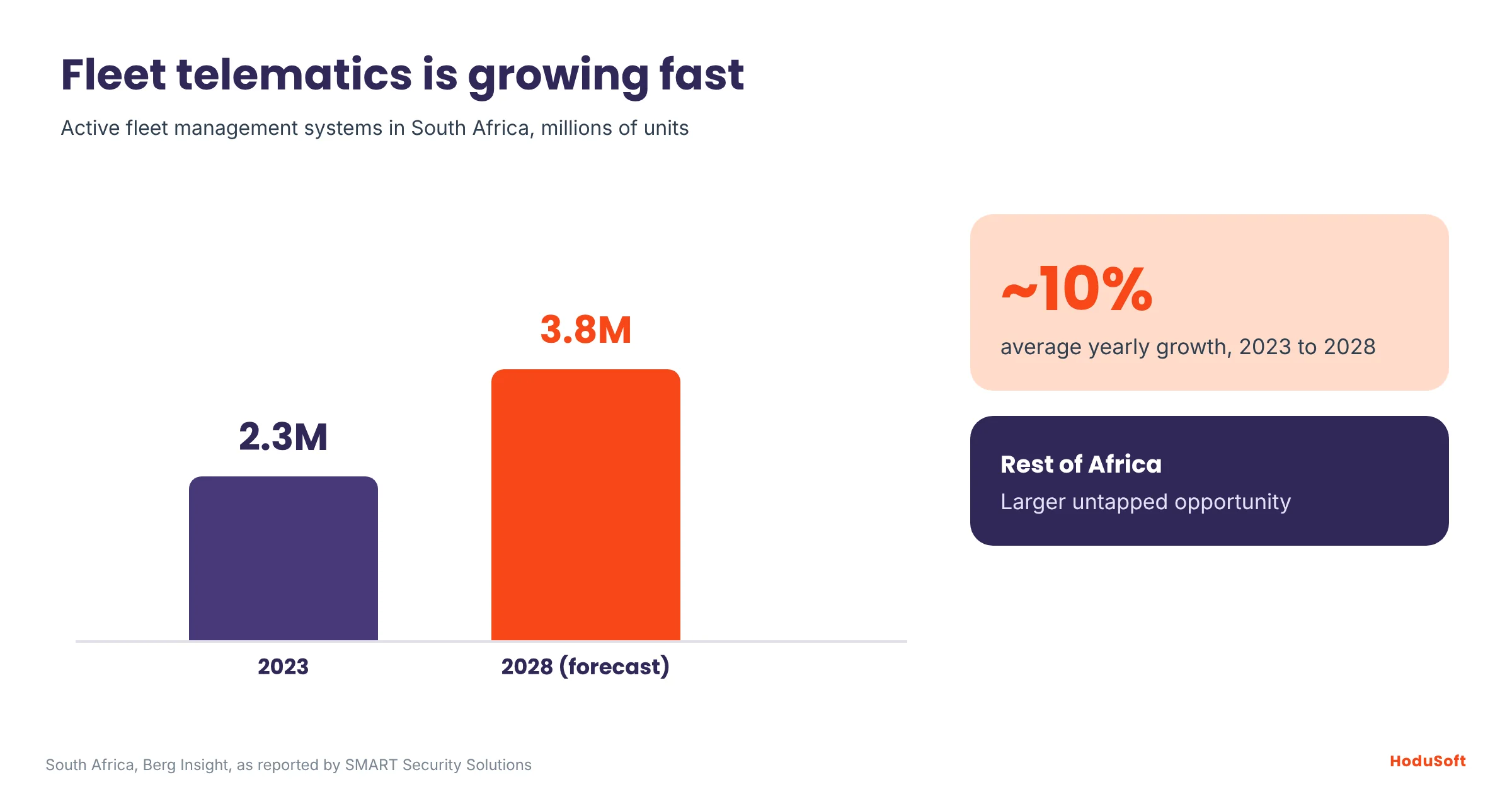
The market is pushing providers in this direction. Berg Insight estimates that active fleet management systems in South Africa will grow from 2.3 million at the end of 2023 to 3.8 million by 2028, about 10% a year. The same study describes the rest of Africa as holding considerably more untapped opportunity. (Berg Insight figures via SMART Security Solutions)
More vehicles mean more alerts, more renewals and more questions. Consider a simple illustration. A provider with 300 client groups, each producing five messages a day, receives 1,500 messages daily on handsets with no queue, owner or history. These numbers are illustrative, but the arithmetic applies at any scale.
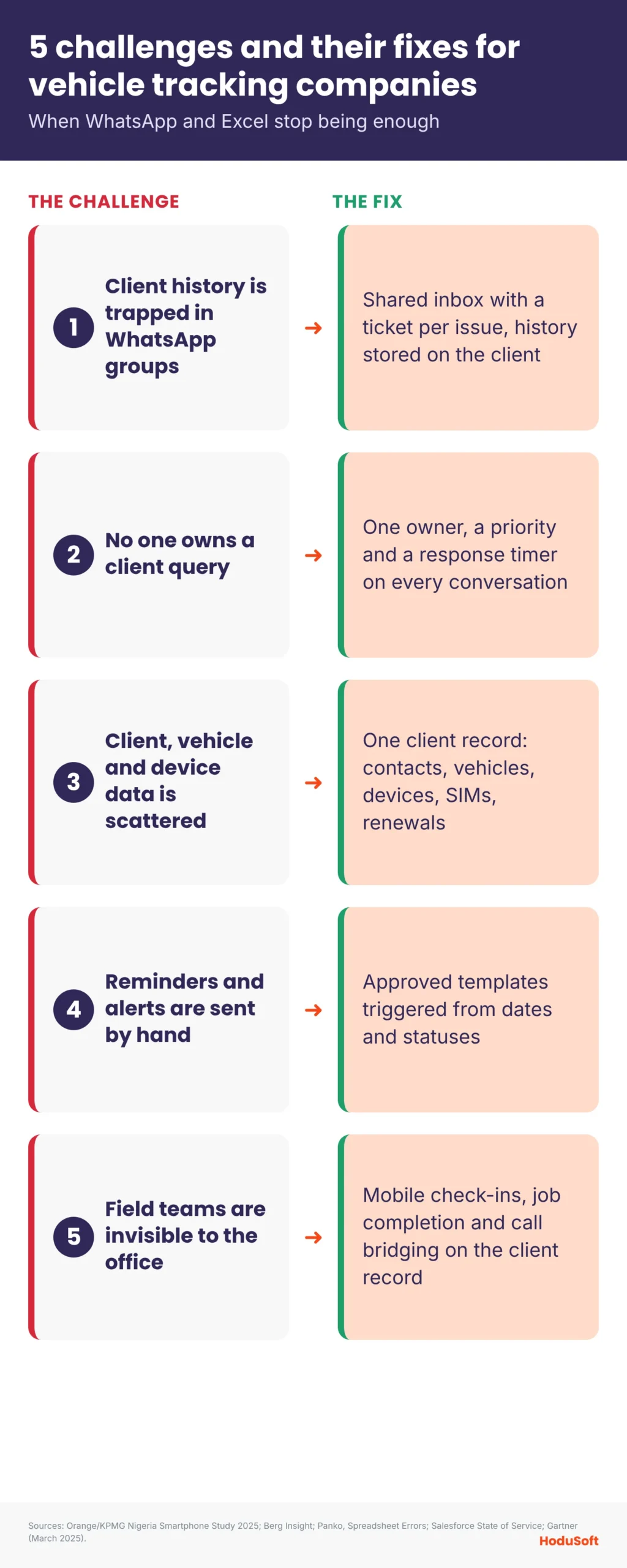
Challenge 1: Client conversation history is trapped inside WhatsApp groups on company phones
Every client conversation lives in a group chat on a handset, so the business has no searchable record per client, vehicle or device.
What it looks like in a tracking company
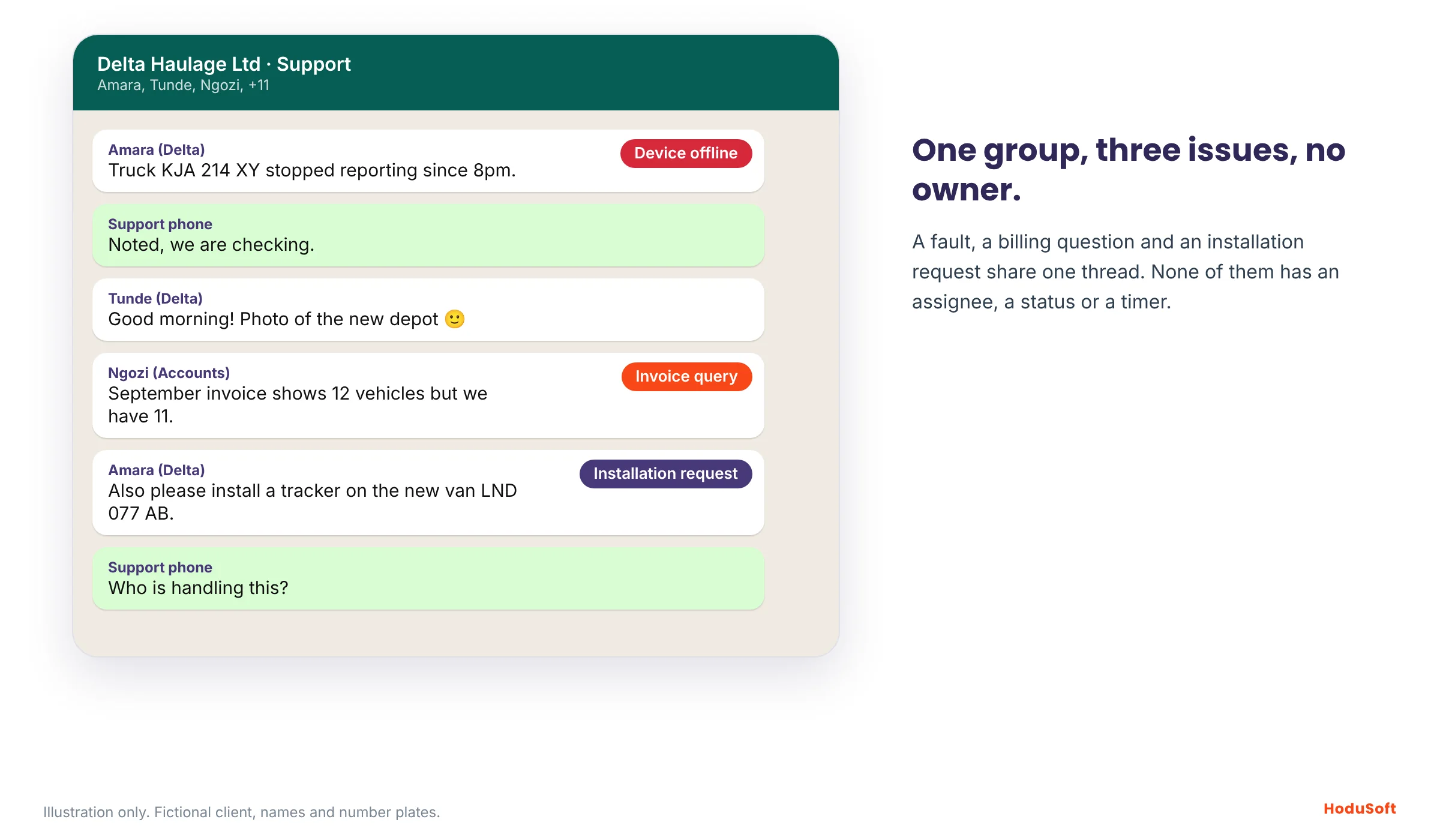
- A device-offline complaint sits between delivery photos, payment reminders and greetings in the same group.
- The same vehicle drops offline again a month later, and nobody can see what was done the first time.
- An agent resigns or a phone is lost, and months of client history leave with it.
- A client disputes whether a fault was reported, and support has to scroll through a chat to find proof.
- An installer calls a client from a mobile phone to arrange a visit, and the office has no record of what was agreed.
Why it happens
The WhatsApp Business app was designed for small teams. It supports one primary phone plus three companion devices, four in total. Conversations stay inside the app and cannot sync to a CRM or ticketing system.
Groups add a second problem. A group is organised around a client, not around an issue. A fault, a billing question and an installation request all share one thread, so none of them can be tracked to closure.
What it costs the business
- Repeat diagnosis. Technicians revisit the same vehicle because the earlier fix was never recorded.
- Weak position in disputes. Without a ticket trail, service-level claims become your word against the client’s.
- Slow onboarding. New agents need months to learn accounts that should be readable in minutes.
- Data exposure. Client contacts and conversations sit on devices that can be lost, stolen or taken to a competitor.
Quick check: Pick any vehicle that had a fault three months ago. Time how long it takes to find what was reported, who handled it and how it was resolved. If the answer is more than two minutes, or “ask the agent who was on shift”, history is trapped.
How to fix it
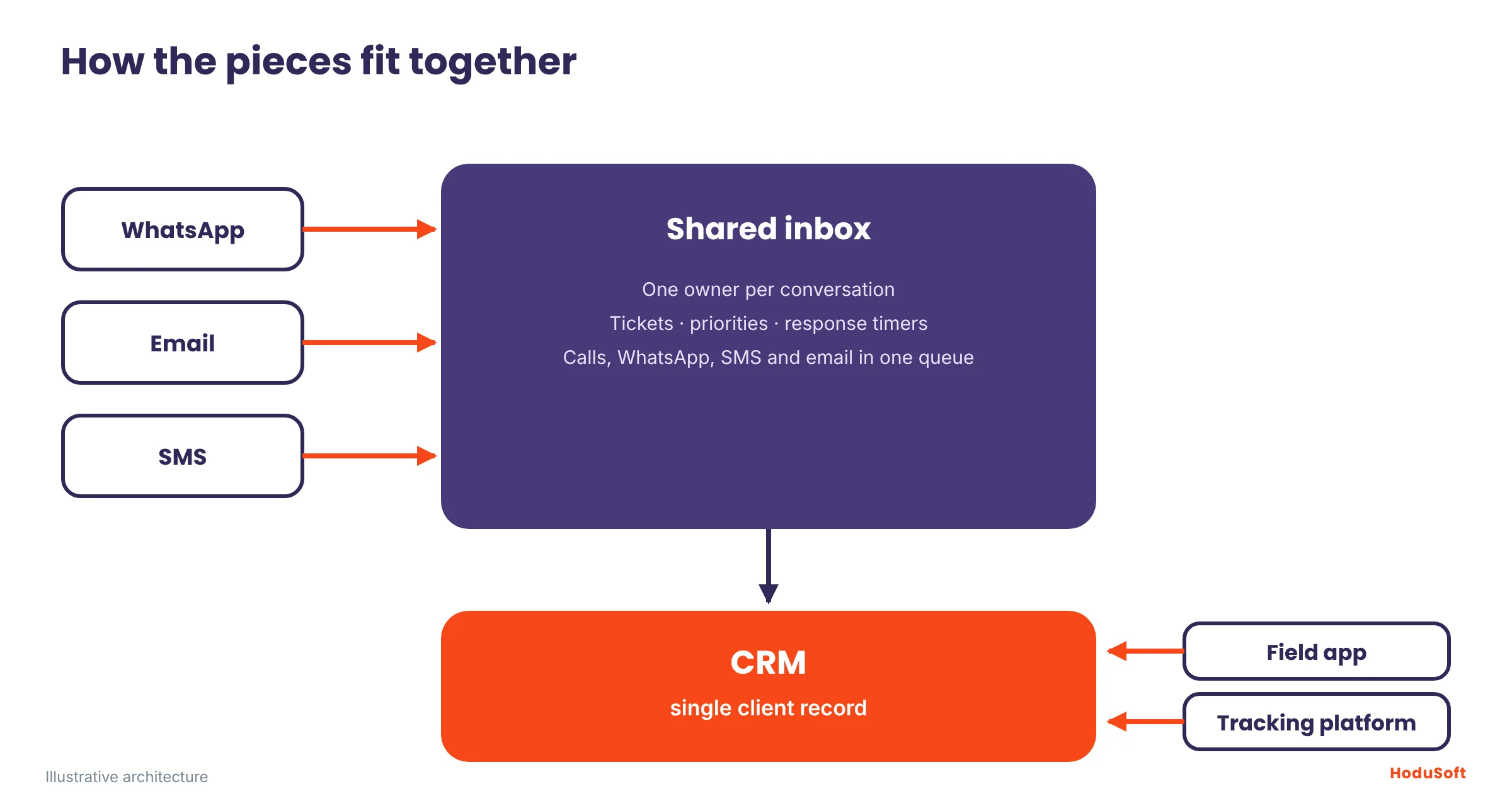
Move client conversations off handsets and into a shared inbox that stores history against the client. Turn each fault, billing question or request into its own ticket with a status, so it can be tracked to closure. Bridge calls made by field staff through the same platform, so they are recorded alongside WhatsApp and email history. Clients keep messaging on WhatsApp as before.
With HoduSoft: HoduCC’s omnichannel inbox keeps WhatsApp, call, SMS and email history against the customer record. Every issue becomes a ticket in the in-built ticketing system.
From our experience: [ADD: one or two sentences of first-hand observation, for example what you found when auditing a tracking provider’s support process. Use real, permissioned detail only.]
Challenge 2: No one owns a client query when several support rooms share the same groups
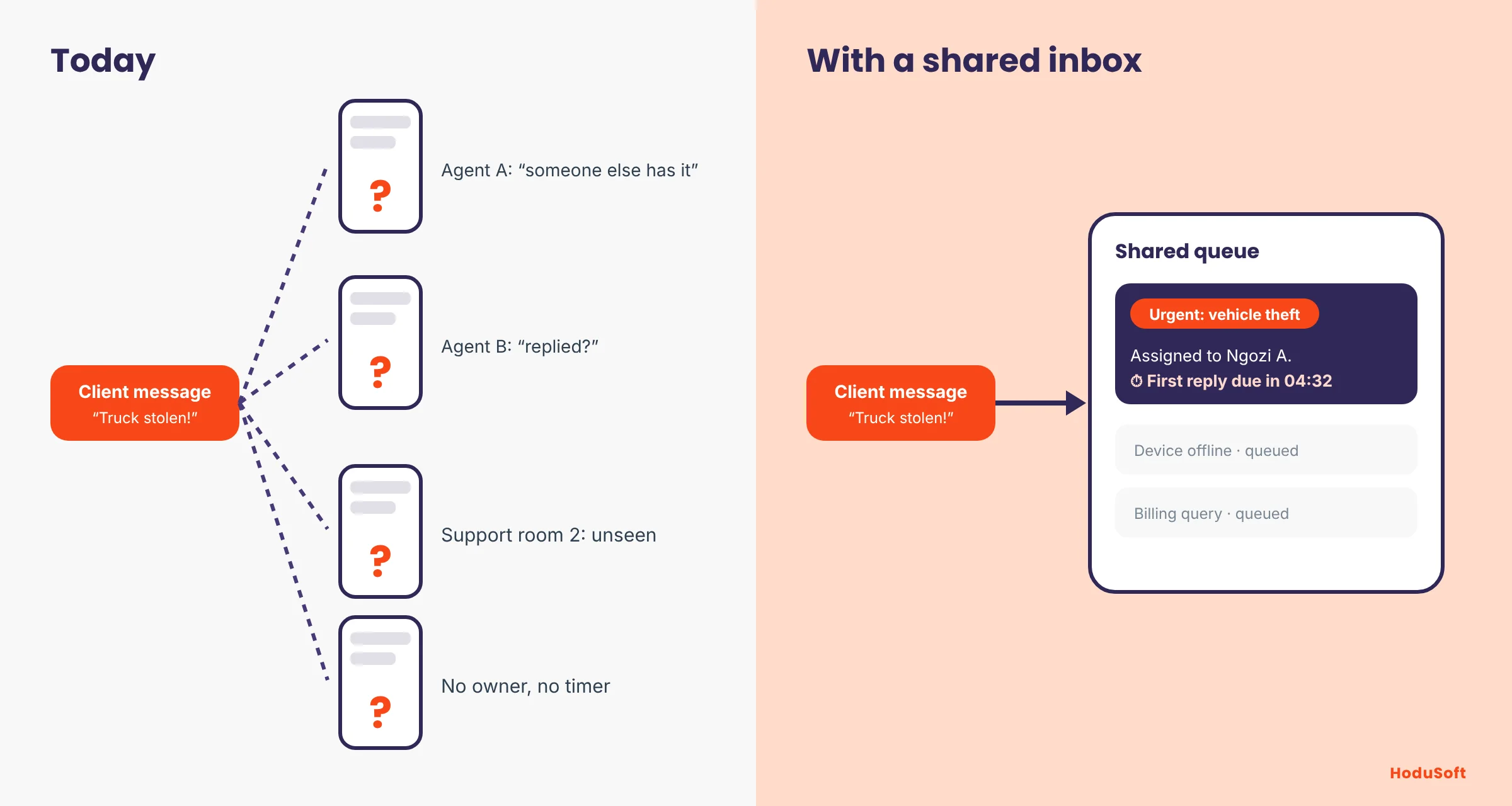
A WhatsApp group has no assignee, no status and no timer, so urgent queries are answered twice or not at all.
What it looks like in a tracking company
- Agents in different support rooms see the same message. Both reply with different answers, or each waits for the other.
- A stolen-vehicle alert and a request for a monthly report look identical in the chat list. Nothing marks one as urgent.
- Shift handovers happen verbally. The night team does not know what the day team promised.
- Managers learn about a missed message when the client escalates to a director.
Why it happens
Phone-based WhatsApp offers labels, but no routing, assignment or supervision. Those functions exist only on the WhatsApp Business Platform, where a team inbox can assign and route conversations.
Without assignment there is nothing to measure. First response time, resolution time and workload per agent cannot be reported from a handset.
What it costs the business
In tracking, slow response carries more risk than in most industries. The first hours after a theft matter most for recovery, and a delayed reply can decide whether a vehicle is found.
It also affects renewals. Salesforce research found that 94% of customers say the service they receive influences their future buying decisions. For a subscription business, that decision is made at every renewal. (Salesforce field service research)
How to fix it
Give every conversation one owner, a priority and a response timer. Define priorities that fit a tracking business: theft and panic alerts first, device-offline second, billing and general requests after. Route phone calls into the same queue, so a call and a WhatsApp message about one incident reach the same agent.
Once ownership is in place, track these metrics:
| Metric | Why it matters for a tracking provider |
|---|---|
| First response time by priority | Theft and panic alerts need minutes, routine requests can wait |
| Open queries by age | Shows what was missed before the client escalates |
| Queries per agent and per support room | Reveals overload and uneven staffing across shifts |
| Repeat contacts per vehicle | Flags devices or installations that keep failing |
| Resolution time by issue type | Separates device faults, SIM problems and billing questions |
With HoduSoft: HoduCC assigns conversations using skill-based routing, and calls enter the same queue through a multi-level IVR. Supervisors follow response times and open queries in real-time analytics and reports.
From our experience: [ADD: a real, anonymised example of a missed or duplicated reply and what changed after assignment was introduced. Include a before-and-after response time only if you have measured it.]
Challenge 3: Client, vehicle and device data is scattered across Excel sheets that never agree
A tracking provider holds more data per client than most businesses, and spreadsheets cannot keep it linked or current.
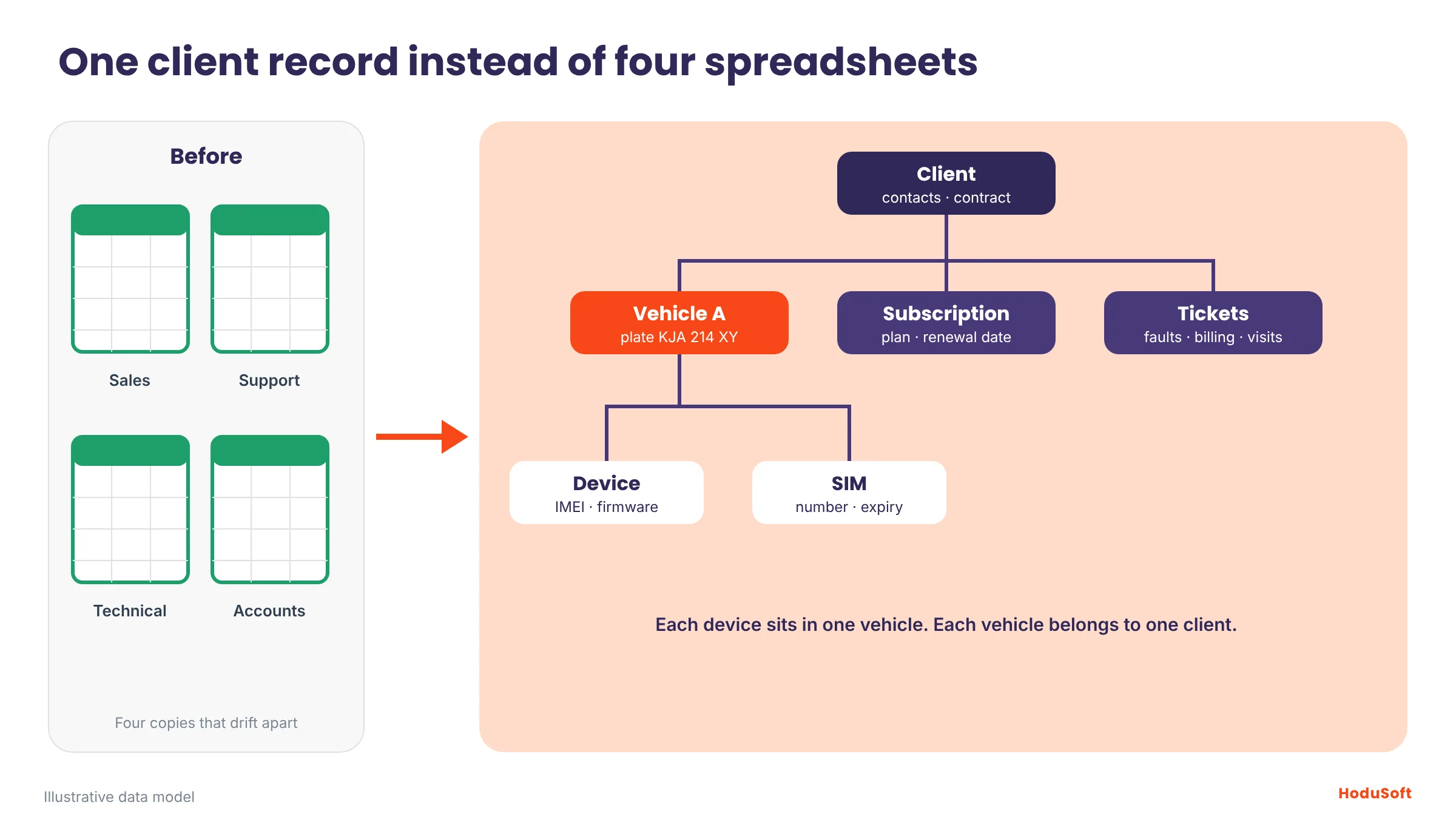
What it looks like in a tracking company
Each account carries several layers of data that depend on each other:
- Client: company, contacts, billing terms, contract dates.
- Vehicles: number plates, vehicle type, assigned driver or branch.
- Devices: IMEI, model, firmware, installation date, installer.
- SIM cards: number, network, data plan, expiry.
- Subscription: plan, start date, renewal date, payment status.
In Excel these end up in separate files owned by sales, support, technical and accounts. A device swap is updated in one sheet and missed in another. Accounts invoice a vehicle that was removed last quarter. Support cannot tell which SIM sits in which truck.
Why it happens
Spreadsheets store rows, not relationships. Nothing forces a device to belong to one vehicle, or a vehicle to one client. Every team keeps its own copy, and each copy drifts.
Spreadsheets are also error-prone by nature. Raymond Panko’s review of fifteen years of spreadsheet research found that every study reached the same conclusion: errors are common and not trivial. (Panko, “Spreadsheet Errors: What We Know”)
What it costs the business
- Billing leakage. Active vehicles that are missing from the billing sheet are never invoiced.
- Paying for dead SIMs. Data plans keep running on devices that were removed months ago.
- Slow answers. A simple question such as “which vehicles renew this month?” takes hours of cross-checking.
- No single view for management. Nobody can state the active vehicle count with confidence.
Quick check: Ask sales, support and accounts for the number of active vehicles for the same three clients. If the three teams give different numbers, your data is scattered.
How to fix it
Replace the separate sheets with one client record that holds contacts, vehicles, devices, SIMs, tickets and renewal dates. A sound migration follows four steps:
- Collect every sheet from sales, support, technical and accounts.
- Reconcile them against the tracking platform, which is the most reliable list of active devices.
- Import clean records with one owner per field, so each value has a single source.
- Lock the old sheets as read-only so nobody keeps updating them.
With HoduSoft: HoduCC includes a built-in CRM and also integrates with third-party CRMs. Agents see the client’s details and ticket history beside the live conversation.
From our experience: [ADD: a real finding from a data clean-up, for example the share of records that did not match between sheets. Only publish numbers you have actually measured.]
Challenge 4: Renewal reminders, service alerts and promotions are sent manually, one group at a time
Subscription revenue depends on timely reminders, yet most providers still send them by hand from a spreadsheet.
What it looks like in a tracking company
- Someone filters a sheet for renewals due this month, then pastes a reminder into each client group.
- A network outage affects hundreds of devices, and support types the same explanation again and again.
- A new dashcam or personal tracker launches, and the announcement reaches only the clients someone remembers to message.
- Clients who write after hours get no acknowledgement until the next morning.
- Bulk SMS goes out from a separate tool with no link to client records or replies.
Why it happens
The WhatsApp Business app limits each broadcast list to 256 contacts. Its automation stops at a greeting message and an away message. It has no scheduled sends, no approved templates and no trigger from a renewal date.
So every recurring message depends on a person noticing a date in a sheet. That works for a few dozen clients and fails for hundreds.
What it costs the business
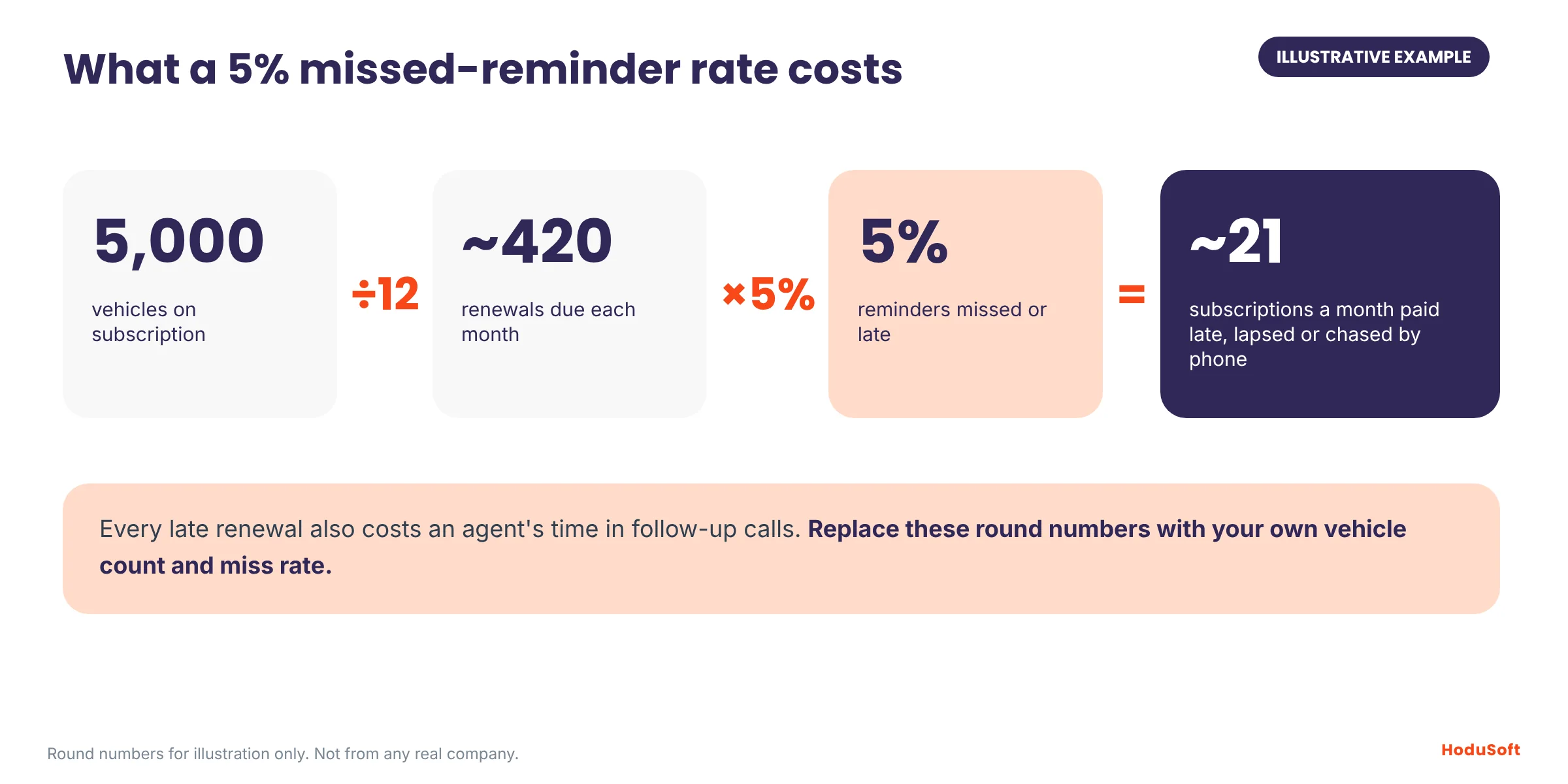
Missed reminders delay cash. Here is an illustrative calculation, using round numbers that are not from any real company:
| Assumption | Illustrative value |
|---|---|
| Vehicles on subscription | 5,000 |
| Renewals falling due each month | About 420 (one twelfth) |
| Reminders missed or sent late | 5% of those, about 21 vehicles |
| Effect | 21 subscriptions a month paid late, lapsed or chased by phone |
Replace these values with your own. Even a small miss rate compounds, because every late renewal also consumes an agent’s time in follow-up calls.
There is a compliance cost too. Messaging clients in bulk from personal-style numbers, without recorded opt-in, risks blocked numbers and breaches of local data protection rules.
How to fix it
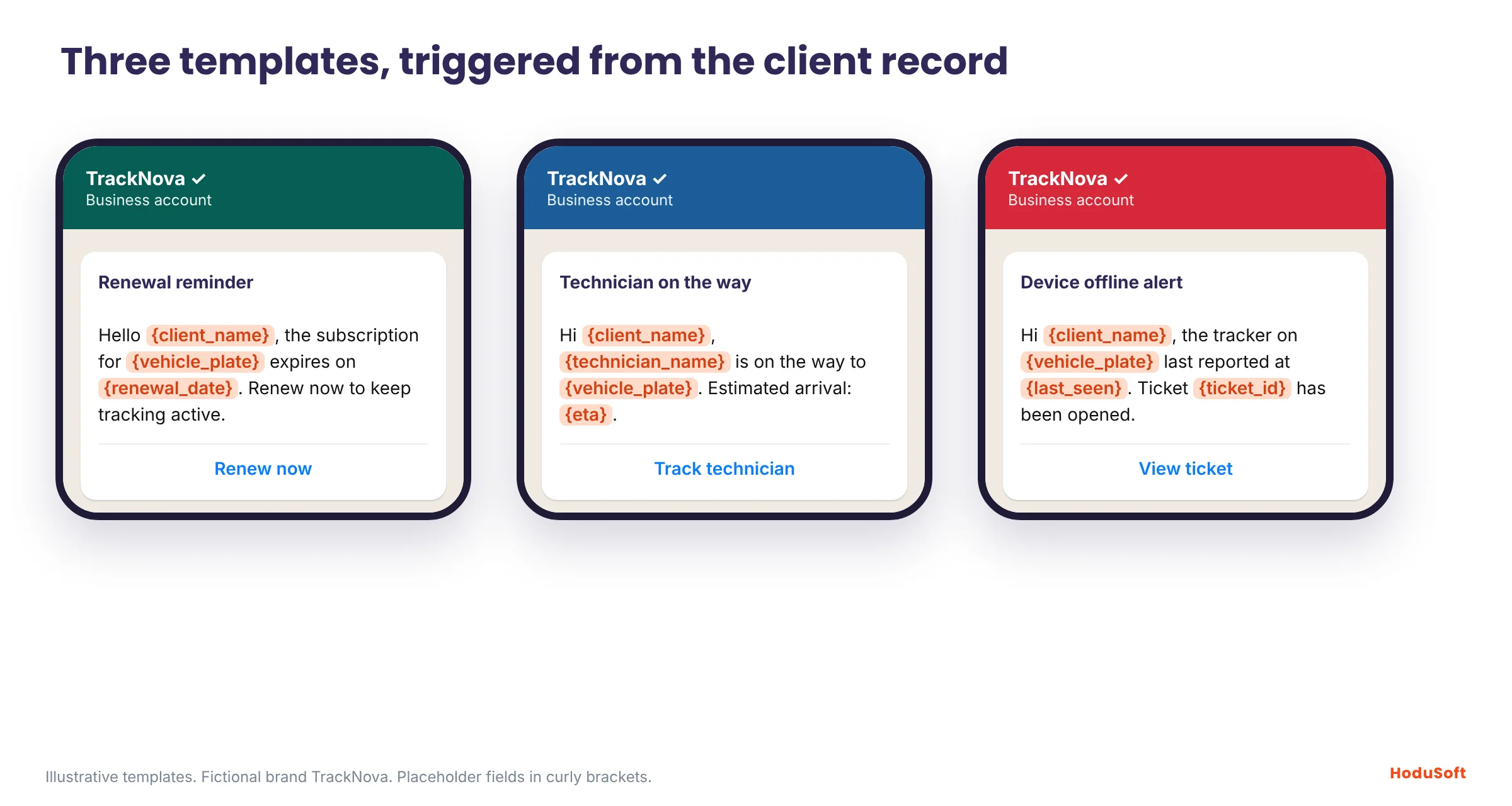
Start by automating the six messages a tracking provider sends most:
- Subscription renewal reminders at 30, 14 and 3 days before expiry.
- Installation and service appointment confirmations, with the technician’s name.
- Device-offline notifications, sent before the client notices.
- Network or platform incident notices to affected clients only.
- After-hours acknowledgement with a ticket number and expected response time.
- Product announcements to segmented lists, such as fleets without video telematics.
Create approved templates for the six message types above and trigger them from dates and statuses in the client record. Record opt-in for promotional messages and keep them separate from service messages. Keep SMS as a fallback for drivers and contacts who are not on WhatsApp.
With HoduSoft: WhatsApp broadcasting, SMS broadcasting and a WhatsApp bot for after-hours replies are HoduCC modules. For high-volume voice and SMS campaigns, HoduBlast reaches thousands of contacts at once.
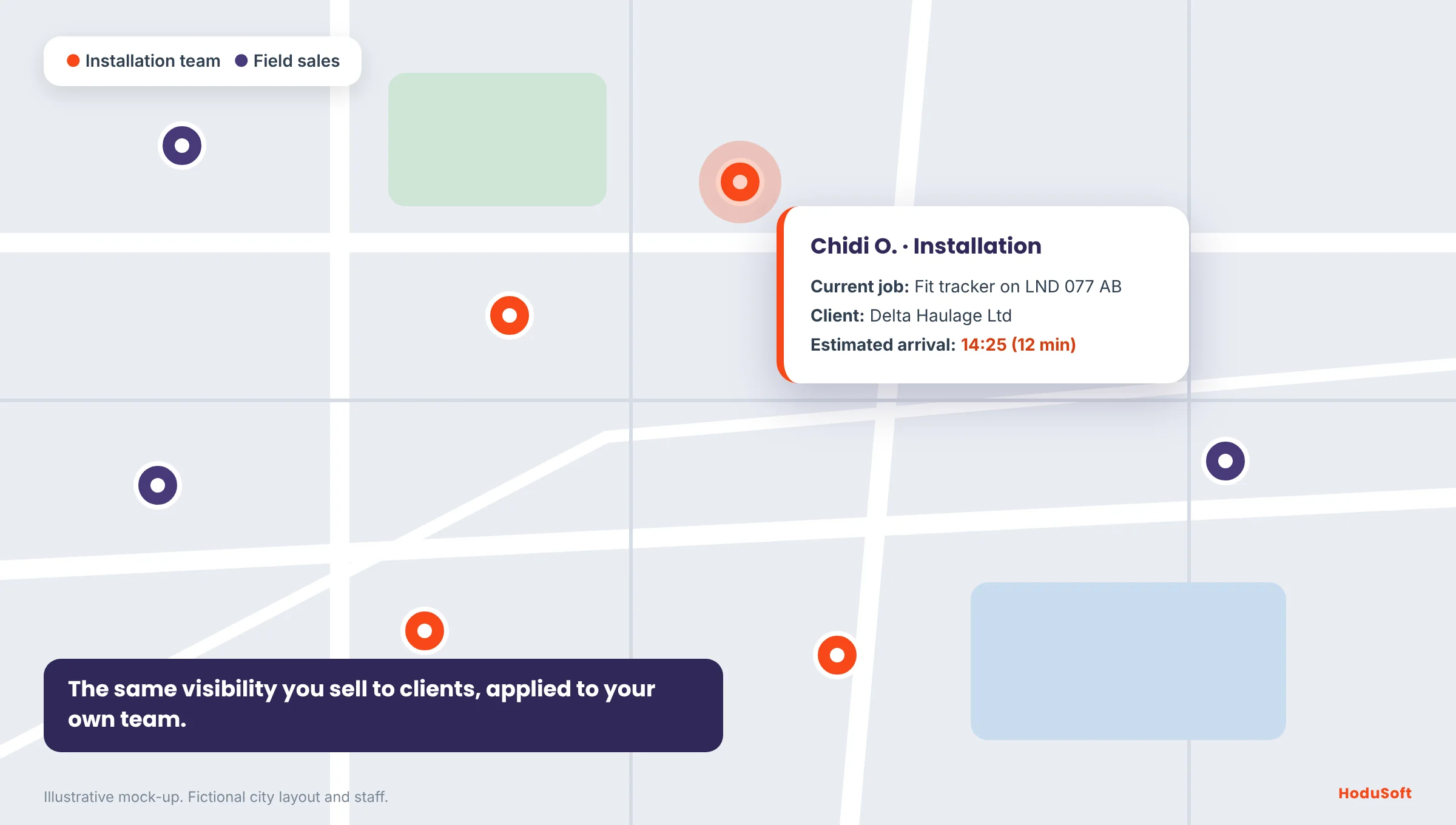
Challenge 5: The company tracks thousands of client vehicles but cannot see its own field teams
Sales staff and installers work across cities and borders, and the office learns about their day through phone calls.
What it looks like in a tracking company
- A client asks when the technician will arrive, and support has to phone around to find out.
- An installer finishes a job, but accounts hear about it days later, so billing starts late.
- Two sales staff visit the same prospect in the same week without knowing it.
- A technician drives across the city for one job while another sits idle nearby.
- Proof of installation is a photo in someone’s personal gallery.
Why it happens
Field work is coordinated through calls and personal WhatsApp chats. Visits, check-ins and job completions are not recorded against the client. The tracking platform watches client vehicles, but nothing equivalent watches the company’s own people and jobs.
What it costs the business
Field teams are a growth engine, not only a cost. In a Salesforce survey of service organisations, 86% of decision makers said field teams are critical to growing the business. The same research found that 82% of organisations rely on mobile workers to upsell products and services. (Salesforce field service research)
The pressure on those workers is real. In that survey, 82% of mobile workers said they struggle to balance speed and quality. Poor coordination makes that harder, because time is lost to travel, waiting and repeat visits.
For a tracking provider, the specific losses are:
- Delayed billing, because installation completion is reported late.
- Repeat visits, because the installer arrived without the device history or the right SIM.
- Missed upsell, because the installer on site did not know the client had asked about dashcams.
- Unverifiable activity, because visit reports rely on memory.
How to fix it
Give field sales and installation staff a mobile app, and capture the following for each team:
| Team | What to capture | Why |
|---|---|---|
| Field sales | Check-in and check-out at the prospect’s location, visit notes, next step | Confirms visits and avoids duplicate calls on one prospect |
| Installation and technical | Job start and finish, device IMEI and SIM scanned on site, photos, client signature | Starts billing on time and builds device history |
| Both | Live location during working hours, with staff consent | Lets dispatch assign the nearest person and give clients an arrival time |
Location tracking of employees should be transparent. Tell staff what is tracked and when, limit it to working hours, and follow local data protection law.
Whatever app you choose, make sure check-ins and job completions land on the client record. Support can then answer “where is the technician?” from the screen in front of them.
Bring field calls into the same system with call bridging. A technician or sales rep starts the call from the contact center portal. The platform rings their mobile first, then dials the other party and joins the two calls.
Bridging also protects phone numbers. Suppose a client needs to speak to a truck driver about a route or a device check. The client calls the company number and is bridged to the driver. The driver sees the company number on the screen, not the caller’s own number. Every bridged call is recorded and logged against the client, like any call from the support room.
With HoduSoft: HoduCC’s remote agent features include call bridging, call forwarding to mobile and call recording. Field staff keep using their mobile phones, while calls with clients and drivers run through the company number. [CONFIRM BEFORE PUBLISHING: add what HoduSoft offers for field staff check-ins and location tracking, or remove the location points above if there is nothing to promote.]
From our experience: [ADD: a short, real account of rolling out field check-ins, including how staff reacted and what you changed. First-hand detail like this is the strongest trust signal in the post.]
A 90-day plan to move a tracking business off WhatsApp groups and Excel
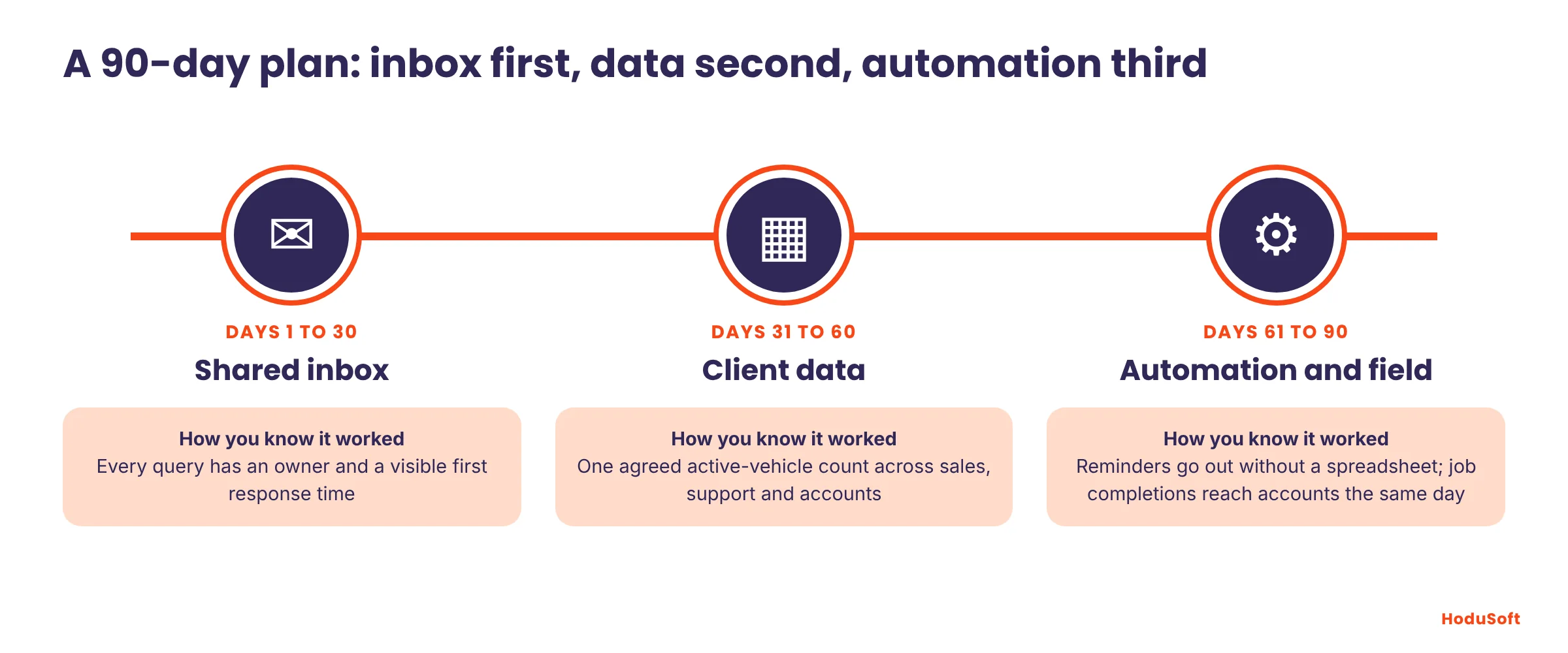
The move works best in three stages, with the inbox first, data second and automation third.
| Stage | Days | What to do | How you know it worked |
|---|---|---|---|
| 1. Shared inbox | 1 to 30 | Register for the WhatsApp Business Platform, migrate the support number, connect email and SMS, define priorities such as theft, device offline, billing and general | Every query has an owner and first response time is visible |
| 2. Client data | 31 to 60 | Reconcile spreadsheets against the tracking platform, import clients, vehicles, devices and SIMs into the CRM, lock old sheets | One agreed active vehicle count across sales, support and accounts |
| 3. Automation and field | 61 to 90 | Launch renewal and appointment templates, switch on after-hours autoresponders, roll out the field app to one team first | Reminders go out without a spreadsheet and job completions reach accounts the same day |
Two cautions apply. First, do not migrate dirty data, because automation will then send wrong reminders at scale. Second, tell clients before the change, with a short message explaining that the number stays the same and replies will be faster.
Want this plan mapped to your operation? HoduSoft provides dedicated onboarding and support through setup, training and go-live. Talk to a HoduSoft expert.
What comes next: AI agents for repetitive support queries
Once conversations and client data sit in one system, AI agents become a practical second phase.
Gartner predicts that by 2029 agentic AI will resolve 80% of common customer service issues without human help, cutting operational costs by 30%. (Gartner press release, March 2025) That is a forecast, not a result, but the direction is clear.
What an AI agent can answer from your data
Much of a tracking provider’s inbound volume is repetitive and answerable from data:
| Client question | Data the AI agent needs | Action it can take |
|---|---|---|
| Why is my device offline? | Last report time, SIM status, power status from the tracking platform | Explain the likely cause and open a ticket if a visit is needed |
| When does my subscription expire? | Renewal date and payment status from the CRM | Answer and send the renewal link |
| Can I book an installation? | Technician availability from the field app | Offer slots and confirm the booking |
| How do I add a user or get a report? | Account permissions and help content | Guide the client or raise a request |
What should always go to a human agent
Some conversations should always go to a person: suspected theft, accidents, panic alerts, disputes and anything involving a child’s tracker. Set these as hard handover rules, with the full context passed to the agent.
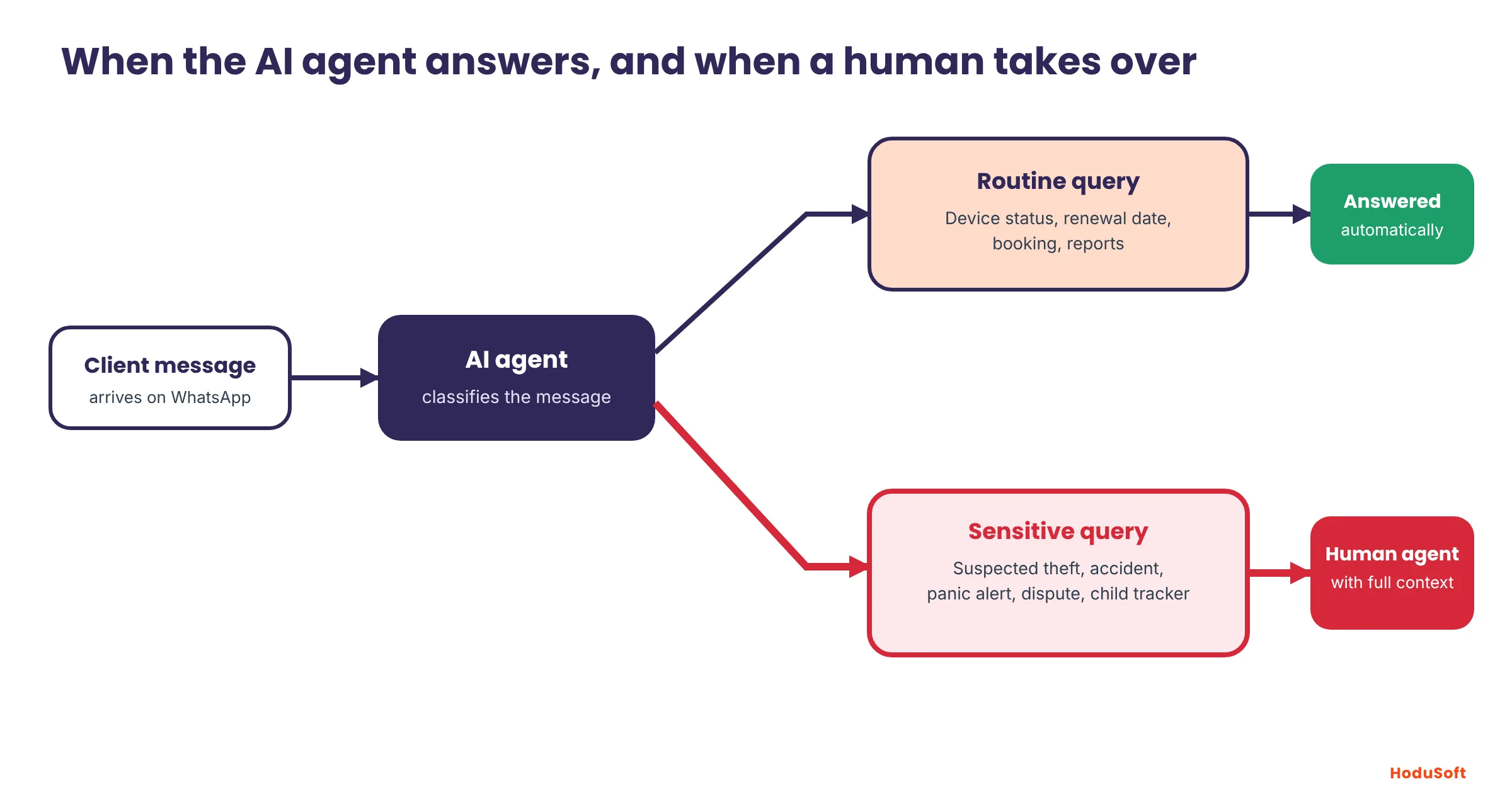
The order matters. An AI agent with no single client record will give confident wrong answers, so the inbox and CRM come first.
With HoduSoft: HoduCC’s AI chatbot and WhatsApp bot handle routine questions and hand over to a live agent when needed. They run on the same platform as the inbox, so the agent receives the conversation with its history.
Conclusion: Vehicle Tracking Companies Need More Than WhatsApp and Excel for Customer Support
WhatsApp and Excel help a vehicle tracking business start, but they were never built to run one at scale. Trapped history, unclear ownership, scattered data, manual messaging and blind field teams are signs that growth has outpaced the tools.
The fix asks nothing of your clients. It gives your team one inbox, one client record, automated messaging and a live view of the field, with AI agents as the next step.
Your clients trust you to know where their vehicles are at every moment. Your own conversations, data and people deserve the same visibility.
See it on your own workflow. HoduSoft’s HoduCC omnichannel contact center software brings calls, WhatsApp, SMS and email into one inbox, with a built-in CRM, ticketing, broadcasting and AI bots. Book a free demo and we will walk through it using a vehicle tracking support scenario.
Frequently asked questions
Do our clients have to install anything or change the number they message?
No. Clients keep using WhatsApp, and an existing business number can usually be migrated to the WhatsApp Business Platform. The change happens on your side of the conversation.
What is the difference between the WhatsApp Business app and the WhatsApp Business API?
The app is a free phone application limited to four linked devices and 256 contacts per broadcast list. The API, now called the WhatsApp Business Platform, supports unlimited agents, automation and CRM integration, and is charged per conversation.
Can we keep our client WhatsApp groups?
You can keep them on a phone, but they will stay outside your inbox and CRM. Group messaging on the Platform is restricted, so most teams replace groups with one-to-one threads tied to a client account.
Do we still need bulk SMS if we use WhatsApp broadcasts?
Yes, as a fallback. SMS reaches drivers and contacts without smartphones or data, and it suits short alerts. Use WhatsApp for richer messages and two-way replies.
Can field teams and drivers keep using their mobile phones?
Yes. With call bridging, the contact center platform sets up the call and connects it to the mobile phone. The person receiving the call sees the company number, not the caller’s personal number, and the call is recorded and logged.
How long does it take to move from Excel to a CRM?
The import takes days. The reconciliation takes longer, because sheets must be checked against the tracking platform. Plan about a month for a provider with thousands of vehicles.
Is it legal to track the location of our field staff?
It depends on the country. As a baseline, tell staff what is tracked, limit tracking to working hours, obtain consent where the law requires it, and take local legal advice.
When should a tracking company add AI agents?
After the shared inbox and CRM are in place and the data is clean. Start with one or two routine query types, such as subscription status, and keep theft and safety alerts with human agents.
About the author
[ADD: 50 to 80 words. Name, role, years of experience, the kinds of telematics or field-service companies the author has worked with, and a link to a LinkedIn profile. Add a headshot.]
Editorial note: The company described in this post is an illustrative composite. Statistics are drawn from the published sources listed below, last checked in October 2026. [ADD: your editorial or fact-checking policy link, if you have one.]
Sources
- Orange Group and KPMG, Nigeria Smartphone Study 2025, as reported by Brand Spur, September 2026. WhatsApp installed on 95% of surveyed smartphones across 12 cities.
- Berg Insight, Fleet Management in South Africa, as reported by SMART Security Solutions. 2.3 million active units in Q4 2023, forecast 3.8 million by 2028.
- Raymond R. Panko, Spreadsheet Errors: What We Know. What We Think We Can Do, 2008.
- Salesforce, field service findings from the State of Service survey, January 2023. Survey of 8,050 service professionals in 36 countries.
- Gartner, press release on agentic AI in customer service, March 2025.