

The ULTIMATE List of 10 Internet Telephony Service Providers in USA
What’s the best way to find the right Internet Telephony Service Provider (ITSP) for your business needs? Would a simple online search be useful?
You may type some highly effective search terms such as “Best ITSPs in the United States,” “Best ITSPs in 2025,” “Top 10 Internet Telephony Service Providers in the world,” but still end up being confused.
Now, don’t get it wrong. After pressing the enter button you will get many results. But it could be a task to skim through and memorize all those names, services they offer, pricing plans, and everything in between.
So to spare you the hassle, we have compiled a list of top ten ITSPs in the United States. At HoduSoft, we have provided HoduPBX multi-tenant IP PBX software to ITSPs of different sizes.
We are not just solutions providers for ITSPs and other professional service providers such as Managed Service Providers (MSPs), Internet Service Providers (ISPs), Cloud Service Providers (CSPs), and more. But we are their strategic communication partners.
If you are looking for the right ITSP in the US, this blog post is just for you. So, without further ado, let’s dive right into the blog post and find out which ITSPs made it to the list. Read on and you would be delighted to do that.
What Is an ITSP?
An ITSP is a company that delivers telephony services (which includes voice calls, video calls, and messages) over the internet instead of traditional Public Switched Telephone Network (PSTN)
.
Unlike a simple home Voice over Internet Protocol (VoIP) provider, many ITSPs provide business-grade services such as Session Initiation Protocol (SIP) trunking, hosted Private Branch Exchange (PBX), cloud calling, unified communications, APIs, global routing, etc.
The internet connection is established using IP phones, softphones, or a PBX system using SIP and H.323. ITSPs are also called ‘voice service providers.’
Benefits of Selecting the Right ITSP
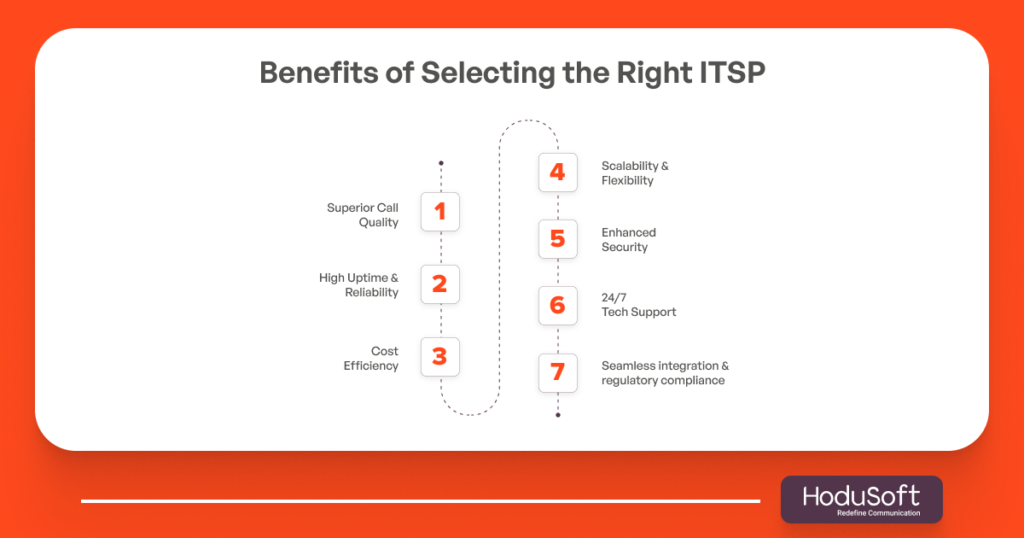
Selecting the right ITSP can mean the difference between success and failure. The very purpose of this blog post is to help you narrow down your search for the right ITSP and help you select the best one for your business. Let’s take a look at the benefits of handpicking the right ITSP:
1. Superior call quality
One of the biggest benefits businesses enjoy when they choose the right ITSP is they get superior call quality. No matter whatever the external conditions may be, a reliable and reputable ITSP ensures crystal-clear voice calls with minimal jitter, latency, or packet loss. By joining hands with the right ITSP, businesses can rest assured of superior call quality.
2. High uptime and reliability
This one is simple. Between a reputable and reliable ITSP and a newly established one, which one would provide high uptime and reliability? That’s correct, the former. By offering high uptime and reliability, trustworthy and reputable ITSP guarantee uninterrupted service even during peak loads or network outages.
Also Read: How Can Partnering with the Right PBX Software Provider Benefit Your ITSP Business?
3. Cost efficiency
There is a wrong notion that reputable and reliable ITSPs charge exorbitant prices. That’s so untrue in today’s competitive market. Most ITSPs have competitive pricing. Agreed, some noteworthy ITSPs command premium pricing; but when you do the cost-benefit analysis, they are highly cost effective.
4. Scalability and flexibility
Whether it’s adding new lines and extensions or scaling down communication as per business requirements, the right ITSP can do both without any issue. As your business grows, a good ITSP allows you to easily add lines, locations, or advanced communication features.
5. Enhanced security
Businesses must do whatever it takes to keep their communication lines safe and secure. An unsecured communication line could be the gateway for many malicious actors and hackers to launch cyber attacks and leak confidential data. Reputable and trustworthy ITSPs implement strong encryption and fraud prevention mechanisms to safeguard your voice data and prevent cyberattacks. By choosing an ITSP that has a robust track record of providing robust security, organizations can safeguard themselves.
6. Round-the-clock technical support
The more reputable an ITSP, the more reliable is their service and support. Many newly established ITSPs have specific working hours and they don’t provide support after the end of the final shift. But reliable ITSPs offer 24/7 support. Whenever any issues arise no matter whatever the time, they resolve those immediately.
7. Seamless integration and regulatory compliance
Reliable and reputable ITSPs provide solutions that integrate smoothly with businesses’ existing systems including PBX, CRM, and unified communication tools. Top ITSPs also comply with telecom regulations and data privacy laws, which can protect businesses from legal risks.
Criteria for Selecting the Right ITSP
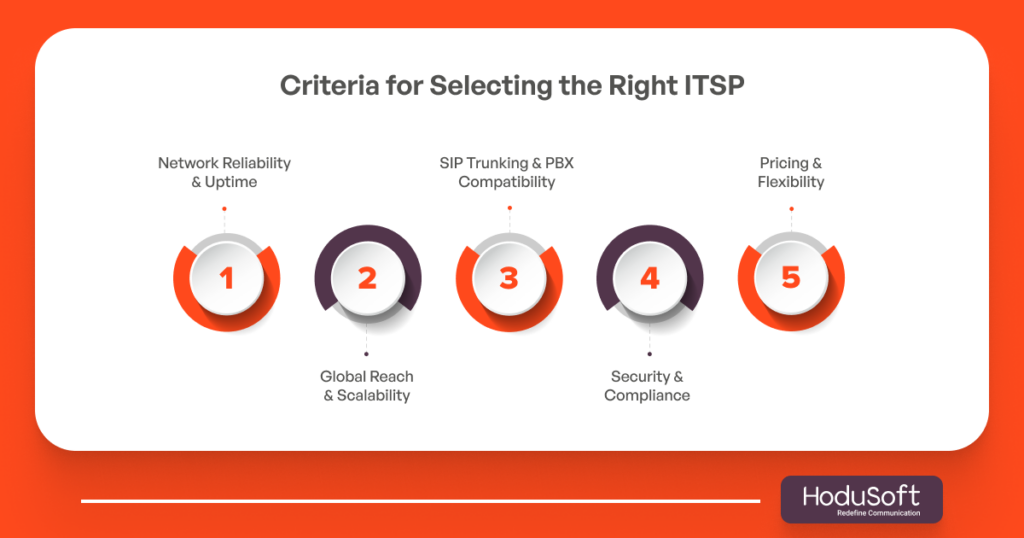
Now that we have discussed the benefits of selecting the right ITSP, let’s take a look at what criteria one must follow while shortlisting the most promising ITSPs:
1. Network reliability and uptime
When choosing an ITSP, ask whether or not the service provider can guarantee high availability. Ask if they can provide data or third-party validation.
2. Global reach and scalability
Can the ITSP support multi-region routing or local numbers? Do they offer local numbers or DIDs (Direct Inward Dialing) in the countries where you operate or plan to expand? Do they have data centers or PoPs (Points of Presence) in multiple regions to minimize latency and improve call quality? If the answer to most of the questions is a yes, selecting the ITSP would be a good idea.s
3. SIP trunking and PBX compatibility
The right ITSP should seamlessly integrate with your existing infrastructure or offer options for replacement when needed. They must be able to integrate smoothly with your on-premise or cloud PBX system. They should also help you migrate from traditional telephony to a modern SIP-based system with minimal disruption.
4. Security and compliance
Security of telephony systems is extremely important for businesses. Make sure that the ITSP you shortlist have robust encryptions and guardrails such as multifactor authentication, two-step verification, access controls, and more such security features. Also, ensure that they have a STIR/SHAKEN framework.
5. Pricing and flexibility
When it comes to prices and flexibility, ask these questions to the ITSPs. Do they offer transparent pricing (per user, per minute, per trunk)? Do they provide custom plans for businesses with fluctuating call volumes? Is there any hidden fee involved? Is the contract flexible?
Top 10 ITSPs in the US
Finally, the list we’ve been waiting for! Let’s discuss the top 10 ITSPs that began their operations in the United States and expanded their reach all over the globe. Let’s discuss them one by one.
1. RingCentral, Inc.
Incorporated in 1999, Belmont-headquartered Ringcentral is regarded as one of the top ITSPs in the U.S., particularly for small-to-medium sized businesses. It is frequently cited as a leader in cloud-based voice, video and messaging platforms for businesses.
Its main service Unified Communications as a Service (UCaaS): cloud business phone system (voice + fax), team messaging, video meetings, contact-center solutions.
The service provider offers strong enterprise-grade features such as call routing, auto-attendant, integrations with CRM tools, and scalability for mid-to-large organisations.
2. Nextiva, Inc.
Founded in Scottsdale, Nextiva, Inc was incorporated in 2006 and customer sign-ups began 2008.
Nextiva is an ITSP at its core that provides internet-based voice, PBX, SIP services, and has expanded into a UCaaS and CX platform. In less than 30 years of its existence, the company is identified as one of the top ITSPs in the U.S.
Nextiva’s core service is cloud-hosted voice and its main product line is a cloud PBX business phone system with auto-attendant, voicemail, call routing, and extension management.
Nextiva partners with licensed carriers and manages SIP trunks and PSTN connectivity for customers’ inbound/outbound calling.
Nextiva runs its own nationwide VoIP network with multiple redundant data centers in the U.S. (Arizona, California, Virginia).
3. Verizon
Verizon offers business digital voice and IP Trunking services, both based on SIP/VoIP architecture for enterprises and SMBs.
Verizon’s solutions enable cloud-based call routing, voicemail, and call forwarding through IP connections. Its hosted VoIP and UCaaS solutions provide scalable, cloud-based phone systems.
Verizon integrates Microsoft Teams, Cisco Webex, and Zoom with its VoIP and UCaaS platforms, aligning with modern ITSP capabilities.
Verizon operates one of the largest global IP networks, ensuring QoS (Quality of Service) and reliability for enterprise telephony.
4. Vonage Holdings Corp.
Vonage was established in 2001 in Holmdel, New Jersey. The
company that began as a residential VoIP pioneer, now delivers enterprise-grade internet telephony.
Vonage provides SIP trunking, hosted PBX, and Vonage Business Communications (VBC), a full UCaaS platform.
Vonage is fully cloud-native, delivering scalable, redundant VoIP infrastructure globally. Vonage operates data centers worldwide, ensuring low latency, redundancy, and 99.999% uptime SLA.
5. 8×8 Inc.
8×8 started in 1987 in Campbell, California. 8×8 provides VoIP calling, SIP trunking, and cloud PBX capabilities for global business communication.
8×8 offers X Series UCaaS, combining voice, video, chat, and contact center tools hosted in the cloud.
8×8 supports international virtual numbers (DIDs) and local presence in 55+ countries. 8×8’s AI-powered analytics and call transcription enhance communication quality and CX optimization.
The ITSP complies with HIPAA, GDPR, ISO 27001, and maintains carrier-grade uptime via global data centers.
6. Ooma, Inc.
Ooma, Inc. was founded in 2004 in Palo Alto. It offers VoIP calling services for all types of businesses. Its ‘Ooma Office’ is a cloud-based business phone system specially designed for SMBs.
Ooma, Inc. provides VoIP and hosted PBX services using SIP/Internet connectivity. It also provides DID provisioning, SIP connectivity, and routing for enterprise clients.
Ooma supports business phone features (virtual receptionist, extensions, porting numbers) via their cloud service. It offers POTS line replacement solutions for business as well as residential purposes.
7. IDT Corporation
IDT Corporation was founded in 1990 in Newark, New Jersey. It now owns subsidiary Net2Phone which offers unified cloud communications (voice, chat, messaging) for business.
IDT operates a global voice network using VoIP and has wholesale/termination services through its ‘IDT Global’ voice network. The network offers wholesale voice termination, DIDs and carries billions of minutes globally.
IDT’s annual reports describe a global infrastructure of switches, PoPs, and hybrid IP/TDM networks to provide telephony services. It operates an international voice network, terminates calls globally, and has interconnects with many carriers.
8. Dialpad, Inc.
Founded in 2011 in San Ramon, California, Dialpad provides cloud-based voice systems and business phone services built on IP/Over-the-Internet infrastructure.
Dialpad offers a unified platform for calling, messaging and meetings, replacing traditional PBX and desk phones.
Dialpad supports business features such as auto-attendant, virtual receptionist, SIP endpoints, multi-device support.
Dialpad markets its platform exactly as the “modern business phone system” that replaces legacy desk phone infrastructure.
9. Fuze
Founded in 2006 in Boston, Massachusetts, Fuze offers cloud-based voice services (enterprise voice), which run over IP and are part of a unified communications offering.
Fuze provides a cloud UCaaS platform that replaces on-prem PBX and supports business telephony, conferencing, chat, etc.
Fuze supports enterprise voice features, integrates with carriers / cloud telephony networks, and provides enterprise telephony solutions. More than 50% of its revenue reportedly comes from enterprise voice customers.
Fuze has multiple global data centers (North America, Europe, Asia-Pacific) and is noted in market reports as a UCaaS provider with global reach.
Fuze’s platform is explicitly positioned to support cloud migration, enterprise telephony and contact-center use, replacing legacy systems.
10. Bandwidth Inc.
Founded in 1999 in Raleigh, North Carolina, Bandwidth, one of the largest U.S. SIP trunking and VoIP carriers, powers many UCaaS and CPaaS platforms such as RingCentral and Zoom.
Bandwidth provides DID numbers, toll-free services, and emergency 911 connectivity across the U.S. and international markets. It also provides a nationwide IP voice network, they are a Tier-1 carrier with direct PSTN access, meaning even other ITSPs use Bandwidth’s network.
Bandwidth’s CPaaS platform enables voice, messaging, and emergency calling via APIs. It holds CLEC (Competitive Local Exchange Carrier) status, which allows it to operate as a telecom provider in the U.S.
Bandwidth owns its own IP voice network, giving it better control over call quality, redundancy, and compliance than resellers.
All In All,
Choosing the right ITSP can dramatically improve how your business communicates, not just voice calls, but meetings, messaging, unified collaboration.
The ten providers above represent some of the strongest options in the U.S. for 2025, spanning small business to enterprise to developer platforms.
Whether you’re a startup looking for affordable but full-featured telephony, a mid-sized business scaling up globally, or a developer building a communications-enabled app, one of the providers above will likely fit your needs.
Selecting the right provider is not just about cost. It’s about aligning features, integrations, reliability, support and future growth. Invest the time now in vetting, comparing, piloting the payoff will be smoother communication, better user experience, and business growth.
Upgrade your communication with the right telephony provider.
Explore the full list and make a smarter choice today.
Frequently Asked Questions,
An ITSP is a short form for Internet Telephony Service Provider. It’s an organization that delivers voice and communication services over the internet using VoIP (Voice over Internet Protocol) technology instead of traditional phone lines.
Unlike consumer VoIP apps, ITSPs provide business-grade telephony, including SIP trunking, hosted PBX, call routing, DIDs, and regulatory compliance.
A top-tier ITSP ensures high call reliability, strong network uptime (99.99%+), scalable cloud infrastructure, global number provisioning, 24/7 support, and compliance with telecom standards like FCC and E911.
Some leading ITSPs include RingCentral, Nextiva, 8×8, Vonage, Verizon, Dialpad, Bandwidth, Fuze, Ooma, and IDT Corporation. Each offers VoIP, hosted PBX, SIP trunking, and UCaaS solutions.
Before selecting an ITSP, assess your communication needs, check scalability, compliance, reliability, support quality, pricing transparency, and integration capabilities carefully.