

How Does SIP Trunking Work? What Is the Role of ITSP in SIP Trunking?
“There is no denying the world is moving to IP, and SIP has become the de facto solution of choice for businesses for IP connections.”
This quote by Diane Myers, principal analyst for VoIP/UC at Infonetics Research, highlights the undeniable reality. Session Initiation Protocol (SIP) has become the backbone of modern business communication.
Gartner Research Director Sorell Slaymaker rightly said, “If you still think SIP trunking is primarily about cost savings, guess what? You’re still right.”
The two quotes perfectly sum up why SIP trunking continues to be a top priority for businesses modernizing their communication systems.
In this blog post we’ll discuss SIP trunking in detail starting from how they work to their benefits and limitations. We’ll also uncover the role of Internet Telephony Service Providers (ITSPs) in SIP trunking.
So let’s dive right into the blog post and know everything about SIP trunking. Read on and thank us later.
What Is SIP Trunking?
As the name suggests, Session Initiation Protocol trunking is the technology that enables us to make and receive phone calls through the internet. Trunking refers to creating a virtual link that carries multiple calls at once.
In the past, physical cables connected private branch exchanges (PBX) to the public switched telephone network (PSTN). Today, SIP trunks do the same job, but over the internet protocol (IP) instead of copper wires.
It provides a simple framework to begin and end communication via the Internet.
A Brief History of SIP Trunking
SIP trunking was designed by the Internet Engineering Task Force in 1996. It was standardized as RFC 2543 in 1999, after which many businesses switched from traditional phone lines to digital systems for external calls.
In less than 30 years, SIP trunking has become the industry standard protocol for voice. It is supported by a wide variety of VoIP equipment, including IP PBX systems, VoIP phones and VoIP gateways.
The market size of SIP trunking is growing by leaps and bounds.
Did you know?
As per Mordor Intelligence
report
, the global SIP trunking market stands at USD 73.14 billion in 2025 and is on course to reach USD 157.91 billion by 2030, advancing at a 16.64% CAGR.
Benefits of SIP Trunking
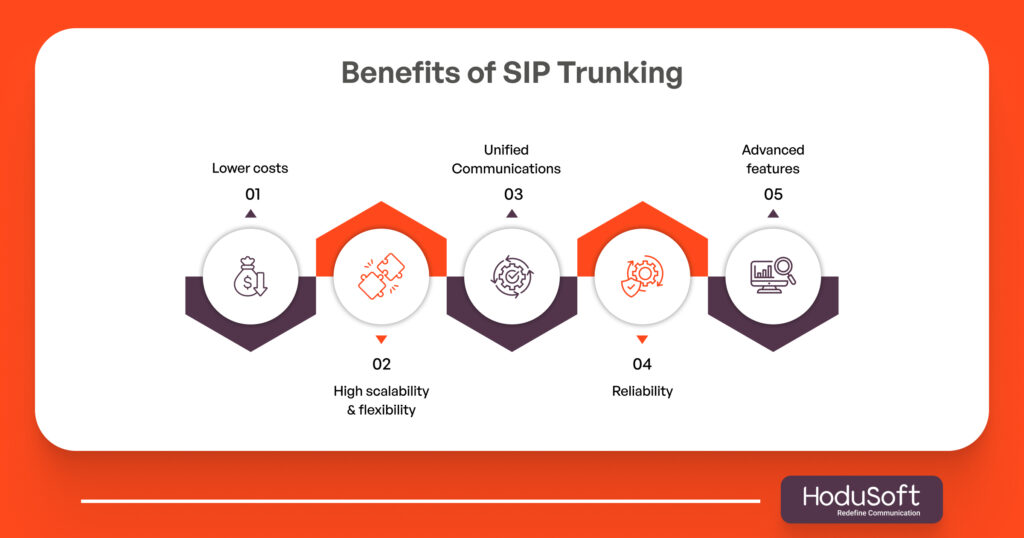
The invention of SIP trunking has come as a boon and it has proved to be extremely beneficial for organizations of all types and sizes. Here are some of the most important benefits of SIP trunking:
1. Lower costs
Would you be surprised to know that by using SIP trunking, organizations can reduce their communication costs? You shouldn’t. As per a study by Frost & Sullivan, SIP trunking can cut communication costs by up to 60%. The pay-as-you-go pricing models also play a huge role in reducing costs. Also, many ITSPs also include unlimited calls or international calling bundles in their business phone plans.
2. Scalability
SIP trunking is highly scalable. An individual trunk can handle multiple concurrent calls, with the upper limit going up to 25. Organizations that use SIP trunking can add as many extensions and phone lines without investing in new hardware. Likewise they can remove SIP channels as per their business needs.
3. Flexibility
SIP trunking allows modern organizations to be highly flexible. Employees don’t need to be tied down to a particular location and they can work from anywhere. SIP trunking users can use a wide range of devices such as mobile apps, desktop apps, IP phones, and more. They can even keep your existing phone numbers when moving to a new office or city.
4. Unified Communications
SIP trunking isn’t only about voice calls. It supports video conferencing, chat messaging, and instant messaging. By using SIP trunking, organizations can ensure that different communication channels are in one place. Not only can they handle all calls, messages, notifications using one interface but they can track all analytics using one dashboard.
5. Reliability
Good ITSPs build redundancy into their networks. If one server goes down, your phone calls are rerouted automatically. The results means higher uptime and fewer missed inbound calls or outbound calls. This keeps communication steady even during network disruptions. It ensures customers can always reach the customer service without interruption, no matter what happens behind the scenes.
6. Advanced features
Modern SIP trunking solutions integrate seamlessly with private branch exchange (PBX), customer relationship management (CRM), and collaboration tools. Users gain access to call analytics, voicemail-to-email, and video conferencing. All these advanced features help teams stay connected in real time.
How SIP Trunking Works?
The architecture of SIP trunking provides a partitioning of the unified communications network into two different domains of expertise:
Private domain: This refers to a part of the network connected to a PBX or unified communications server.
Public domain: This refers to the part of the network which allows access into the public switched telephone network (PSTN) or public land mobile network (PLMN).
Here’s what happens each time you make a call using SIP trunking:
The start of the call: When you dial a number from your desk phone or softphone, your IP PBX system sends a SIP request to your SIP trunk provider.
Session setup: The SIP sets up the call after deciding what type of session it is (voice, video, etc.) and which codecs to use.
Authentication and routing: The ITSP checks credentials, then uses call routing to connect the call to the right network, which is often the PSTN or another SIP-based system.
Data transmission: Once connected, the voice calls are converted into small data packets. These travel over your internet connection just like emails or files.
Call end: After the call ends, SIP sends a “BYE” message to end the session.
Also Read – Top 5 Reasons of Popularity of SIP Trunking
The Role of ITSPs in SIP Trunking
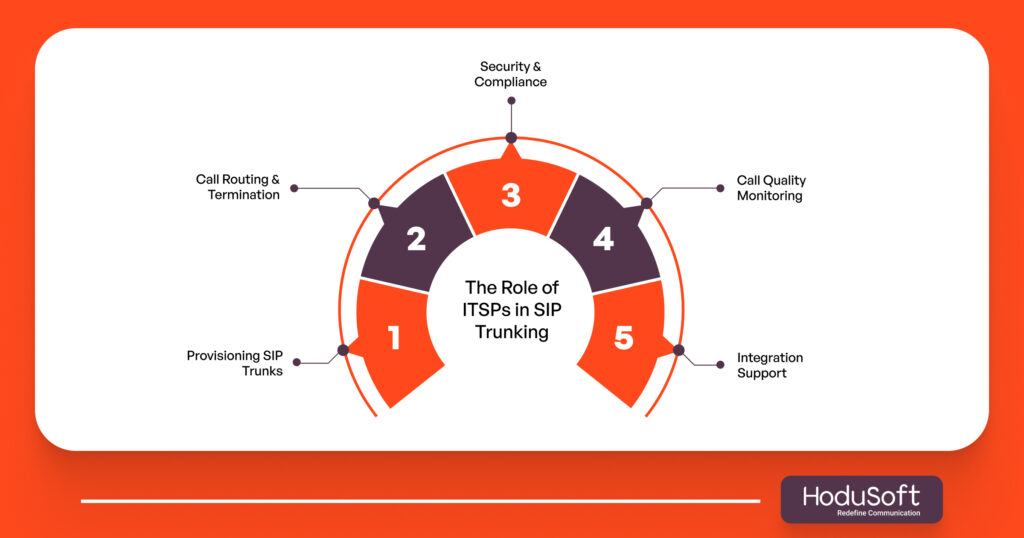
The seamless operations of SIP trunking would not have been possible without the existence of Internet Telephony Service Providers (ITSPs).
They are the ones that ensure SIP trunking connects internal communication setup with the broader public telephone network and the internet.
Here are the things ITSPs do to ensure the smooth working of SIP trunking:
Provisioning SIP trunks: They assign SIP channels, phone numbers, and routing options to ensure your system is ready for smooth, multi-channel communication.
Call routing and termination: ITSPs handle the routing of incoming and outgoing calls through global telephone networks, ensuring calls reach their destination quickly and clearly.
Security and compliance: They block spam traffic, encrypt sensitive voice data, and ensure your communication setup meets regional telecom regulations.
Call quality monitoring: Continuous quality checks help maintain clear, uninterrupted voice calls and HD video conferencing experiences.
Integration support: ITSPs assist in connecting SIP trunks with your IP PBX, CRM, and collaboration tools for unified communication.
Ready to elevate your communication strategy?
Explore HoduSoft’s SIP trunking solutions.
Why Choosing the Right ITSP Matters?
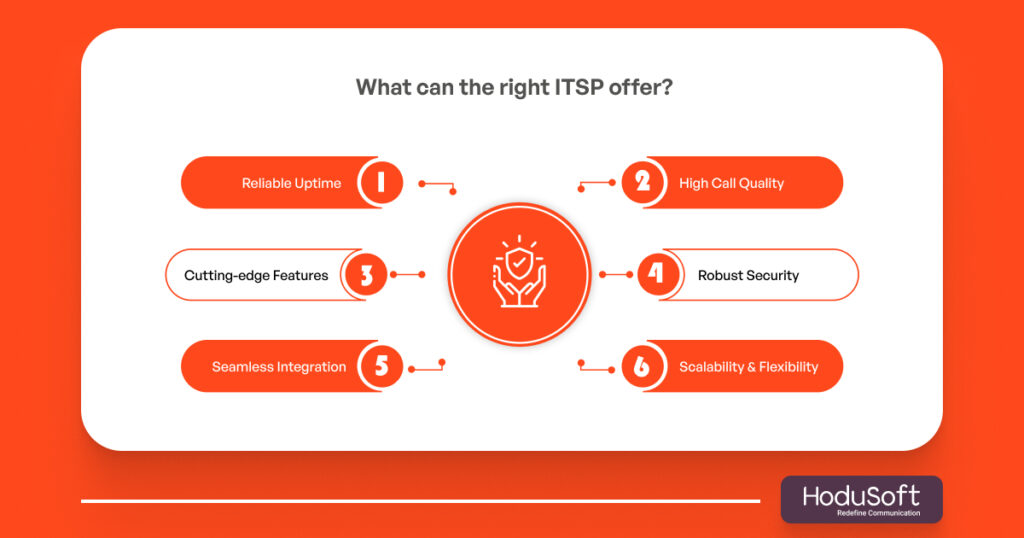
Handpicking the right ITSP can mean the difference between successful SIP trunking and a communication system full of dropped calls and downtime. A reliable ITSP ensures the seamless functioning of the business phone system. Here are some reasons why choosing the right ITSP is indispensable:
1. Reliable uptime
A reliable ITSP ensures 99.99% uptime. Be it bad weather, network congestion, or any unforeseen circumstances, users get crystal-clear voice calls, stable call routing, and consistent call quality across all locations. Built-in redundancy ensures that even if one server fails, calls are automatically rerouted with zero disruption.
2. Call quality
The right ITSP ensures high-definition audio with ultra-low latency and minimal jitter. With SIP trunking, the call quality is superior to traditional telephony, offering lifelike clarity that enhances every customer interaction. Reliable ITSPs also prioritize voice traffic through Quality of Service (QoS) mechanisms.
3. Advanced features
Modern ITSPs go beyond just connectivity. They offer auto attendants, ring groups, voicemail transcription, and call analytics. These features help businesses manage high call volumes efficiently. These smart tools enable faster call routing, improved agent productivity, and a seamless customer experience from start to finish.
4. Robust security
Security is non-negotiable in business communication. Modern ITSPs encrypt SIP trunking traffic and protect every call against eavesdropping, spoofing, and tampering. With compliance to global telecom and data protection standards, your communication remains private and secure.
5. Seamless integration
A strong ITSP integrates effortlessly with your IP PBX, CRM, and collaboration platforms. This unified setup allows your teams to handle voice calls, video conferencing, and instant messaging from a single interface. The result? Better teamwork, smoother workflows, and reduced switching between tools.
Also Read: How Can Partnering with the Right PBX Software Provider Benefit Your ITSP Business?
6. Scalability
As your business grows, your communication system should too. The right ITSP allows you to add SIP trunks instantly. No extra hardware. No complex setup. Whether you’re expanding teams, opening new branches, or handling seasonal surges, SIP trunking scales with your needs in real time.
7. Global reach
With the right ITSP, your organization isn’t limited by geography. You can acquire virtual phone numbers from any country or region, giving your business a global presence while operating from a central hub. This makes it easier to connect with international clients and deliver local experiences worldwide.
8. Automation
Top-tier ITSPs offer built-in automation tools like IVR systems, auto attendants, and intelligent ring groups. These features streamline call handling, minimize wait times, and ensure every customer reaches the right department quickly. Automation enhances both efficiency and professionalism.
All In All,
Business communication has undergone a complete transformation after the advent of SIP. The protocol has come as a boon for organizations, enabling them to move beyond the limitations of traditional telephony.
By allowing voice, video, and messaging to travel seamlessly over IP networks, SIP has not only reduced costs but also enhanced flexibility, scalability, and collaboration across teams and geographies. It has become the foundation for modern unified communications.
However, the true potential of SIP trunking can only be realized with the support of the right ITSP, which plays a pivotal role in provisioning, securing, and optimizing SIP trunks to ensure crystal-clear call quality, reliable uptime, and smooth integration with existing business systems.
A good ITSP ensures your business phone system scales easily, delivers consistent call quality, and helps your teams work smarter with automation and global reach. With providers like HoduSoft, you get more than uptime. You get peace of mind, flexibility, and the power to grow your communication network with confidence.
Build a smarter communication network with HoduSoft’s SIP trunking
Frequently Asked Questions
SIP trunking uses the Session Initiation Protocol (SIP) to connect your business phone system to the internet instead of traditional phone lines. It lets you make and receive voice calls, video conferences, and messages over a single internet connection.
An ITSP delivers the connection and infrastructure that make SIP trunks work. They handle call routing, security, bandwidth, and uptime, ensuring your business phone system performs reliably and scales easily.
While both use the internet for voice communication, VoIP is the technology behind the calls, and SIP trunking is the method that connects your phone system to the PSTN.
SIP trunking reduces costs, removes physical phone lines, improves call quality, and allows easy scaling. It also supports unified communications, combining voice calls, video conferencing, and instant messaging on one secure, flexible platform.
Look for an ITSP that offers 99.99% uptime, strong encryption, global coverage, and 24/7 support. Solutions providers such as HoduSoft combine scalability, automation, and integration.