

AI Sentiment Analysis: Measuring Emotions in Every Customer Interaction
“Sentiment analysis is the ultimate listening tool. Brands that don’t use it are missing out on what their customers truly feel.”
This quote by well-known serial entrepreneur and media professional Gary Vaynerchuk perfectly sums up the growing importance of sentiment analysis in customer interactions.
That’s because customers may say one thing but their underlying feelings and emotions may be completely different. This is where AI sentiment analysis can be helpful for organizations to capture and measure emotions in real time.
In this blog post we will discuss what AI sentiment analysis is, types of AI sentiment analysis, how AI sentiment analysis works, and why sentiment analysis matters for customer experience.
We will also discuss the use cases of AI sentiment analysis across different industries and the best practices in implementing sentiment analysis. Read on and thank us later.
What is AI Sentiment Analysis?
AI sentiment analysis is the process of analyzing the real sentiments in conversations.
.
Every message, review, or support call carries an emotional tone. The tone and sentiments are not always loud. More often than not, they are subtle.
As interactions multiply across multiple channels, it’s impossible for human agents alone to decode every emotional cue.
This is where Artificial Intelligence, Natural Language Processing (NLP), and Machine Learning (ML) are used to detect emotions and attitudes expressed in speech or text.
They determine whether a statement is positive, negative, or neutral, and can even detect nuanced emotions such as anger, joy, sadness, or sarcasm.
AI sentiment analysis helps businesses understand how customers feel about their products, services, or brand by classifying sentiments as positive, negative, or neutral.
By analyzing large volumes of customer feedback, reviews, or support interactions, AI sentiment analysis provides actionable insights into customer satisfaction, emerging issues, and market trends.
Did You Know?
As per Research and Markets report, the sentiment analytics market size is projected to grow at a compounded annual growth rate of 14.3% between 2024 and 2030 from USD 5.1 billion in 2024 to USD 11.4 billion by 2030.
.
Types of AI Sentiment Analysis
There are three key types of sentiment analysis:
1. Text sentiment analysis
As the name suggests, this type of AI sentiment analysis identifies sentiment in written messages such as emails, chat transcripts, or social media posts.
2. Voice sentiment analysis
This one is quite self-explanatory. This type of sentiment analysis detects emotional cues such as pitch, volume, tone, and pauses in voice calls.
3. Multimodal sentiment analysis
This type of sentiment analysis combines inputs from text, speech, and even facial expressions (in video calls) to provide deeper emotional context.
How AI Sentiment Analysis Works?
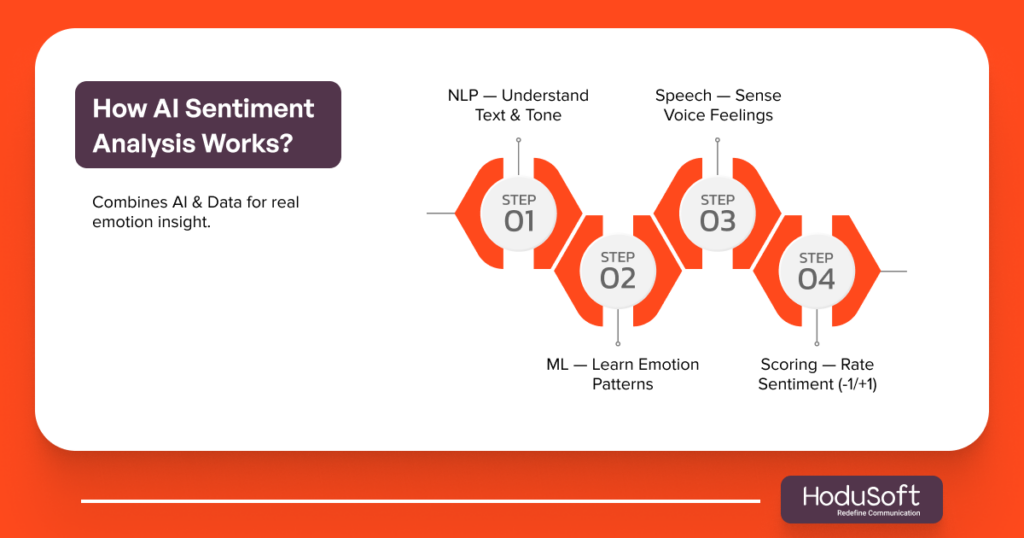
As we have discussed, AI sentiment analysis combines AI, NLP, and ML to understand and interpret human emotions hidden within text, speech, or even facial expressions. Let’s discuss that in details to understand how it works:
1. NLP
Natural Language Programming is the technology that helps computers understand and respond to human language the way people do. It breaks down text or speech into words, phrases, and syntax to understand tone and meaning.
It not only teaches machines to read, listen, and make sense of words but also enables them to analyze text or speech, understand the meaning behind it, and even detect the emotion or intent of the speaker.
For example, when a customer says “The service was great, but delivery was slow,” NLP helps the system recognize that your overall feeling is mixed. It’s positive about the service but negative about the delivery.
Likewise the feedback “Your service is unbelievable.” Without NLP context, it’s unclear if the sentiment is positive or sarcastic. With NLP, AI learns from word patterns and context to interpret it correctly.
2. ML models
ML models give sentiment analysis its intelligence. It’s the part of AI that allows systems to learn from data and improve over time, without being directly programmed.
In simple words, machine learning helps computers recognize emotional patterns in text, speech, or feedback by studying millions of real-world data samples such as tweets, chats, and reviews labeled with emotional categories. Over time, the algorithm learns to identify complex emotions, dialects, and cultural nuances.
For example, when customers write things such as “I love this product” or “The service was terrible,” the system learns what words or phrases usually express happiness, anger, or disappointment. Over time, it becomes better at identifying those emotions even when people use slang, sarcasm, or different sentence structures.
3. Speech analytics
Speech analytics is a technology that helps businesses understand what customers are saying, and how they are saying it, during phone calls or voice conversations.
In simple words, it listens to customer calls, converts spoken words into text, and then uses AI sentiment analysis to detect emotions hidden in the customer’s voice tone, pace, and choice of words.
For example, if a customer says, “I’ve been waiting for so long!” with a raised voice or frustration in their tone, speech analytics identifies that emotion as negative sentiment. On the other hand, if someone says, “That was really helpful, thank you,” it recognizes it as a positive sentiment.
By combining speech analytics with NLP and ML models, organizations can get a complete picture of customer emotions during support interactions. It helps them analyze customer sentiment in real time, spot pain points, and coach customer service agents to respond with empathy.
4. Sentiment scoring
Sentiment scoring is the process of giving a numerical value to emotions expressed in text, speech, or messages.
In simple words, it’s like giving each customer comment a score that shows how positive, negative, or neutral it is. The numerical scores can range from -1 (negative) to +1 (positive). These scores can be tracked in real time to detect mood shifts during a conversation. For example:
A happy comment such as “I love your service!” might get a score of +0.9 (positive).
A complaint such as “I’m disappointed with the delay” might get -0.8 (negative).
A neutral comment like “The product arrived today” might get 0 (neutral).
These sentiment scores are calculated by AI sentiment analysis tools using natural language processing (NLP) and machine learning. They look at words, tone, and context to understand how the customer feels and then assign the right score.
Businesses use sentiment scoring to track overall customer sentiment, measure customer satisfaction, and detect changes in mood or opinion over time. For instance, a sudden drop in average sentiment scores after a product update could indicate growing customer pain points.
Why AI Sentiment Analysis Matters for Customer Experience?
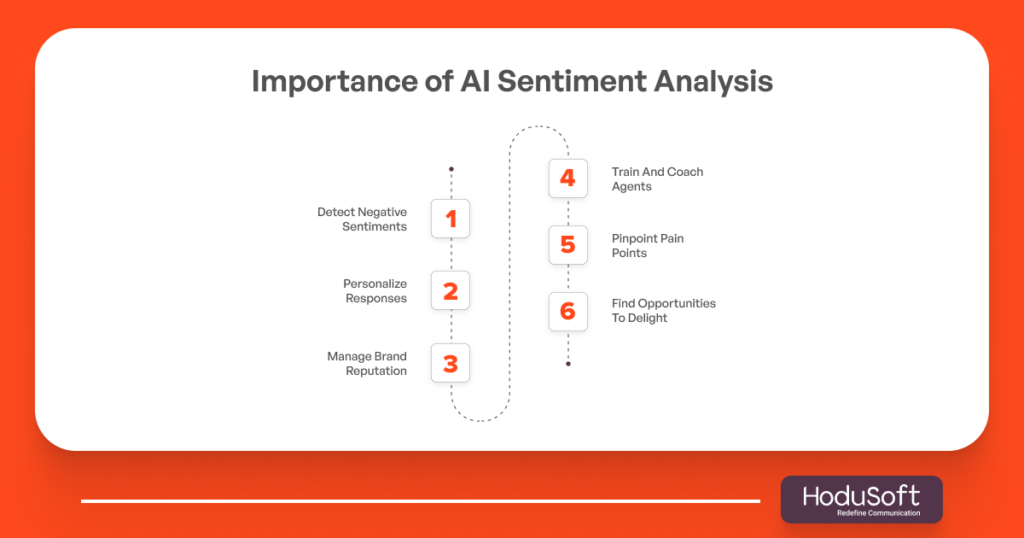
AI sentiment analysis matters for customer experience (CX) because it helps businesses understand customer emotions in real time and respond with empathy and precision. Here are some reasons why sentiment analysis is important for CX:
1. Early detection of customer frustration
AI can flag negative sentiments even before customers explicitly complain, allowing proactive intervention.
2. Greater personalization
Understanding emotional tone helps agents tailor responses. For example, if AI detects a customer is irritated or frustrated, it can send an automated response starting with an apology instead of a generic greeting.
3. Brand reputation management
By scanning social media, reviews, and emails, AI provides a bird’s-eye-view of how customers feel about a brand in real time.
4. Training and coaching agents
Analyzing emotional patterns helps supervisors train agents in emotional intelligence. It can improve tone, empathy, and response time.
5. Data-driven CX strategy
When businesses map customer sentiment across different stages of journey, they can pinpoint pain points as well as find opportunities to delight customers.
Use Cases of AI Sentiment Analysis Across Industries
The invention of AI sentiment analysis has come as a boon for almost all industries. However, some industries have benefited a lot from using AI sentiment analysis. They are:
1. Call and contact centers
Are you surprised to find the call and contact center industry ranking at the top when it comes to using AI sentiment analysis? You definitely aren’t for obvious reasons. The industry handles thousands of customer interactions every day. That gives ample opportunities for AI sentiment analysis to shine.
By detecting emotions in real time, AI sentiment analysis helps agents respond with empathy, improve customer satisfaction, and turn every conversation into a better customer experience.
As per a recent study by Kapture CX, a Bengaluru-based AI-powered customer experience platform, 41% of contact center experts ranked AI-powered sentiment analysis as the top AI use case for customer experience.
2. Telecom
In the telecom industry, millions of customer interactions happen daily. AI sentiment analysis helps identify customer pain points faster.
It detects frustration in support calls, monitors social media posts for negative sentiment, and enables agents to respond with empathy.
Telecom brands use real-time sentiment analysis to improve customer satisfaction and loyalty, reduce churn, and refine service delivery.
Did You Know?
A study revealed that AI sentiment analysis tools have been reported to reduce complaint-resolution times by about 28% in some cases.
.
3. E-commerce
For e-commerce platforms, AI-powered sentiment analysis provides actionable insights from reviews, chat transcripts, and survey responses.
It helps brands understand customer emotions behind purchase decisions, product complaints, or return requests.
By analyzing sentiment trends, online retailers can enhance product quality, optimize listings, and improve customer satisfaction with data-backed decisions.
4. Banking, financial services, and insurance
In the BFSI sector, customer trust is everything. A survey found that when it comes to choosing a bank, nearly 70% of respondents said trust is more important than convenience.
AI sentiment analysis tools help banks monitor customer feedback across multiple channels, from chatbots to emails.
By detecting anxiety or dissatisfaction early, financial institutions can take proactive steps to retain customers and personalize advisory services. It also supports intent analysis, helping identify when customers might be considering switching providers.
Emotion analytics during claims or complaints can identify trust gaps and improve agent handling.
5. Healthcare
In the healthcare industry, AI sentiment analysis can play a crucial role in understanding patient feedback and emotional tone during consultations or surveys.
Hospitals and telehealth providers use it to ensure patients feel heard and cared for. By analyzing sentiment data, healthcare organizations can identify areas needing attention such as appointment delays, staff communication, or treatment satisfaction.
As per a study, companies using AI-powered sentiment analysis report around a 20% increase in customer satisfaction and a 20% reduction in service costs.
6. Hospitality
Hotels, airlines, and travel companies rely heavily on customer emotions. AI-driven sentiment analysis helps them capture emotional cues in guest reviews and customer support interactions.
It identifies what travelers loved and what disappointed them, which allows brands to analyze customer sentiment in real time and enhance customer experience before negative reviews spread online.
Monitoring guest sentiment from reviews and social channels helps hotels personalize guest experiences and address issues quickly.
7. Education
In education, especially in online learning, sentiment analysis software helps institutions gauge how students feel about course materials, instructors, or digital platforms.
By understanding student sentiment, schools and edtech companies can adjust content delivery, improve engagement, and support better learning outcomes.
The Role of AI Sentiment Analysis in Omnichannel Contact Centers
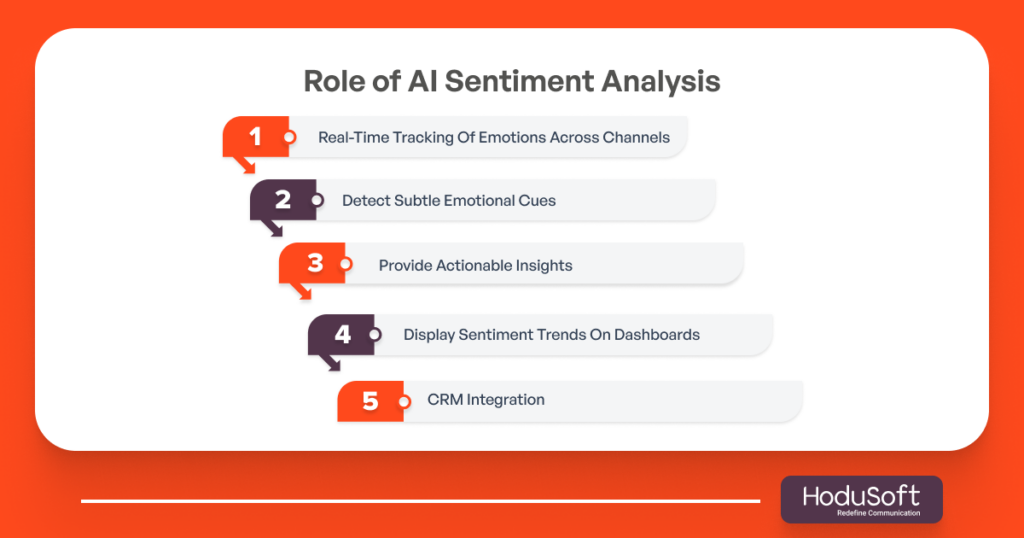
A majority of customers no longer call contact centers using voice calls. Instead they contact using chat, email, voice, and social media. Advanced AI sentiment analysis analyze communication from all the channels and does the following:
1. Track emotions across channels in real-time
AI tools continuously analyze ongoing interactions to gauge emotional tone. They gather customer feedback and emotional signals from voice, chat, email, and social media posts. They build a single emotional profile for each customer interaction.
2. Detect subtle emotional cues
AI sentiment analysis tools identify positive, negative, or neutral tones in messages and recognize subtle emotional cues such as hesitation, sarcasm, or frustration. They provide on-screen cues like “Customer sounds anxious” or “Tone turning positive.”
3. Provide actionable insights
The system translates raw sentiment data into actionable insights, which helps supervisors monitor agent empathy, tone, and performance.
4. Supervisor dashboards
Display sentiment trends across calls, agents, or campaigns for better decision-making. If a customer sentiment turns negative during a chat or call, managers get alerts to step in and guide the conversation before it escalates.
5. CRM integration
Combines emotion data with behavioral data (purchase history, churn risk) for a 360° view of each customer.
From Automation to Personalization: How AI is Shaping the Future of CX
Best Practices in Implementing AI Sentiment Analysis
Implementing AI sentiment analysis doesn’t have to be overwhelming. Here’s a step-by-step path:
1. Determine the objective
First of all, determine the objective(s) behind implementing AI sentiment analysis. Ask what you aim to achieve with AI sentiment analysis. Do you intend to reduce customer churn? Enhance agent performance? Improve brand reputation? Or simply gain deeper customer insights across touchpoints? Being clear about your objectives helps you choose the right tools, set realistic KPIs, and measure ROI effectively.
2. Choose the right tool
Every business has unique needs. Select the right sentiment analysis tool that aligns with your industry, language preferences, and integration capabilities. Look for advanced natural language processing (NLP) and machine learning features that can adapt to context, slang, and regional nuances for accurate emotion detection. Also make sure that the tool integrates with your existing CRM or contact center platform.
3. Use aspect-based sentiment analysis for deeper insights
Instead of measuring only overall sentiment, adopt aspect-based sentiment analysis to understand specific areas customers talk about such as pricing, product quality, or service speed. This approach helps you identify customer pain points and uncover valuable insights to refine your operations.
4. Combine human intelligence with AI
While AI-powered sentiment analysis offers speed and scale, human review ensures emotional accuracy. CX teams can validate sentiment scores, interpret complex emotions, and ensure empathy remains at the heart of every customer interaction.
5. Track sentiment trends over time
Use sentiment scoring and sentiment trends to track how customers feel about your brand month over month. This helps spot changes in customer sentiment, measure campaign impact, and align future strategies with evolving customer expectations.
6. Integrate with existing CX and CRM systems
To make sentiment analysis truly actionable, integrate it with your customer support and CRM systems. This ensures that every customer service agent can access emotional insights during support interactions, improving personalization and customer satisfaction.
7. Ensure data privacy and compliance
As AI sentiment analysis relies heavily on personal communication data, maintaining transparency and compliance is crucial. Always inform customers how their feedback will be used and follow regional privacy laws such as General Data Protection Regulation (GDPR) or local data protection regulations.
Taking Everything Into Consideration,
AI sentiment analysis is transforming the way businesses understand and engage with their customers.
By decoding emotions hidden within words, tones, and expressions, brands can move beyond surface-level interactions to build genuine emotional connections.
At HoduSoft, we have powered our HoduCC omnichannel CX Suite with cutting-edge AI-powered sentiment analysis.
By leveraging our omnichannel contact center software, businesses of different types and sizes across all industries have succeeded in understanding what their customers really feel.
If you are curious to know more about our HoduCC omnichannel contact center software, contact us today and book a free demo.
Boost CX with Real-Time Sentiment Analysis
FAQs
It’s an AI-powered technique that identifies emotions and opinions in customer interactions using natural language processing and machine learning.
It analyzes customer conversations across channels to detect emotional tone, classify sentiments, and deliver actionable insights for better engagement.
It helps businesses understand customer emotions in real time, enabling faster responses and improved overall customer satisfaction and loyalty.
Industries like BFSI, telecom, retail, and healthcare use it to analyze customer sentiment and improve service experiences effectively.
Choose a reliable sentiment analysis tool, define goals, integrate it with CRM systems, and track customer sentiment for insights.