

From PSTN to VoIP: How ITSPs Are Reshaping Contact Center Telephony
The history of contact centers dates back to the early 1900s. They were called call centers back then. As the name suggests, they handled calls only.
The calls were made via Public Switched Telephone Network (PSTN). The early call centers were powered by Private Automatic Branch Exchange (PABX).
PABX were switchboards that connected several devices (such as telephones, faxes, and answering machines) with each other and with the PSTN.
However, the advent of Voice over Internet Protocol (VoIP) technology marked a paradigm shift in the contact center industry.
In the late 60s and early 70s, VoIP was made available for commercial use. And contact centers started using it for their multiple benefits.
And that’s where the concept of Internet Telephony Service Providers (ITSPs) started.
In this blog post, we will discuss the history of call centers, the benefits and limitations of PSTN, the benefits and limitations of VoIP, and the ways ITSPs are revolutionizing contact centers. Read on and you would be delighted to do so.
History of Call Centers
The Public Switched Telephone Network (PSTN) originated in the late 1800s as a system of manually operated switchboards. The first telephone exchange opened in 1878 in New Haven, Connecticut. Early telephone operators physically connected calls using plugs and jacks, a process that laid the foundation for customer support via phone.
In the 1920s, the introduction of automatic switching systems replaced manual operators. An electromechanical system named the Strowger switch automated call connections without human operators. By the 1960s, many large organizations used PSTN lines and Private Automated Business Exchanges (PABXs) to run their call centers and handle customer calls.
During that time, Automatic Call Distributors (ACDs) were introduced. Incoming calls could be automatically routed to available agents. During the 1980s, toll-free numbers (1-800) became widespread, further driving customer contact volumes through the PSTN.
The late 1990s marked the advent of VoIP. Many organizations began moving away from traditional circuit-switched PSTN systems to packet-switched IP networks.
What Benefits Did PSTN Offer?
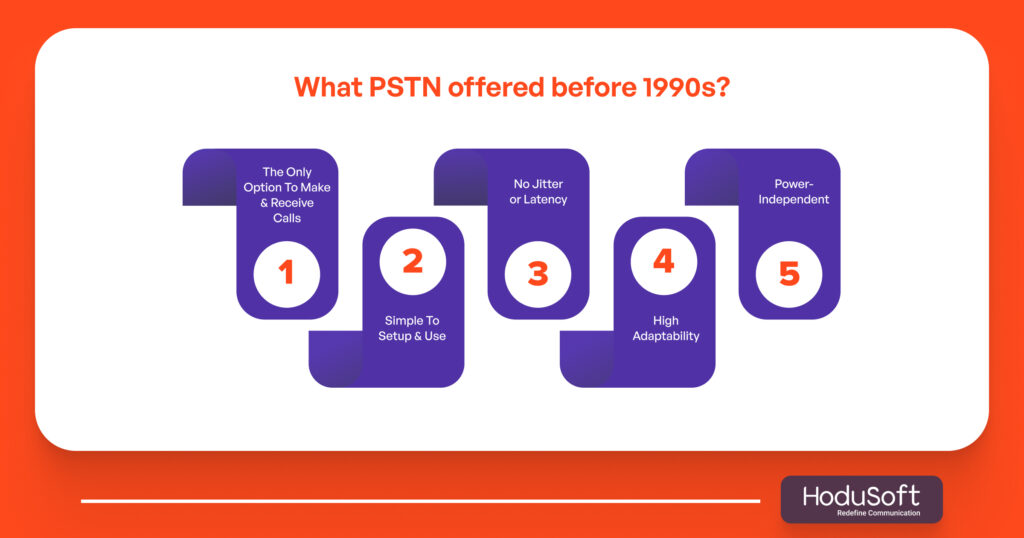
Back in the day, when there was no concept of VOIP, PSTN was the only option. Like it or not, businesses had to use it in their call centers for the following reasons:
1. The only option
From the late 1800s to early 1950s, PSTN was the only available telephony option. There was no concept of the internet. There simply wasn’t an alternative. During those decades, PSTN was the standard and the only reliable way to make and receive calls across distances. That’s why PSTN lines powered the communication backbone of the earliest contact centers.
2. Simple to setup and use
When PSTN was the only option, it was relatively simple for call center owners to get it up and running. All they needed to do was take the help of experts and PSTN providers to install the machinery and equipment. Within a few days they were able to run their operations. No software installation, app updates, or internet dependency. Agents just picked up the phone and talked.
3. Reliable call quality
PSTN provided consistent and clear voice quality with minimal interruptions. Since calls traveled over dedicated lines, there were no internet-based issues such as jitter or latency. Call centers around the world benefitted from reliable call quality from the very beginning.
4. Adaptable
Traditional phone systems, relying on the Public Switched Telephone Network (PSTN), have long been known for their simplicity and reliability.. Unlike VoIP-based telephony, they do not require massive infrastructure, high-speed internet, or complex configurations. All they needed was a working telephone line. This made it simple and dependable for any business environment.
5. Power-independent operation
One of PSTN’s biggest strengths was that it worked even during power cuts. The lines were powered through the exchange. This gave the telephony system uninterrupted connectivity and reliable communication even in emergency or outage situations.
Limitations of PSTN
Even though PSTN was the only option for a long time, it also had many limitations which affected the operations of call centers during the early part of the 20th century.
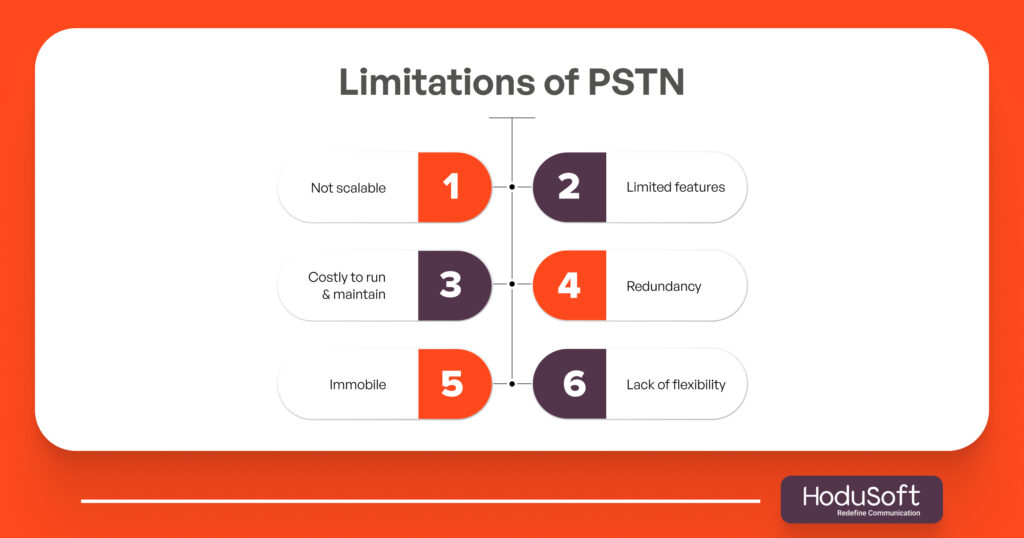
1. Limited scalability
PSTN offers limited scalability. Adding new phone lines or expanding operations with PSTN is expensive and time-consuming. Let’s suppose a call center wants to hire new agents, then it will have to install additional hardware and connect those with the telephony system.
2. High maintenance and operational costs
Maintaining and operating PSTN is quite costly than VoIP technology. As PSTN relies on physical infrastructure such as switchboards, cables, and on-site maintenance, the setup and upkeep costs are higher compared to cloud-based VoIP systems.
3. Geographical constraints
PSTN systems are location-dependent and immobile. Agents must work from physical offices where the phone system lines are installed. This limits remote workers and teams who need the flexibility to make and receive calls from multiple locations.
4. Lack of advanced features
Traditional PSTN systems support only voice calls. They don’t offer modern features like call analytics, IVR, omnichannel integration, call recording, or CRM synchronization. This limits the ability to deliver modern, digital-first customer service.
5. Difficult disaster recovery
In case of a power outage, hardware failure, or natural disaster, PSTN lines can go down. Unlike hosted PBX or SIP trunking setups that provide cost-effective redundancy, traditional phone systems offer little resilience during crises. Without an easy backup or rerouting option, communication is disrupted.
6. Limited integration capability
PSTN systems cannot easily integrate with modern contact center tools, CRM platforms, or internet protocol (IP) network-based solutions. This makes it harder to manage workflows, automate call forwarding, or track performance metrics. Without integration, contact centers miss out on cost savings and operational insights that VoIP-based PBX systems provide.
7. Poor global flexibility
International calling through PSTN is costly and complex to manage. Businesses often require multiple local telecom vendors to handle external calls and long-distance phone connections. Modern SIP trunking and hosted PBX solutions allow organizations to connect globally through the internet.
8. Imminent obsolescence
With telecom providers worldwide phasing out copper networks, PSTN systems are fast becoming obsolete. Newer solutions such as VoIP and hosted PBX systems operate over the internet, offering cost savings, scalability, and better call quality.
What is PSTN – A Complete Guide
How VoIP Transformed Call Centers?
The invention of VoIP technology in the late 1960s and the mass adoption in the early 1990s proved to be a boon for many businesses. A majority of organizations took the services of Internet Telephony Service Providers (ITSPs) and switched from PSTN to VoIP for the following reasons:
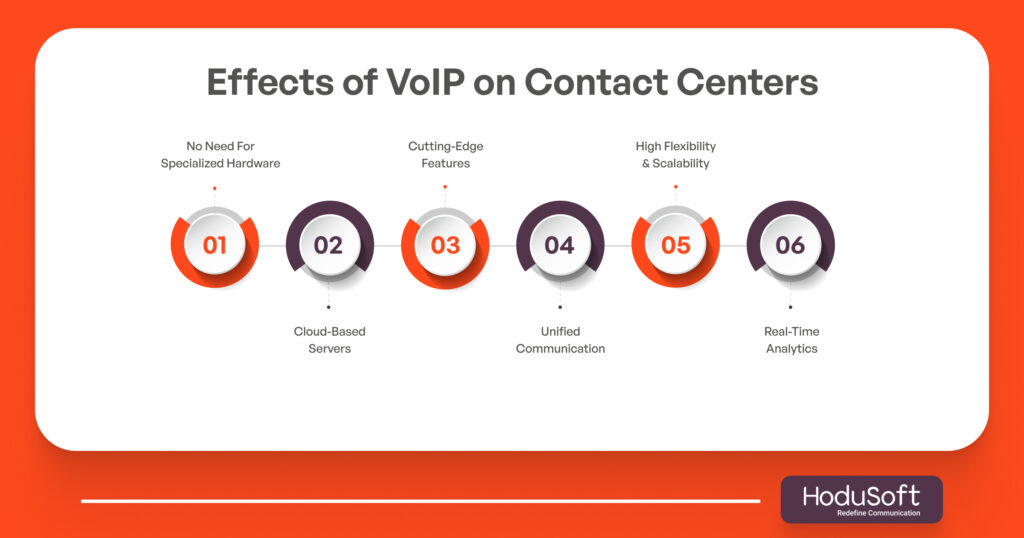
1. No need of expensive and specialized hardware
When call centers used PSTN, they required specialized hardware and equipment to sustain their operations. But the mass adoption of VoIP eliminated the requirement of specialized hardware in call centers. New age call centers require just a good computer system, a steady internet connection, some basic hardware such as headsets and the communication system is ready.
2. Cloud storage
The advent of cloud technology meant that call centers no longer needed to have their servers on their premises. The cloud-based servers provide massive flexibility and scalability. They not only reduce deployment time and enhance seamless data access but also reduce maintenance costs and ensure business continuity during high call volumes.
3. Advanced features
VoIP systems come loaded with intelligent features such as IVR, call recording, auto-attendant, voicemail-to-email, analytics, and CRM integration. These cutting-edge features automate repetitive tasks, streamline call routing, and empower agents to deliver more personalized customer service. By doing that, they improve overall operational efficiency and responsiveness.
4. Unified communication
VoIP enables voice, video, chat, and conferencing from a single platform. In fact, this approach of unifying a wide number of communication channels led to the concept of contact centers. The centers not only handled customer calls but also handled queries over websites, emails, text and instant messaging apps, social media, and more.
5. Integration with CRM and productivity tools
VoIP easily connects with CRMs, helpdesks, and business applications, ensuring every call is logged and contextual customer data is instantly available to agents. This seamless integration enhances workflow automation, reduces manual data entry, and allows businesses to track customer interactions in real time.
6. High flexibility
By using VoIP technology, agents can work from anywhere using softphones, web dialers, or mobile apps. This makes VoIP perfect for remote or hybrid contact centers. By leveraging VoIP technology, contact centers can empower their agents to work from anywhere in the world. They just need to have a computer system, stable internet connection, and a good headset.
7. Real-time analytics
In traditional communication systems, it is not possible to get all critical analytics in real-time. Without real-time analytics, call centers and contact centers won’t know how well the agents are handling queries and providing solutions to customers. That’s where VoIP systems come to the rescue. They provide detailed call metrics such as average handling time, call volumes, and customer satisfaction scores.
Limitations of VoIP Technology
Even though VoIP technology has many advantages, it also has a few limitations. Here are some of those.
1. Dependence on internet connection
VoIP systems rely entirely on a stable internet connection to make and receive voice calls. Poor bandwidth or network congestion can affect call quality, leading to latency, jitter, or dropped calls.
2. Power outage vulnerability
Unlike traditional PSTN phone systems, VoIP services stop functioning during power cuts unless backup power or mobile data networks are available. This makes business continuity planning crucial for uninterrupted customer service.
3. Security and privacy risks
Since VoIP operates over the internet, it’s more exposed to threats like hacking, phishing, and denial-of-service attacks. Without proper encryption and network security, sensitive customer data and voicemail messages can be compromised.
4. Call quality variability
The quality of VoIP calls depends heavily on network performance. Factors such as bandwidth sharing, IP network congestion, and device compatibility can lead to inconsistent call quality compared to circuit-switched PSTN systems.
5. Emergency call limitations
VoIP systems may face challenges with location tracking for emergency numbers. Unlike traditional PBX systems, which are tied to physical addresses, VoIP may not automatically relay user location to emergency responders, posing compliance and safety concerns.
Key Differences Between PSTN and VoIP in Contact Center Use
|
Aspect |
PSTN |
VoIP |
|
Technology |
Circuit-switched traditional phone lines. |
Packet-switched digital communication over the internet. |
|
Infrastructure |
Requires physical cabling, PBX hardware, and on-site setup. |
Cloud-based, requires only internet connectivity and devices. |
|
Scalability |
Difficult and costly to expand. |
Instantly scalable with virtual extensions. |
|
Cost |
High installation and maintenance costs. |
Lower setup and operational costs. |
|
Flexibility |
Location-bound. Agents must be on-site. |
Supports remote and hybrid work from anywhere. |
|
Features |
Limited to voice calls. |
Includes advanced features such as IVR, analytics, recording, and CRM integration. |
|
Maintenance |
Requires regular on-site maintenance. |
Managed remotely by service providers (ITSPs). |
|
Global reach |
Restricted. Needs multiple vendors for international operations. |
Global connectivity through SIP trunking and virtual numbers. |
|
Disaster recovery |
Complex and hardware-dependent. |
Easy rerouting and cloud-based redundancy. |
|
Integration |
Cannot integrate with digital tools or CRMs. |
Seamless integration with CRMs, helpdesks, and analytics tools. |
|
Quality of service |
Generally stable but not adaptable. |
Enhanced with QoS controls, adaptive codecs, and redundancy. |
|
Analytics and Reporting |
Minimal reporting. Manual tracking required. |
Real-time metrics, dashboards, and call recording enhance customer experience insights. |
|
Future Readiness |
Becoming obsolete with copper line phase-outs. |
Future-ready and compatible with AI and cloud technologies. |
How ITSPs Are Reshaping Contact Center Telephony?
Internet Telephony Service Providers (ITSPs) are redefining how modern contact centers operate. By leveraging VoIP, SIP trunking, and hosted PBX systems, ITSPs empower businesses to communicate smarter, scale faster, and deliver superior customer experiences. Let’s explore how they’re leading this digital telephony revolution.
1. Moving communication to the cloud
ITSPs have enabled businesses to shift from on-premise PBX systems to cloud-hosted PBX models. This transition eliminates bulky hardware, reduces operational costs, and allows companies to manage all internal and external calls through the internet. Cloud telephony gives agents and remote workers the flexibility to connect from anywhere.
2. Simplifying call routing and management
Through SIP trunking and intelligent call routing, ITSPs ensure every customer connects to the right agent or department quickly. Features like auto attendant, call forwarding, and voicemail to email streamline workflows, helping contact centers handle both inbound and outbound calls efficiently.
3. Integrating advanced and unified communication tools
Modern ITSPs integrate advanced features such as video calls, voicemail message management, analytics, and CRM synchronization. By combining voice, chat, and video into a single unified communications solution, ITSPs help organizations achieve seamless collaboration between teams and deliver consistent, high-quality customer service across all channels.
4. Delivering scalability and cost savings
Scaling a traditional phone system requires major investment. However, ITSPs make scaling up (or scaling down) easy. For growing organizations, ITSPs make expansion simple, cost effective, and sustainable. Contact centers can add new users, teams, or locations within minutes.
5. Strengthening security and reliability
ITSPs use encryption, firewalls, and secure IP networks to protect sensitive voice data. They also provide built-in redundancy and failover systems, ensuring continuity during outages. This means businesses experience minimal downtime, consistent service quality, and robust security.
Summing Up,
ITSPs have played a key role in enabling the shift from PSTN to VoIP, which marks a defining moment in the evolution of contact center telephony.
With the rise of ITSPs, contact centers are embracing cloud-based PBX systems, SIP trunking, and unified communications that deliver flexibility, scalability, and cost efficiency like never before.
At HoduSoft, we have empowered all types and sizes of ITSPs with our HoduPBX multi-tenant IP PBX software. If you are an ITSP and you want the right multi-tenant IP PBX software for your contact center clients, we happen to have just the right solutions for you.
FAQs
An Internet Telephony Service Provider (ITSP) delivers voice communication services using VoIP (Voice over Internet Protocol) instead of traditional phone lines.
Unlike the PSTN, which relies on copper phone lines, VoIP uses the internet to transmit voice calls.
Businesses are moving from PSTN to VoIP because it offers scalability, mobility, and significant cost savings.
ITSPs enhance customer service by providing VoIP-based telephony solutions with features like call analytics, voicemail to email, and auto attendant.
Yes. Reputed ITSPs use robust security measures like encryption, firewalls, and secure IP networks to protect sensitive voice data.