

Top 14 Cloud Hosted PBX Providers For Businesses in 2026 and Beyond
Looking for the best cloud-hosted PBX providers for your business in 2026? Well, you’re not alone. Businesses are moving their phone systems to the cloud faster than ever, and with good reason. Cloud-hosted PBX (private branch exchange) systems remove the hardware headaches, make remote and hybrid work easier, and pack advanced features (call routing, auto-attendants, integrations, analytics, and AI) into a monthly subscription.
But with dozens of providers shouting about reliability, AI, and flexible pricing, choosing the right partner can feel overwhelming.
This guide cuts through the noise. Below you’ll find a clear walk-through of what a cloud-hosted PBX is, why it matters in 2026 and beyond, what to watch for when choosing a provider, and a practical profile of 14 cloud-hosted PBX providers that businesses commonly evaluate.
What is a cloud-hosted PBX?
A cloud-hosted PBX is a business phone system where call control and PBX features (auto-attendants, call queues, extensions, voicemail, call recording, etc.) are hosted by a provider in the cloud rather than on premises. Users connect via IP phones, softphones (desktop/mobile apps), or SIP trunks over the internet, which makes the system scalable, quicker to deploy, and easier to manage than traditional, on-site PBX hardware.
.
Why Cloud PBX is Important?
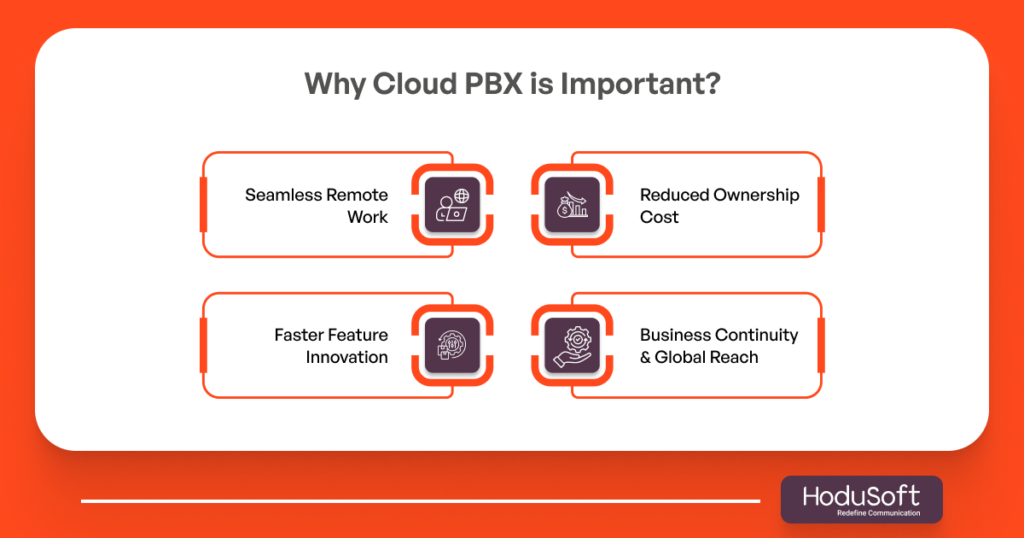
- Remote & hybrid work is permanent. Employees expect the same phone experience whether they’re at home, in the office, or on mobile – cloud PBX makes that seamless.
- Faster feature innovation. Providers release software updates, AI features, and integrations regularly; you don’t wait months for firmware upgrades.
- Total cost of ownership often looks better. No heavy CAPEX for on-prem hardware, easier maintenance, and predictable monthly bills (but watch add-ons).
- Business continuity & global reach. Cloud providers offer geo-redundancy, local numbers in many countries, and flexible routing for disaster recovery.
These trends are reflected across recent buyer guides and market reviews for cloud phone systems.
What to Look for When Choosing a Cloud PBX
Before we profile vendors, here’s a quick checklist you should use while evaluating:
- Reliability & call quality: Core voice reliability & call quality (SLA, codec support, QoS guidance).
- Device & app support: Desktop softphone, mobile app, and IP phone models supported.
- Integrations: CRM, helpdesk, collaboration tools (Slack, Microsoft 365, Salesforce).
- Contact center capabilities: ACD, IVR, call queues, reporting — if you need support/sales teams.
- Security & compliance: TLS/SRTP, PCI/DSS, or industry-specific compliance.
- SIP trunking & portability: Ease of number porting, BYOD/SIP trunk options.
- Global presence & local numbers: Does the vendor offer local numbers where you operate?
- Pricing transparency & add-on costs: Basic plan vs features that cost extra (recording, analytics).
- Support model: 24/7, dedicated account manager, onboarding assistance.
- AI & automation: Live transcription, summaries, or conversational AI (bonus, but not everything).
Use that checklist as you read the short profiles below.
Top 14 Cloud-hosted PBX Providers for Businesses in 2026
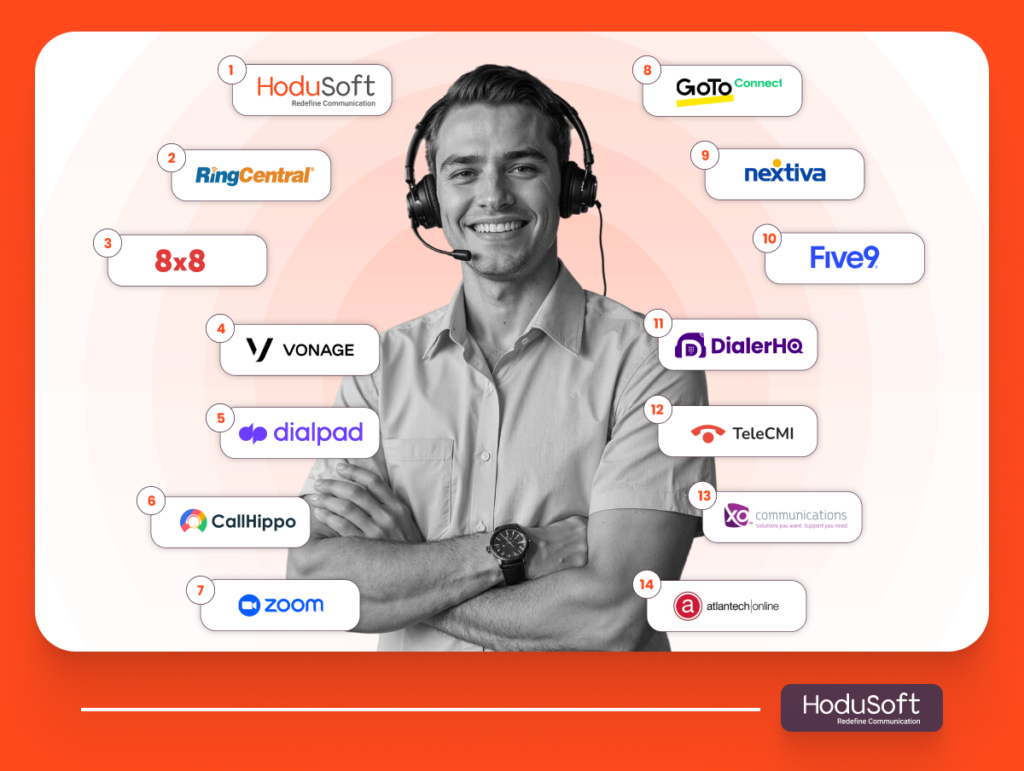
For each vendor, we have listed: what they’re best at, who should consider them, and one thing to watch for.
1. HoduSoft
Best for: Businesses of all sizes looking for a customizable, scalable, and feature-rich cloud-hosted PBX with carrier-grade capabilities.
Why consider it: HoduSoft offers a modern cloud-hosted PBX platform built for reliability, multi-level automation, and global communication needs. Its modular architecture, strong SIP trunking support, multi-level IVR, analytics, and integrations make it suitable for enterprises, ISPs, contact centers, and fast-growing businesses.
Watch for: Evaluate the deployment model (single-tenant/multi-tenant) you need and the customizations required for your industry.
Also Read: Seamless Connectivity: Exploring the World of IP PBX for Hosted Service Providers
2. CallHippo
Best for: Small to mid-sized teams that need fast setup and global local numbers.
Why consider it: CallHippo markets itself as an easy virtual phone system with quick provisioning of local/toll-free numbers in many countries. It’s positioned for teams that want a low-friction cloud PBX with basic contact features. The platform also reflects how modern cloud application development services enable rapid deployment, scalability, and reliable performance for communication tools.
Watch for: Pricing tiers and add-ons, check which reporting or call-center features are included vs add-ons.
3. Nextiva
Best for: Mid-market to enterprise teams that want unified communications with strong customer support.
Why consider it: Nextiva is frequently highlighted as a cloud PBX and UCaaS provider with robust business features from inbound/outbound voice to collaboration and CRM integrations. Reviewers praise its scalability and reliability for business voice.
Watch for: Feature parity between plans, confirm advanced analytics, and contact center capabilities on the plan you choose.
4. Zoom (Zoom Phone)
Best for: Organizations already using Zoom Meetings who want to consolidate meetings and phone calls into one vendor.
Why consider it: Zoom Phone extends Zoom’s collaboration stack with cloud telephony, voicemail transcription, and familiar user apps (desktop & mobile), making adoption easier for existing Zoom users.
Watch for: If you require deep contact-center features, Zoom’s add-ons and contact center products may increase total cost.
5. RingCentral
Best for: Businesses seeking a feature-rich UCaaS platform with strong contact center options and integrations.
Why consider it: RingCentral is a market leader in cloud phone/UCaaS. It continually adds capabilities (including AI and workforce management enhancements) and has a strong global presence. Recent moves to expand AI workforce management show an aggressive roadmap toward integrated contact center operations.
Watch for: RingCentral’s breadth is great, but pricing can climb as you add contact center or workforce management modules.
6. DialerHQ
Best for: Growing businesses that want simple cloud PBX features plus call center essentials.
Why consider it: DialerHQ advertises call queuing, ACD, and analytics alongside standard PBX functions, attractive if you run a small support or sales team and want an easier UI.
Watch for: Check independent reviews for long-term reliability and support SLA.
7. Dialpad
Best for: Teams that want AI-first features like real-time transcription, post-call summaries, and conversational AI.
Why consider it: Dialpad emphasizes AI voice intelligence that transcribes and surfaces action items, useful for sales and support teams that want to capture conversational insights automatically.
Watch for: AI features are powerful, validate how they perform in your accent/industry, and whether they are included in base plans.
8. Vonage
Best for: Companies wanting flexible APIs and a strong developer ecosystem alongside standard PBX features.
Why consider it: Vonage offers business cloud PBX and extensive programmable-voice APIs (good if you plan to build custom integrations or contact flows). It also explains cloud PBX concepts clearly for buyers.
Watch for: If you’re not building custom integrations, compare bundled features vs price; API power matters only if you’ll use it.
9. 8×8
Best for: Companies that want a single vendor for global voice, video, and contact center solutions at reasonable price points.
Why consider it: 8×8 competes on value and global reach, offering UCaaS plus contact center bundles suitable for distributed teams. Many buyer guides include 8×8 among the top cloud phone systems.
Watch for: Check local number availability and quality in regions important to you.
10. TeleCMI
Best for: Organizations seeking regional support (particularly if you’re operating where TeleCMI is active) and tailored virtual PBX services.
Why consider it: TeleCMI publishes comparison content on virtual PBX options and targets businesses looking for specialized deployments. Use it if you value local sales/support and region-specific packaging.
Watch for: Verify global coverage and integrations if you have multi-region needs.
11. XO Communications
Best for: Larger enterprises and service providers that need carrier-grade voice, SIP trunking, and network services.
Why consider it: XO (often operating in carrier services and SIP/trunking) appeals to enterprises that require strong network integration, direct interconnects, and telephony expertise. If you need SIP trunking at scale, XO is a candidate.
Watch for: Ensure the company’s current product names and go-to-market structure are the same in your region; telecom brands sometimes rebrand after M&A.
12. Atlantech Online
Best for: Businesses looking for a hosted PBX with strong managed services and network support (commonly used by enterprises and resellers).
Why consider it: Atlantech focuses on managed voice and hosted PBX solutions with an emphasis on reliability and service delivery. If you want a provider that’s comfortable in managed service environments, consider them.
Watch for: Compare SLAs and on-call support terms.
13. GoToConnect
Best for: SMBs that want an affordable, predictable cloud phone system with integrated meetings and messaging.
Why consider it: GoToConnect combines phone, messaging, and meeting features under a single tariff, attractive for smaller teams seeking simplicity and a unified app experience.
Watch for: Feature comparison against peers: GoToConnect is solid for SMBs, but enterprises may need more advanced contact center modules.
14. Five9
Best for: Mid-market to enterprise contact centers that need advanced, cloud-native contact center features.
Why consider it: Five9 is primarily a contact-center-first cloud platform offering ACD, IVR, omnichannel routing, and analytics, which is excellent when your primary need is customer engagement at scale. Use Five9 if your phone system must double as a full contact center.
Watch for: Pricing is aligned to contact center use-cases; it may be overkill if you only need basic PBX functions.
Quick Comparison: Grouping the Providers by Typical Buyer Need
- Best for SMB simplicity & cost: HoduSoft, CallHippo, GoToConnect.
- Best for UCaaS & broad feature set: RingCentral, Nextiva, 8×8.
- Best for AI & conversational insights: HoduSoft, Dialpad, RingCentral (AI roadmap).
- Best for contact center needs: Five9, RingCentral, HoduSoft, Nextiva (with contact center add-ons).
- Best for programmable voice / API workflows: Vonage (strong developer tools).
- Carrier/enterprise SIP needs: XO Communications, Atlantech.
- Regional/reseller focus: HoduSoft, TeleCMI, DialerHQ (depending on region).
How to Choose: 6 Practical Buying Scenarios
- You’re a 10-person startup with a limited budget: Prioritize simple monthly pricing, a reliable mobile app, and good onboarding.
- You already use Zoom for meetings: Consider Zoom Phone for consistent UX and single-vendor billing.
- You run a 50-seat sales/support team: Evaluate contact center features (HoduSoft, Five9, and RingCentral are strong candidates).
- You want AI capabilities for coaching and transcription: Test Dialpad, RingCentral’s AI suite, or HoduSoft for intelligent routing, analytics, automation, and workflow optimization.
- You need carrier-grade SIP trunking & network services: Discuss XO Communications or Atlantech for carrier integrations.
- You plan custom integrations (CRM, bots): Choose Vonage or any vendor with a strong API ecosystem.
Migration Tips: What to Do Before You Switch
- Audit your current call flow, numbers, and integrations. Know what must move (DIDs, IVR flows, porting windows).
- Run a network readiness test (bandwidth, jitter, packet loss) and plan QoS settings on your WAN.
- Pilot with a small set of users to validate call quality and app experience.
- Clarify number porting timelines and potential downtime with the provider.
- Negotiate onboarding, training, and support SLAs in the contract.
Pricing Realities and Hidden Costs
Cloud PBX pricing is usually per-user per-month, but some costs commonly surprise buyers:
- Advanced reporting, recordings, or CRM integrations sometimes cost extra.
- SIP trunking or long-distance minutes may be billed differently from the base plan.
- Emergency calling & regulatory fees vary by country.
- Onboarding, porting fees, or premium support can add up in year one.
Always build a 12–24 month TCO (total cost of ownership) model rather than compare per-user sticker prices alone. Recent market guides show that typical annual per-user costs vary widely depending on included features.
Final Verdict
There is no single “best” cloud PBX for every business; the right provider depends on size, priorities (simplicity vs advanced contact center), integration needs, and budget. Use the checklist above, run a pilot with 2–4 providers you shortlist, and validate voice quality, integrations, and support before committing. The 14 vendors profiled here cover the majority of buyer needs from simple SMB phone systems to enterprise contact center platforms.
Need help choosing the right PBX provider for 2026?
FAQs
Yes, for most businesses, cloud PBX offers equal or better reliability because providers run redundant cloud infrastructure and geographic failover. However, call quality depends on your internet connection and WAN configuration; run network checks and enable QoS.
Usually, yes – number porting is standard, but timelines and rules vary by country/provider. Always check porting SLAs and any temporary forwarding options during migration.
Many do (HoduPBX, RingCentral, Nextiva, Five9, etc.), either built into higher tiers or as add-on modules. If you need advanced omnichannel routing, prioritize contact-center-focused vendors or add-ons.
They can be for coaching, compliance, and productivity, but test them against your accent, industry vocabulary, and data privacy rules. AI is a productivity boost if it’s accurate and included at an acceptable cost.
Migration time varies: simple softphone rollouts can take days; full number porting, user training, and SIP trunk migration can take weeks. Plan for pilots and overlapping forwarding to avoid downtime.
HoduSoft, RingCentral, 8×8, Nextiva, and Zoom have broad global footprints. For developer flexibility and programmable voice, Vonage is strong. Always check local number availability in the regions you serve.