
If you are an Internet Telephony Service Provider (ITSP) then you must be using a private branch exchange (PBX) system.
The question is do you belong to the “do-it-yourself” school of thought? Or do you belong to the “some things are best left to the experts” school of thought?
Let’s elaborate. In today’s time, some ITSPs still use and manage traditional PBX systems by themselves. Others rely on PBX software providers to run their business and provide ITSP business solutions. But very few ITSPs treat their IP PBX solutions providers as strategic communication partners.
Curious to know what strategic communication partners mean? In this blog post we will discuss the key challenges ITSPs face when they manage their IP PBX systems all by themselves.
We will also discuss the benefits of partnering with the right IP PBX software provider, common mistakes ITSPs make while joining hands with IP PBX software providers, and the best practices to partner with the right IP PBX software provider. Read on and you would be delighted to do so.
When it comes to managing their IP PBX systems, ITSPs have two options to do that. They can either manage the IP PBX systems on their own. Or they can join hands with experts for that. Let’s find out which one is better.
Vendor vs. Partner: The ITSP Perspective
Challenges ITSPs Face by Using and Managing Traditional PBX on Their Own
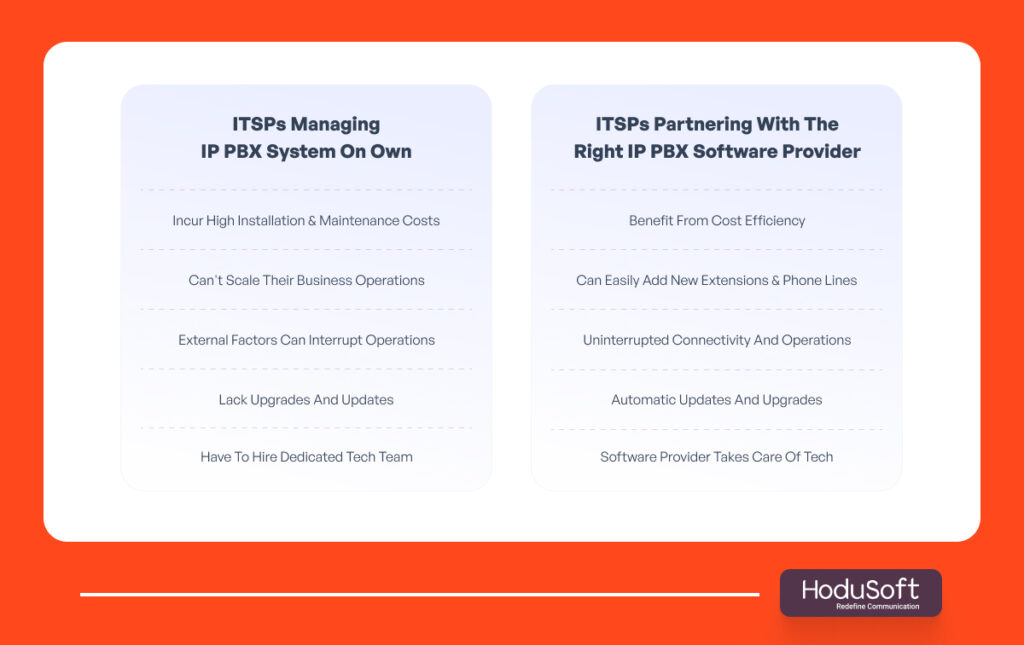
As we have discussed, many ITSPs still use traditional PBX systems and manage their telephony infrastructure all by themselves. On the surface it may seem like they are effective at controlling costs and other aspects but the reality is different. They face many problems and some of those are listed below:
1. High maintenance and infrastructure costs
Traditional PBX systems need highly specialized hardware and equipment. They need significant investment in computer servers, telephone switching systems, and even fax machines or analog phones. They need to be installed and maintained by expert professionals. Maintaining traditional small business PBX or conventional small business PBX can be expensive for small businesses.
2. Limited scalability
Many ITSPs find that traditional phone systems or conventional PBX setups struggle to scale effectively. Adding remote IP extensions, IP phones, or mobile devices to meet the needs of remote work can be complex. Without this flexibility, growing customer bases or new locations can become a technical bottleneck.
3. Reliability issues
Call quality and system uptime are critical for customer satisfaction. Traditional PBX phone systems often face challenges with outgoing and incoming calls, desk phones, or managing multiple incoming calls simultaneously. Without a reliable phone system, ITSPs risk disruptions in phone calls and overall communication performance.
4. Lack of technical expertise
There is this popular saying “Some things are better left to experts.” ITSPs that use traditional PBX systems and manage that on their own should note that. That’s because managing internal users and data networks for multiple lines and computer servers requires specialized knowledge. They don’t have the technical expertise to handle all those aspects.
5. Lack of upgrades
Legacy telephony systems often lag behind in delivering software updates, advanced features, new features, or additional features that modern businesses demand. This limits competitive advantage and reduces the ability to provide a feature-rich experience for clients.
6. Security and compliance risks
ITSPs that manage their traditional telephony systems may feel more secure but it’s the opposite. They are more susceptible to security and compliance issues. Traditional PBX systems often have gaps in network management and data protection. The lack of right safeguards can expose ITSPs to compliance and security risks.
7. Integration challenges
Integrating new business phone systems, virtual PBX, PBX phone setups, or IP PBX phone systems with business phone systems, hosted PBX, and VoIP providers can be difficult. ITSPs may struggle to route calls, manage call routing, or handle incoming and outgoing calls effectively. Incorporating instant messaging, interactive voice response, unified communications, and customer experiences without the right infrastructure is a recipe for disaster.
Benefits of Partnering with the Right PBX Software Provider
ITSPs that partner with the right PBX software provider can benefit in multiple ways. Let’s take a look at some key benefits of joining hands with the right IP PBX software provider.
1. Access to cutting-edge technology
ITSPs that use and manage traditional PBX don’t have access to superior technology or cutting-edge technology. However, if they partner with the right IP PBX software provider, then they have access to cutting-edge technology and a wide range of advanced features. That’s worth every cent invested on partnering with the right IP PBX software provider!
Also Read: IP PBX Software- Optimizing ITSP Call Management
2. Lower infrastructure and maintenance costs
Not many years back, being an ITSP required a lot of money just because of the exorbitant telephony and infrastructure costs. But now, starting an ITSP business needs a fraction of the costs all thanks to cloud-based and hosted PBX. Partnering with the right IP PBX software provider can help ITSPs reduce heavy capital expenses. Hosted PBX, virtual PBX, and cloud PBX models eliminate the need for physical landlines, analog phones, or telephone switching systems. ITSPs don’t need specialized hardware and equipment. They can save significantly on infrastructure and maintenance costs while benefiting from flexible licensing and multi-tenant setups.
Did you know?
ITSPs can save up to 70 percent on phone costs by adopting hosted PBX solutions, as per data published by VoIPstudio.
3. Robust security
The right IP PBX software provider can enhance security of ITSPs. A reliable PBX provider integrates advanced security layers into their IP PBX and hosted IP PBX systems. They encrypt the data, secure SIP signaling, and ensure they comply with all the necessary regulations and frameworks. This minimizes data breach risks and strengthens network management.
4. Reliability
Partnering with the right PBX software provider provides exceptional reliability to ITSPs. Be it rain or shine, the IP PBX software from a reliable solutions provider works well with almost a cent percent uptime. Many hosted IP PBX software providers guarantee 99.99% uptime!
5. Superior call quality and uninterrupted connectivity
ITSPs need to make sure that their customers get uninterrupted connectivity and superior call quality. Anything less is not acceptable. That’s where the right IP PBX software provider can help. By partnering with the right IP PBX software providers, ITSPs can be assured of exceptional call quality.
6. Scalability
The right PBX software provider provides scalable business phone systems by the help of which ITSPs can add or remove as many extensions, SIP trunks, and IP phones. As ITSPs expand into new markets or onboard more users, the PBX system automatically adjusts capacity. Likewise, if they discontinue operations in some locations, they can scale down as per their needs.
Mistakes ITSPs Make When they Rope in PBX Software Provider

There is no doubt that ITSPs can benefit a lot from partnering with the right PBX software providers. But is that the case for every ITSP? Unfortunately, the answer is no. That’s because many of them make some avoidable mistakes such as:
1. Viewing PBX software provider not as a strategic partner but a vendor
The biggest mistake many ITSPs make is they think of an IP PBX software provider as just another solution provider or vendor rather than a long-term communication partner. When ITSPs fail to build a strategic relationship, they miss out on deeper collaboration, shared innovation, and technology alignment. All of these are essential for delivering scalable, reliable, and future-ready telecom solutions.
2. Not considering PBX software provider’s track record
“Does the IP PBX software provider have a track record of providing services to ITSPs?” Asking this question while looking for a software provider can make all the difference. Experience matters. PBX software providers familiar with ITSP operations understand multi-tenant setups, SIP trunking, and complex call routing. Without that expertise, ITSPs risk service disruptions, poor integration, and limited scalability. Not choosing a PBX software provider with a proven track record in serving ITSPs is a major mistake.
3. Choosing price over performance
One of the worst decisions ITSPs can make is choosing a PBX software provider solely based on the lowest price. Cost-cutting often leads to compromised features, unreliable uptime, and limited support. Instead of focusing only on pricing, ITSPs should set a balanced budget that prioritizes performance, scalability, and long-term value over short-term savings.
4. Overlooking integration capabilities
A IP PBX software provider can tick all the right boxes but partnering with them can still be a huge setback if their hosted PBX for ITSPs and PBX software for VoIP providers are not compatible with existing tools and systems such as Customer Relationship Management (CRM) systems, helpdesk platforms, billing software, and more. Without such integrations, ITSPs end up managing data manually, wasting time, and reducing efficiency.
5. Not doing due diligence
Rushing into a partnership without researching a provider’s market reputation, client reviews, or uptime records is a costly mistake. Many ITSPs fail to conduct detailed technical and financial due diligence. This results in unreliable partnerships, hidden costs, and subpar performance that directly affect brand credibility and customer retention.
Ready to scale your ITSP business? Partner with a leading PBX software provider and experience growth without limits.
Partnering with PBX Provider vs Treating PBX Provider as a Vendor
We have discussed how important it is for ITSPs to treat their IP PBX providers as their communication partners and not just solution providers or vendors. Here we have listed some points of difference between partnering with an IP PBX provider and treating an IP PBX provider as a vendor.
Partnering with IP PBX Provider | Treating IP PBX provider as vendor |
Here the partnership is strategic and goal-oriented. PBX software providers align their goals with ITSPs to improve efficiency, innovation, and profitability. | Here the relationship is purely transactional. The main focus is only on solution/service delivery. |
This model fosters shared growth goals and success. | Here the delivery is one-sided. |
Here, the focus is on continuous innovation and constant updates of systems. | Here the focus is only on maintenance, offering minimal innovation. |
The support is proactive. | The support is reactive. |
The solutions are customized and tailored to specific business needs and use cases. | The solutions are standardized. |
This model focuses on long-term ROI. | This model focuses on cost control but it can prove to be costly in the future. |
Continuous engagement. | Limited engagement. |
Best Practices to Partner with the Right PBX Software Provider
A strong partnership can change how an ITSP works. It can shape the way you connect, serve, and grow. Follow these seven best practices to build a partnership that lasts.
1. Look for track record of serving ITSPs
If you type the search terms “best IP PBX software provider” you will get many results. But it’s imperative to shortlist the ones that have expertise and experience in serving all types and sizes of ITSPs.
2. Evaluate technical expertise and product reliability
Reliability matters. So do uptime, speed, and seamless fit with your setup. Select an IP PBX software provider that demonstrates strong technical expertise and demonstrates robust product reliability.
3. Assess customization and integration flexibility
The right IP PBX software provider acts as a strategic communication partner. They customize solutions to match an ITSP’s workflows. They also ensure seamless integration with existing business systems and tools.
4. Evaluate scalability and future-readiness
Is the PBX software scalable enough to allow you scale up or scale down as per your requirements? Ask yourself this question as you go through the demo. It’s critical for ITSPs to evaluate scalability and future-readiness in an IP PBX software provider.
5. Consider quality of support and SLAs
The right IP PBX software provider would have robust and airtight Service Level Agreements (SLAs). They are quite clear and easy to understand. And they ensure consistent uptime, faster support responses, and uninterrupted communication for growing businesses. Partner with a PBX software provider that has robust SLAs and high quality of support.
Summing Up,
Businesses in various industries use PBX sSystems for communication. But when it comes to ITSPs, they need multi-tenant IP PBX systems to provide telephony and communication services.
So they cannot afford to rely on outdated communication systems. Nor can they treat their PBX solutions providers as just another vendor. They need to consider them as their true communication partners.
At HoduSoft, we have partnered with all types and sizes of ITSPs to provide the right PBX software for their business. We have engineered our HoduPBX multi-tenant IP PBX software specially for ITSPs.
If you are curious to know more about HoduPBX multi-tenant IP PBX software for ITSPs, contact our team of experts and book a free demo.
FAQs
A PBX software provider offers Internet Protocol (IP)-based communication solutions that manage incoming and outgoing calls for businesses. These systems—often called IP PBX or hosted PBX—help ITSPs deliver advanced voice, video, and messaging features over a unified communication platform.
Partnering with a PBX software provider allows ITSPs to reduce infrastructure costs, enhance scalability, and improve service reliability. It also gives them access to new features, automated updates, and better support without the burden of managing hardware or maintenance in-house.
A reliable PBX platform ensures clear call quality, faster response times, and fewer downtimes. With intelligent call routing, unified communications, and CRM integration, ITSPs can deliver smooth, consistent, and personalized customer interactions that strengthen long-term loyalty.
ITSPs should look for features like SIP trunking, IVR (Interactive Voice Response), call recording, advanced call routing, instant messaging, and video conferencing. Integration with CRMs and real-time analytics is also essential for streamlined operations and performance tracking.
ITSPs should evaluate providers based on technical expertise, scalability, support quality, security standards, and proven track record in serving ITSP businesses. The best PBX partner aligns technology with business goals to ensure long-term success and customer satisfaction.
