

KPIs That Actually Matter for Betting Contact Center Support Team
“What gets measured gets managed.”
In betting contact centers, this quote by legendary management guru Peter F. Drucker is so true.
The key performance indicators (KPIs) a betting organization tracks can make or break it.
Tracking the wrong KPIs means chasing behind vanity metrics. Tracking the right ones results in improved player experience, reduced churn, and keeping the support team ahead of every surge, spike, and escalation.
This blog cuts through the noise and brings you the KPIs that truly matter. The ones that help betting brands manage call surges, reduce churn, detect fraud early, and deliver a seamless player experience.
In this we will discuss why KPIs matter in betting contact centers, advantages of tracking KPIs in betting contact centers, the important KPIs for betting contact centers, strategies to choose the best KPIs, and tips to improve KPIs performance over time.
Why KPIs Matter in Betting Contact Centers?
Betting platforms operate in a fast, competitive environment where customer interactions are high-volume and time-sensitive. Every minute customers spend in call queues, every issue resolved on the first attempt, and every instance of feedback contributes to overall customer perception.
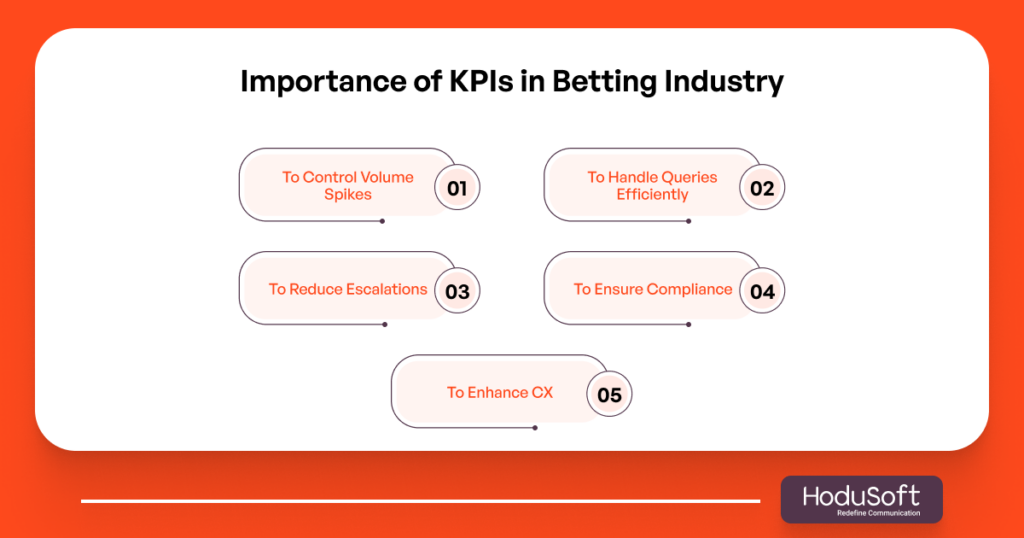
1. To control extreme volume spikes during live events
Betting platforms face sudden call and chat surges during match delays, payout issues, odds changes, and system glitches. The right KPIs help forecast these spikes, allocate resources better, and avoid long queues or abandonments.
2. To handle money-linked queries need faster
Withdrawal delays. Failed bets. KYC problems. These are high-stake issues. KPIs ensure agents respond quickly, resolve correctly, and maintain player trust when real money is involved.
3. High player emotions demand high sensitivity
Betting is emotional. Frustrated or excited players expect instant support. KPIs like sentiment score, FRT, and FCR help teams manage emotional volatility and reduce escalations.
4. Regulatory compliance leaves zero room for error
Age verification, self-exclusion, responsible gambling flags, and transaction checks must be handled precisely. Compliance-focused KPIs keep operations audit-ready and protect the operator from penalties.
5. Player loyalty depends on experience, not just odds
Support quality is a major differentiator in a crowded betting market. KPIs help refine the experience, reduce churn, and ensure players return after every match, win, or loss.
Advantages of Tracking KPIs in Betting Contact Center
Tracking KPIs in a betting contact center ensures faster resolutions, improved player satisfaction, and smoother operations. It helps teams manage call surges, optimize agent performance, and maintain compliance consistently.
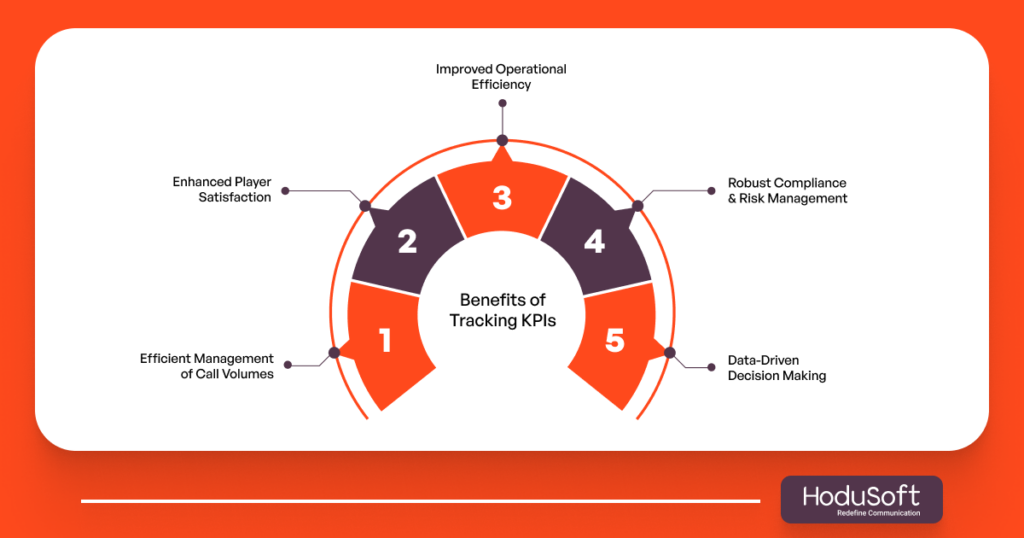
1. Better management of high call volumes
Tracking KPIs such as Average Speed of Answer (ASA), Average Handling Time (AHT), and Call Abandon Rate helps betting operators manage sudden call surges during live matches or payout issues. With real-time performance insights, supervisors can allocate agents efficiently, reduce queue times, and prevent service bottlenecks.
2. Improved player satisfaction and experience
KPIs such as Customer Satisfaction (CSAT), First Call Resolution (FCR), and Sentiment Score allow contact centers to measure how players feel after each interaction. By identifying gaps in tone, speed, and accuracy, operators can enhance the overall player experience and strengthen trust during money-related issues.
3. Enhanced operational efficiency
Metrics like Agent Utilization Rate, Occupancy, and Repeat Contact Rate help optimize workflows. Contact centers can identify underperforming areas, improve agent productivity, streamline call routing, and minimize unnecessary operational costs.
4. Stronger compliance and risk management
Tracking KPIs related to KYC handling, verification errors, responsible gambling cases, and compliance accuracy ensures adherence to regulatory requirements. This reduces the risk of fines, audit failures, and reputational damage within the betting industry.
5. Data-driven decision making for peak events
During tournaments, jackpot hours, or system outages, KPIs give leaders instant clarity. Metrics like Real-Time Queue Monitoring, Callback Rates, and Service Level help managers identify trends, predict rush periods, and proactively adjust staffing and routing strategies.
Important KPIs for Betting Contact Centers
Betting contact centers need to make sure that their operations are effective. They can do that by tracking some essential KPIs. Here are some important key performance indicators for betting contact centers.
1. Customer Satisfaction Score (CSAT)
The customer satisfaction score isn’t a feel-good metric. It’s the earliest signal that your customer service team is failing at maintaining customer satisfaction. If customer satisfaction drops even 5%, your customer retention rate dips almost immediately. CSAT reveals:
- Where customer interactions are breaking
- Whether support agents understand customer intent
- Which workflows create unhappy or satisfied customers
2. Average Speed of Answer (ASA)
Why it matters:
Betting contact centers see extreme spikes during match delays, server errors, or payout issues. ASA tracks how long players wait before an agent picks up.
Signs of trouble:
- Call abandon rate rising
- Queue frustration leading to negative reviews
- Angry social media complaints
The target benchmark should be 20-30 seconds. Anything more increases churn dramatically.
3. First Contact Resolution (FCR)
Nothing drains revenue like poor first contact resolution.
When FCR drops:
- Customer churn rate rises
- The entire team gets overloaded
- Customer support team costs spike
Repeat contacts explode across the same time period.
Improving your first call resolution rate fixes everything downstream: cost, satisfaction, speed, and overall customer service.
This is what the KPI executives should check daily.
High FCR equals fewer callbacks, less pressure on your team, and more trust from players. The ideal range should be 65%-80%, depending on complexity.
4. Queue Callback Rate (QCR)
Why this is specifically vital for betting:
Players dislike holding. Automated callbacks reduce queue abandonment and agent burnout. What QCR tells you:
- Whether your queues are consistently overloaded
- If your dialer/predictive dialer is optimized
- How many players preferred a callback over waiting
Pro tip: Pair QCR with automated callback systems to save thousands of agent hours.
5. First Response Time (FRT)
When money is on the line, players expect instant help. This KPI shows how quickly your team acknowledges a query on voice, chat, or WhatsApp.
What it influences:
- Reduces player anxiety
- Prevents escalations
- Increases trust during high-stake events
Ideal benchmark for betting should be less than 20 seconds for calls and less than 10 seconds for chat during peak hours.
6. Net Promoter Score (NPS)
“Happiness doesn’t grow your brand. Trust does.” The net promoter score (or net promoter score NPS) shows how strongly customers believe in your betting platform. If NPS falls, so does business growth.
NPS tells you:
- Whether players trust your platform
- If they’d recommend you
- How likely they are to make repeat purchases
It is a direct reflection of your customer relationships. NPS shows the likelihood a player will recommend the platform, crucial in a competitive industry with low switching costs. The ideal range of NPS should be between 10 to 30, depending on region.
7. Agent Utilization Rate
Betting demand is seasonal and unpredictable. Over-utilized agents burn out. Under-utilized agents inflate cost. This KPI tracks how efficiently agents are spending their login hours.
The ideal range of agent utilization rate should be 70% to 80% to maintain quality and reduce fatigue.
8. Call Abandonment Rate
“Why is the call abandonment rate critical?” If players hang up before talking to an agent, that’s a potential lost customer and a potential compliance risk if the issue was about KYC or money. High abandon rate means red flag for:
- Poor call routing
- Understaffing
- No callback mechanism
- Slow IVR
The healthy benchmark should be less than 5%.
9. Average Handling Time (AHT)
In betting, long AHT means long queues. Long queues mean lost players. But the goal is not short AHT. It’s balanced AHT. Balanced AHT ensures:
- Issue resolved fully
- No unnecessary call backs
Agents aren’t rushing and making mistakes. Track AHT along with FCR for better accuracy.
10. Compliance Error Rate
Regulators monitor how betting operators handle age-verification, fraud alerts, responsible gambling flags, and financial disputes.
Compliance errors can result in penalties, suspensions, or brand-damage. The compliance error rates track how often agents mishandle:
- KYC documentation
- Restricted territories
- Betting limits
- Self-exclusion cases
The ideal benchmark should be less than 2%.
11. Sentiment Score (AI-based)
AI can detect emotional cues in player messages, anger, urgency, panic during live matches. This KPI helps:
- Predict churn
- Route angry players to senior agents
- Identify fraud patterns
- Improve coaching and training
Operators using AI sentiment routing reduce escalations by up to 30%.
12. Customer Effort Score
Players don’t leave after a bad experience. They leave after a high-effort experience. If customers ask for support “Why is this so hard?” you’re already losing them.
The customer effort score shows how much effort customers spend fixing issues. CES spikes reveal:
- Complex verification flows
- Confusing payment resolutions
- Slow internal escalations
- Repeated steps across contact center touchpoints
Reducing customer effort increases customer loyalty, decreases churn, and makes the entire customer journey smoother.
How to Choose the Right KPIs for Your Betting Contact Center
Selecting the right KPIs isn’t about tracking everything. It’s about tracking what drives meaningful improvement. Here are the key considerations when choosing KPIs for your betting contact center:
1. Align KPIs with business goals
If your goal is improving player retention, track CSAT, NPS, and Repeat Contact Rate. If the focus is reducing wait time, prioritize ASA, AHT, and Queue Callback Rate.
2. Reflect real player behavior and expectations
Players expect instant responses when money is involved. Choose KPIs that measure responsiveness, such as First Response Time and Call Abandon Rate.
3. Include compliance-focused metrics
Regulated markets demand accuracy in identity checks, self-exclusion handling, and responsible gambling. KPIs should monitor compliance errors and verification handling time.
4. Prioritize quality over quantity metrics
Measuring agent speed without measuring resolution accuracy leads to rushed and repeated queries. Balance AHT with First Contact Resolution and Sentiment Score.
5. Ensure KPIs predict operational bottlenecks
Use KPIs like Real-Time Queue Monitoring, callback metrics, and forecast vs. staffing variance to detect performance gaps before they become service failures.
6. Choose KPIs that enhance agent productivity
KPIs such as Agent Utilization Rate, Occupancy Rate, and Coaching Time help ensure agents are neither overwhelmed nor underutilized.
7. Use KPIs that support continuous improvement
Metrics should help teams evolve. Not just report results. Trend-based KPIs like week-on-week performance, peak-hour CSAT, and system-related issue frequency provide insights for ongoing optimization.
Tips to Improve KPI Performance Over Time
Improving KPIs is not a one-time task. It takes consistent effort, the right tools, and continuous learning. Here are practical ways to make steady progress and build a high-performing betting contact center:
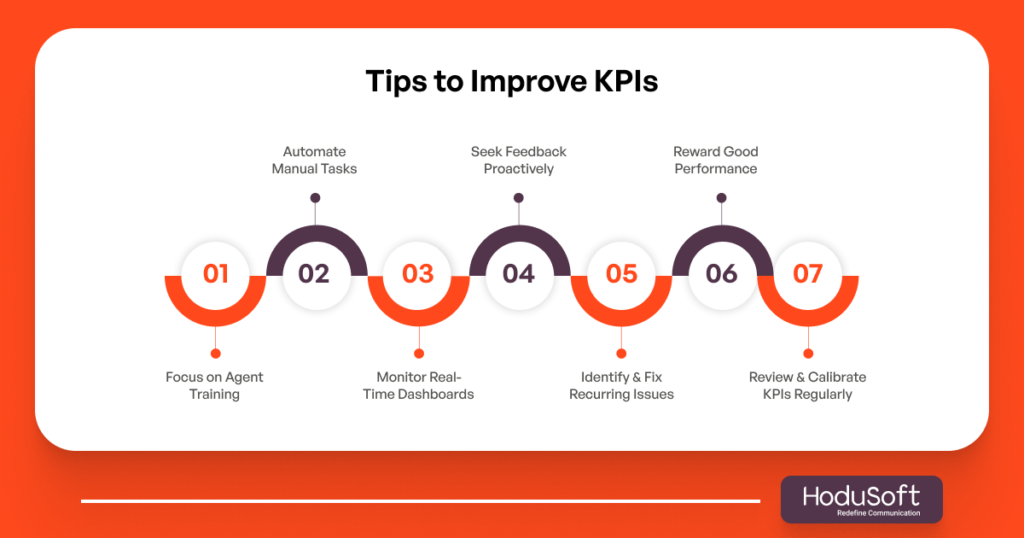
1. Train agents regularly
Continuous training helps agents stay confident, accurate, and fast. Focus on product knowledge, platform features, emotional communication, and compliance rules.
2. Use technology to reduce manual work
Tools like intelligent call routing, automated callbacks, AI sentiment analysis, and CRM integration help reduce delays and speed up resolution times.
3. Monitor real-time dashboards
Live dashboards help supervisors identify problems quickly. If queue times spike or call abandonment increases, the team can react immediately.
4. Encourage feedback and coaching
One-on-one feedback sessions help agents improve tone, accuracy, and handling time. Coaching builds confidence and reduces repeated mistakes.
5. Identify and fix recurring issues
If many players ask the same question about payouts or KYC, it may not be an agent problem. It may be a process or system issue that needs attention.
6. Reward improvements and good performance
Recognition works. Celebrate achievements like higher CSAT, improved FCR, or lower abandonment rate. Small rewards can motivate consistent performance.
7. Review and adjust KPIs periodically
The betting industry changes quickly. Review KPIs every quarter to ensure they still match current goals, regulations, and player expectations.
In Conclusion
KPIs are more than numbers on a dashboard. In a betting contact center, they guide performance, protect compliance, and shape the overall player experience.
By tracking the right metrics and continuously improving them, support teams can respond faster, resolve issues accurately, and build trust in moments when players need help the most.
With the right KPIs in place, betting operators stay proactive, efficient, and ready for every surge, season, and high-stakes moment ahead.
This is where HoduCC contact center software becomes valuable. HoduCC offers real-time dashboards, automated reporting, intelligent call routing, and AI-powered analytics that simplify KPI tracking.
Managers can monitor key metrics such as FCR, AHT, sentiment score, CSAT, queue wait time, and agent productivity from a single interface. Features like automated callbacks, omnichannel support, and customizable alerts help teams stay efficient during peak traffic and live events.
If you want to scale, maintain efficiency, and deliver fast support during peak load, then HoduCC provides the agility, automation, and analytics required to stay ahead.
If you want to know more about how HoduCC can improve your betting support operations, then contact us today.
Boost Your Betting Support Performance—Get Expert KPI Insights!
Frequently Asked Questions
Key KPIs include First Response Time (FRT), Average Speed of Answer (ASA), First Contact Resolution (FCR), Call Abandon Rate, and CSAT. These metrics directly impact player satisfaction and operational efficiency.
Betting involves money-sensitive issues, high emotional interactions, and sudden call spikes during live events. KPIs help teams stay prepared, compliant, and responsive under pressure.
KPIs highlight delays, repeated queries, and dissatisfaction early. By tracking CSAT, sentiment score, and FCR, operators can resolve issues faster and build trust with players.
Agent Utilization Rate, AHT, and Repeat Contact Rate help reveal training gaps, overwork, or underperformance, allowing managers to optimize workloads and coach agents effectively.
Compliance-related KPIs track KYC accuracy, verification errors, and responsible gambling interactions. This ensures agents follow strict guidelines and reduces the risk of penalties or audit failures.