
“Artificial intelligence and generative AI may be the most important technology of any lifetime.”
This quote by Marc Benioff, noted internet entrepreneur and the CEO of Salesforce, is also apt for IP PBX solutions.
AI and automation are reshaping how telecom providers deliver, scale, and manage communication services.
Especially within IP PBX hosted environments. The cost of not automating has become too visible to ignore.
In this blog, we will explore the challenges of not adopting AI and automation in telecom, how AI and automation are transforming IP PBX hosted services, and why providers must embrace this shift to stay competitive in a rapidly changing market.
Challenges of Not Adopting AI & Automation in Telecom

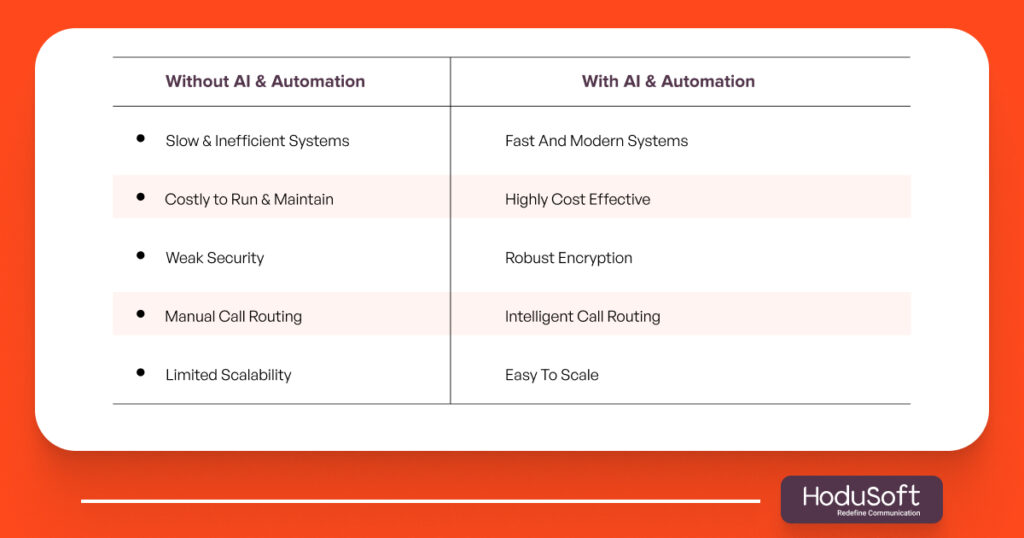
Not adopting AI and automation in 2025 is just similar to running a traditional phone system in an era of AI-powered PBX systems. It slows growth, increases operational costs, and exposes the network to failures your competitors have already automated away.
Telecom providers relying solely on manual processes and outdated IP PBX systems face a widening performance gap that directly impacts customer experience, uptime, and scalability. Here are the major challenges that emerge when telecom businesses delay AI integration:
1. Legacy infrastructure limitations and integration complexity
Without AI-driven modernization, telecom operators remain stuck with:
- Outdated private branch exchange (PBX) setups
- Limited IP connectivity
- Rigid routing rules
- Analog phones and old fax systems
- Fragmented business communication channels
This prevents the deployment of advanced features like intelligent call routing, predictive analytics, and machine learning-based network management. As communication data grows, legacy systems simply can’t keep up with real-time analysis or automated decision-making.
2. High implementation and maintenance costs
Manual configurations, repeated troubleshooting, and hardware-heavy setups inflate:
- Operational costs
- Maintenance workloads
- Resource allocation efforts
Automation reduces these drastically. Avoiding AI means continuing to pay teams for routine tasks such as updating routing tables, managing uptime, checking IP PBX performance, and handling predictable customer queries. Over time, the cost difference between automated and manual PBX operations becomes impossible to ignore.
3. Data security and compliance concerns
Telecom providers handle significant volumes of sensitive information, including voice data, customer identities, call logs, and biometric verification details. Without AI-driven security:
- Fraud detection slows down
- Abnormal activity goes unnoticed
- Compliance audits become manual and error-prone
- Authentication relies on outdated processes
AI supports proactive fraud prevention through voice recognition, anomaly detection, and automated compliance workflows. These are the capabilities traditional IP-based systems cannot deliver alone.
4. Limited in-house AI expertise and talent
Telecom operators that delay AI adoption face a widening talent gap. As competitors hire or upskill teams in:
- Artificial intelligence
- Machine learning
- Sentiment analysis
- NLP-driven automated assistants
Teams without AI proficiency struggle to manage modern IP PBX platforms, build AI powered communication workflows, or integrate unified communications solutions. Lack of talent eventually impacts scalability, innovation, and service reliability.
5. AI model accuracy, reliability, and trust issues
Avoiding AI implementation means missing out on systems that improve through:
- Data-driven decisions
- Learning from customer interactions
- Ongoing optimization
Modern AI driven systems use communication data to refine call routing, enhance caller intent understanding, and deliver consistent performance across voice, video conferencing, instant messaging, and other channels. Without AI, telecom providers rely on static rules.
6. Resistance to organizational and cultural change
Teams accustomed to manual workflows may resist AI because:
- Automation threatens established roles
- New tools require reskilling
- Leadership struggles to drive change
- Legacy processes feel “safer”
However, avoiding AI prolongs inefficiencies in handling phone calls, voicemail, call forwarding, and multi-device workflows. Telecom providers that fail to push cultural adoption fall behind competitors who deploy AI technologies to streamline operations and improve overall customer experience.
7. Scalability challenges for large user bases
Without AI, scaling a business phone system becomes a bottleneck. Some of the key scalability challenges include:
- Limited routing capacity
- Slow onboarding
- Manual configuration of PBX systems
- Inconsistent quality during high traffic
- No automation to balance loads
AI automates capacity planning, identifies bottlenecks, and helps providers deliver seamless communication even when user bases grow rapidly.
How AI Enhances Hosted IP PBX Services
AI isn’t just adding features to hosted IP PBX systems. It’s fundamentally transforming how telecom providers route calls, secure networks, scale user bases, and deliver unified communications.
Modern AI-powered PBX systems use machine learning, NLP, and real-time communication data to automate decision-making, reduce operational costs, and elevate the overall customer experience.
Below are the core enhancements AI brings to the next generation of IP-based business phone systems:
1. Predictive call routing for faster resolution
Traditional call routing follows static rules. AI-driven routing uses caller intent, past interactions, sentiment analysis, and real-time queue data to route calls to the right agent or automated assistant. AI improves:
- First-call resolution (FCR)
- Intelligent call routing accuracy
- Reduced wait times
- Overall customer experience
Predictive routing ensures every incoming call reaches the resource best suited to resolve it, human or automated.
2. Automated provisioning and system configuration
AI automates repetitive provisioning tasks that previously required manual engineer hours. This includes:
- Configuring new IP phones
- Updating SIP profiles
- Setting call forwarding rules
- Multi-device syncing
- Automatic QoS adjustments
Automating system configuration reduces deployment time, eliminates human errors, and supports scalable business phone system rollouts.
3. Real-time analytics for smarter decision-making
AI-powered analytics turn raw communication data into actionable insights. Hosted IP PBX systems can now provide real-time visibility into:
- Call trends
- Agent performance
- Network health
- Customer sentiment
- Capacity utilization
Telecom providers gain deeper understanding for data-driven decisions, enabling better resource allocation and improved operational efficiency.
4. AI-powered IVR and self-service capabilities
Traditional IVR menus frustrate customers. AI-driven IVR uses natural language processing (NLP) and voice recognition to understand requests conversationally. Benefits include:
- Human-like self-service
- Automated resolution of routine tasks
- Reduced load on human agents
- 24/7 support coverage
This transforms the IVR from a menu-based tree into an intelligent, self-learning system.
5. Enhanced fraud detection and security monitoring
AI significantly boosts security in IP PBX hosted services through:
- Anomaly detection
- Voice biometrics
- Real-time fraud monitoring
- Automated alerts for suspicious activity
- Pattern analysis of unauthorized access attempts
With increasing threats targeting VoIP, SIP channels, and UC platforms, AI helps telecom providers safeguard sensitive information, ensure compliance, and maintain trust.
6. Intelligent scalability and resource optimization
AI understands peak usage patterns and automatically adjusts resources across the hosted PBX environment. Capabilities include:
- Auto-scaling for high call volumes
- Bandwidth optimization
- Dynamic routing load balancing
- Predictive capacity planning
This ensures seamless communication even as user bases expand, preventing outages and improving reliability.
7. Improved customer experience through personalization
AI analyzes customer history, behavior, sentiment, and communication preferences to personalize interactions. This enables:
- Personalized greetings
- Context-aware suggestions
- Better caller-agent matching
- Faster resolution paths
Personalization drives a stronger overall customer experience, reduces churn, and increases customer satisfaction across voice, chat, and instant messaging channels.
Key Advantages of AI-Driven Hosted PBX
AI-driven Hosted PBX solutions are transforming business communication by bringing automation, intelligence, and scalability into everyday calling workflows. Here are the key advantages:
1. Reduced operational costs through automation
AI automates routine PBX tasks. This means fewer repetitive tickets, fewer human errors, and a PBX that practically manages itself. As per a study, AI automation can cut telecom operational costs by 20–40%.
2. Faster response and resolution times
Speed wins. Delay always loses trust. With AI-powered call routing and intelligent IVR, customers reach the right agent or self-service path instantly. As per a stat, agentic AI will autonomously resolve 80% of common customer service issues without human intervention by 2029.
3. Higher call accuracy and routing efficiency
AI algorithms analyze caller intent, history, and behavior to route calls with higher precision. This improves routing accuracy, reduces misrouted calls, and boosts overall PBX performance. Right routing. Fewer mistakes. Happier customers.
4. Improved scalability without added infrastructure
Hosted PBX systems enhanced with AI can scale user capacity by up to five times instantly. No new servers. No new racks. Just pure cloud elasticity.
5. Enhanced customer satisfaction and personalization
AI analyzes caller behavior, sentiment, and history to tailor every interaction. By leveraging AI, businesses can deliver personalized communication experiences.
According to Deloitte, personalized communication experiences can increase customer satisfaction by 20% and customer loyalty by up to 15%.
6. Real-time monitoring and performance optimization
AI provides real-time analytics, QoS tracking, anomaly detection, and performance insights to help IT teams optimize bandwidth, call flows, and system health proactively. When insights appear instantly, fixes follow immediately.
7. Increased reliability with predictive maintenance
AI identifies hardware failures, network issues, and performance degradation before they impact users. Predictive maintenance powered by AI cuts unplanned outages by 30-40%.
Best Practices for Seamless AI Integration

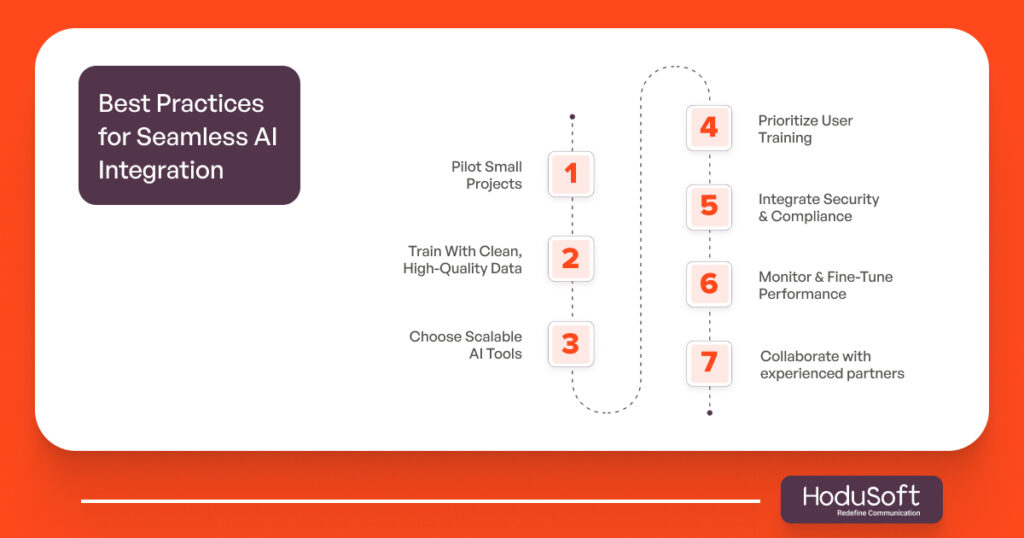
Integrating AI into IP PBX systems requires thoughtful planning and execution. It’s about alignment. The right approach ensures smooth adoption, better performance, and long-term value. Here are some best practices:
1. Start with small pilot projects before full rollout
Begin with controlled pilot deployments instead of implementing AI across the entire telecom or PBX ecosystem at once. Pilot projects help validate feasibility, expose technical gaps, and demonstrate early ROI.
According to McKinsey, organizations that adopt a pilot-first approach see 2-3× higher AI success rates, making scaling far more predictable and stable.
2. Ensure clean, high-quality data for model training
AI performance heavily depends on the quality of the data it is trained on. Poor, unstructured, or inconsistent data leads to inaccurate predictions and unreliable automation outcomes. Bad data kills even good AI.
Gartner reports that nearly 80% of AI failures stem from bad data, highlighting the need for strong data hygiene, governance, and validation frameworks.
3. Choose scalable AI tools that support future growth
Select AI solutions built on cloud-native, modular, and API-friendly architectures that can scale as your user base, call volumes, or business locations grow.
Scalable systems can handle sudden traffic spikes up to 5× more efficiently, ensuring uninterrupted service delivery as communication needs evolve.
4. Prioritize user training and change management
Human adoption is one of the biggest determinants of AI success. Without proper training and internal alignment, even the most advanced tools fail to deliver impact.
Research by BCG shows that 70% of digital transformation failures are caused by organizational resistance rather than technical limitations. Training programs, internal documentation, and change champions help ease this transition.
5. Integrate security and compliance from day one
AI integration must follow strict compliance frameworks, especially for telecom operators handling sensitive communication data. Embedding encryption, role-based access control, audit trails, and regulatory alignment early prevents vulnerabilities later.
IBM’s security research reveals that systems without early security planning face three times higher breach risks.
6. Continuously monitor and fine-tune AI performance
AI models degrade over time due to data drift, changing user patterns, or outdated training sets. Continuous monitoring helps detect anomalies, optimize accuracy, and improve response quality.
Studies show that unmonitored AI systems can lose up to 15% accuracy within months, making ongoing evaluation essential.
7. Collaborate with experienced technology partners
Good partners guide. Great partners transform. Working with seasoned AI and telecom technology providers significantly reduces integration risks. These partners bring proven frameworks, ready-to-deploy modules, and industry-specific expertise that accelerate time-to-value.
Businesses that collaborate with expert providers report 40-60% faster AI deployment and fewer operational bottlenecks.
How to Handpick the Right AI-Enabled PBX Provider
Selecting the right AI-enabled PBX provider goes beyond features and pricing. It requires evaluating long-term value, scalability, and support. The right choice can future-proof your communication infrastructure and accelerate digital transformation. Here are some steps to choose the right AI-enabled PBX provider:
1. Check the provider’s AI maturity and real-world deployments
Start by evaluating how mature the provider’s AI-powered PBX capabilities actually are. Ask for case studies, live demos, and proof of large-scale deployments. Providers with established AI frameworks, NLP-driven call flows, predictive routing, and proven automation success offer far more reliability than vendors using basic or shallow AI add-ons.
2. Evaluate integration compatibility with your existing systems
The right AI-enabled PBX provider should integrate seamlessly with your existing CRM, ticketing, ERP, UCaaS, SIP trunks, and communication workflows. API-first architecture, pre-built connectors, and flexible integration options ensure no downtime, no data loss, and no disruption to your business communication ecosystem.
3. Look for advanced automation features beyond basic AI
Avoid providers that only offer simple IVR or rule-based routing. Modern AI-driven PBX systems should include advanced automation such as predictive call routing, AI-generated analytics, sentiment analysis, automated provisioning, smart voicemail transcription, and real-time anomaly detection. These capabilities define the future of intelligent communication systems.
4. Compare scalability, performance benchmarks, and uptime guarantees
A capable provider should offer cloud-native scalability, low-latency routing, and the ability to handle call surges effortlessly. Look for 99.95%-99.999% uptime SLAs, load balancing support, and proven performance benchmarks across large user bases. This ensures your IP PBX grows with your business without performance drops.
5. Assess transparency in pricing and long-term cost benefits
Choose a provider with clear, predictable pricing models. No hidden fees for AI add-ons, usage spikes, or feature access. The right AI-powered PBX platform should reduce long-term operational costs through automation, lower maintenance overhead, and improved resource utilization.
6. Confirm the availability of dedicated support and training
AI adoption is only successful when your teams understand how to use it. Ensure the provider offers onboarding support, training sessions, technical documentation, and round-the-clock assistance. Strong support reduces friction, accelerates adoption, and improves system ROI.
7. Verify ongoing innovation, updates, and roadmap alignment
The telecom landscape evolves fast, and your provider should keep pace. Evaluate how frequently they roll out updates, what their AI roadmap looks like, and whether their innovation aligns with your future communication needs. Providers committed to continuous improvement ensure your AI-enabled PBX system stays competitive over time.
Taking Everything Into Consideration,
Smarter call routing. Real-time data. Automated workflows. Consistent uptime. And a personalized customer experience that legacy systems can’t match. AI-driven hosted IP PBX transforms your phone system into a strategic asset.
That’s why a solution such as HoduPBX matters. HoduPBX brings together cloud-native scalability, advanced automation and AI capabilities, multi-tenant flexibility, and strong support.
By leveraging telecom providers, MSPs, and enterprises can skip the maintenance headaches and build a future-ready communication infrastructure.
If you’re ready to move beyond cost-cutting and step into operational excellence, growth readiness, and superior customer experience, now is the time to evaluate and switch to a robust AI-enabled Hosted PBX platform.
Start the transformation. Choose intelligence. Choose reliability. Choose HoduPBX.
Discover how AI-powered IP PBX is reshaping telecom services
FAQs
An AI-enabled PBX system is a modern cloud-based business phone solution that uses artificial intelligence for call routing, analytics, automation, fraud detection, and self-service. It enhances traditional PBX functions by adding intelligent decision-making, predictive insights, and automated workflows.
AI analyzes caller intent, past interactions, sentiment, and agent availability to route calls more accurately and faster than traditional rule-based systems. This reduces wait times, improves first-call resolution, and delivers a more personalized customer experience.
Not necessarily. While initial integration may require investment in data, training, and configuration, AI dramatically reduces long-term operational costs by automating routine tasks, minimizing manual intervention, and improving system efficiency. Most providers see measurable ROI within months.
Yes. Cloud-native AI PBX platforms offer instant scalability, allowing you to add users, locations, or phone lines without new hardware. AI also optimizes resource usage to handle call surges efficiently, making it ideal for enterprises, remote teams, and multi-site operations.
Modern AI-enabled PBX providers use end-to-end encryption, biometric authentication, anomaly detection, and real-time fraud monitoring to ensure data privacy. AI enhances security by identifying suspicious patterns early and preventing unauthorized access or VoIP fraud.