
Every online betting and gaming company knows the scene too well. A sudden glitch during a live bet, a delayed withdrawal, or a suspicious account lock. Within seconds, their contact centers are flooded with calls, chats, and messages filled with frustration.
When stakes are high and response times lag, even the most loyal players can lose patience. But what if AI could predict player rage before the customer even says a word?
That’s where AI-powered sentiment analysis comes in. It helps businesses understand customer emotions, detect negative sentiment, and provide real-time insights into how customers feel during customer interactions. By analyzing the emotions expressed in voice tone, speech patterns, and language, AI can give customer service teams the power to respond appropriately and improve overall service quality.
In this blog, we’ll explore how AI-driven sentiment analysis is reshaping call centers, enhancing customer satisfaction, and even preventing emotional escalations before they happen. Read on and thank us later.
What Is Sentiment Analysis?
Sentiment analysis, also known as emotion detection, is a powerful tool that allows companies to understand how customers feel during conversations.
It uses machine learning models and natural language processing (NLP) to analyze speech, text, and tone to determine whether the customer’s sentiment is positive, negative, or neutral.
In simple terms, sentiment analysis helps businesses “read between the lines.” It interprets underlying feelings, emotional tone, and voice sentiment from calls or messages.
Example: When a customer expresses frustration, their voice pitch might rise, or their words may become shorter and sharper. An AI sentiment analysis model can detect these subtle cues in real time and alert the call center agent that the customer is agitated.
This allows the agent to adjust their communication strategy, empathize, and take steps to improve customer satisfaction before the situation escalates.
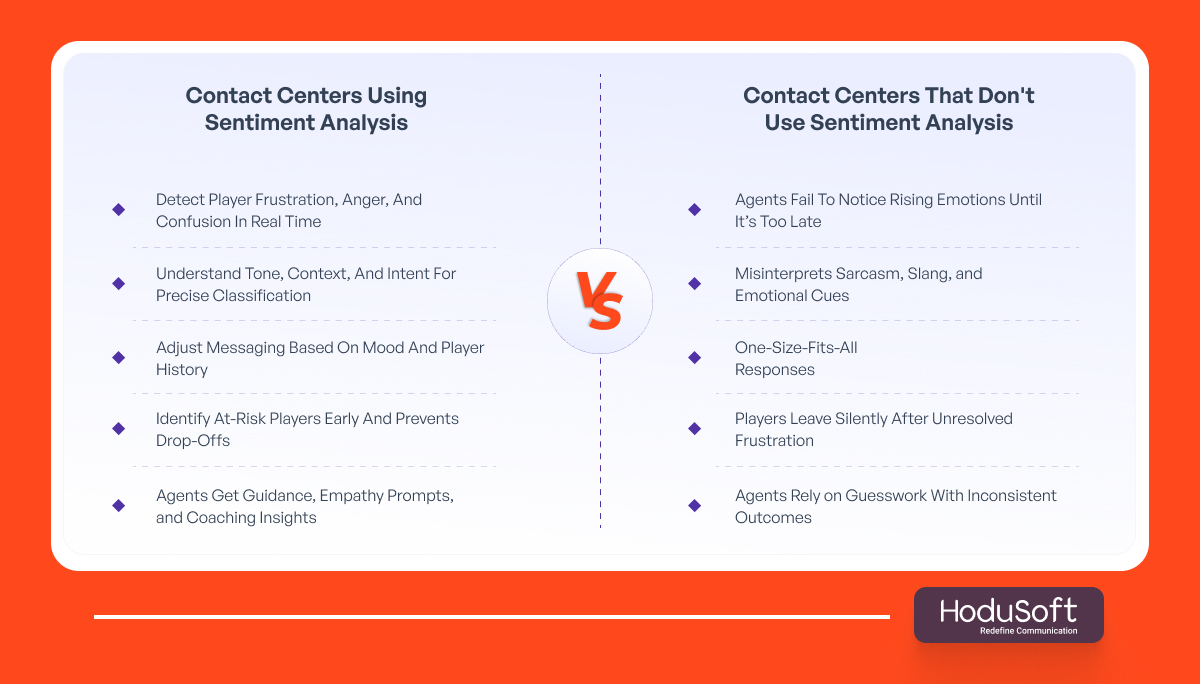
Contact Centres With vs Without Sentiment Analysis
Why Traditional Contact Centres Fail to Detect Player Emotions
Traditional contact centres rely on outdated tools and manual monitoring, which makes it hard to understand how players truly feel. Here are some reasons why traditional contact centres fail to detect player emotions.
1. Limited visibility into emotional cues across channels
Traditional systems only capture the words players type or say, not the tone, urgency, pacing, or context behind them. Without emotional intelligence, agents miss the early signs of frustration building.
2. Manual monitoring can’t keep up with high volumes
Gaming and iGaming platforms handle thousands of chats and calls during peak hours. Human supervisors simply can’t monitor everything, which means critical emotional shifts go completely unnoticed.
3. Static scripts don’t adapt to player mood
Legacy contact centres rely on fixed scripts that sound robotic during emotionally charged moments. When players are irritated or confused, generic responses can escalate anger rather than defuse it.
4. No real-time insight into escalation patterns
Most traditional setups only record interactions for post-call review. They lack real-time analysis that shows when a player’s sentiment is dropping. It leaves agents blind to imminent rage or churn risks.
5. Agents rely on guesswork, not data
Without sentiment data, agents must interpret emotions based on hunches or limited experience. Misreading a player’s mood (especially sarcasm or gaming slang) is common and often leads to mishandled conversations.
6. Delayed supervisor intervention
Supervisors only step in after agents raise flags, often when the situation has already gone bad. Without automated alerts, teams miss the opportunity to recover the player before they rage-quit or leave negative reviews.
7. No unified view of player history or frustration trends
Traditional systems don’t combine past complaints, ticket frequency, or behavioural patterns. Without this context, agents can’t see whether a player is a chronic complainer or someone hitting a frustration limit for the first time.
Did you know?
As per a
study
, 48% of gamers report that they have experienced frustration due to lack of support for technical issues. As per another
research
, 62% of active gamers say that player support for console games is outdated; console rated the worst platform for customer support experience.
How AI Detects Player Rage Before It Happens

Predicting rage is not just about detecting angry words. AI models go deeper, analyzing several emotional indicators:
1. Tone of voice (for voice interactions)
In voice calls, AI monitors pitch, volume, and pace. A sudden rise in pitch or a sharp tone can signal growing irritation.
2. Word choice and repetition
Repeated complaints, sarcasm (“sure, this always works out well”), or emotionally charged words (“ridiculous,” “unfair,” “again?”) flag potential escalation.
3. Response patterns
Players typing faster or using shorter, curt messages during chat sessions often indicate agitation.
4. Behavioral trends
AI maps player history starting from number of tickets raised, issue frequency, and time spent waiting to gauge if the player is nearing frustration fatigue.
By combining these layers, AI sentiment models can predict emotional states with surprising accuracy, sometimes before the player consciously realizes their own rising
How AI-Powered Sentiment Analysis Works

AI-powered sentiment analysis evaluates player messages, tone, and behaviour in real time to detect emotional cues. It identifies frustration early and predicts escalation. Here is how AI-powered sentiment analysis works.
1. Data collection and training
AI systems are trained on millions of customer interactions such as emails, chats, and voice recordings across industries and languages. Using training data, they learn how different words customers use, tones, and pauses reflect various emotional responses.
2. Detecting emotions and sentiment scores
Once deployed in a call center, the AI listens to or reads ongoing customer interactions. It assigns sentiment scores to each conversation ranging from -1 (negative) to +1 (positive). These scores reflect the customer’s voice, speech patterns, and overall emotional context.
3. Real-time insights for agents
With real-time sentiment analysis, agents can see a live “mood meter” of each conversation. If the sentiment score drops suddenly, it signals that the customer’s sentiment has turned negative. It allows the agent to respond appropriately.
4. Post-interaction analysis
After the call, post-interaction data is analyzed to identify patterns of frustration, positive feedback, and common customer issues. Managers can use these insights for targeted coaching and improving agent performance.
Sentiment Analysis in Online Betting & Gaming Contact Centers
Online betting platforms are highly emotional environments. Wins and losses trigger intense human emotions from excitement to anger often in seconds.
In such high-stakes settings, AI-powered sentiment analysis can make a massive difference.
Here’s how it helps:
- Detect negative sentiment early during heated interactions
- Help call center agents de-escalate emotional situations
- Provide real-time feedback to supervisors
- Improve overall service quality
- Capture valuable insights from thousands of customer calls
By analyzing sentiment across player conversations, gaming companies can understand what frustrates players most such as delays, payouts, or technical glitches and take informed decisions to fix root causes.
How AI Sentiment Analysis Benefits Online Betting & Gaming Companies
AI sentiment analysis helps gaming and betting companies in the following ways.
1. Improved retention
Early detection of player frustration allows teams to intervene before players quit or rage-post online.
Also read: Effective Strategies for Enhancing Customer Retention in Call Centers
2. Better compliance and fair play reputation
By maintaining consistent, emotionally intelligent responses, brands strengthen trust. It may seem inconsequential at first, but it’s essential in a regulated space.
3. Reduced agent burnout
When AI flags emotional intensity, supervisors can redistribute workload or assist agents before conversations spiral out of control.
4. Enhanced personalization
Emotion data can be integrated into CRM systems, allowing tailored offers or messaging based on a player’s mood profile.
5. Predictive insights
Over time, companies can forecast when support volumes and frustrations might spike, such as after game updates or payout delays.
AI Sentiment Analysis: Measuring Emotions in Every Customer Interaction
Sentiment Analysis Best Practices for Online Betting & Gaming Contact Centres
Effective sentiment analysis requires the right approach. These best practices ensure accurate emotion detection, faster responses, and consistently better player experiences.
1. Train your models on industry-specific data
Generic sentiment models struggle with gaming slang, sarcasm, abbreviations, or heated player expressions. Use domain-trained datasets (gaming, iGaming, telecom, customer-support chats).
2. Combine text and voice sentiment for higher accuracy
Text alone is not enough. Voice interactions reveal emotions through:
- pitch spikes
- pauses
- rushed speech
- volume increases
Multimodal sentiment detection increases precision by 30-40% in many contact-centre environments.
3. Detect escalation patterns, not just words
A single angry word doesn’t equal “rage.” Consider emotional patterns over time:
- repeated complaints
- repeated contact attempts
- shorter messages over time
- faster typing speed
- long silence followed by abrupt replies
These patterns predict escalation before it happens.
4. Use real-time alerts to prevent player rage
Sentiment AI should trigger:
- priority routing
- supervisor alerts
- script recommendations
- empathy prompts
- cooling-off workflows
If AI detects a frustration spike, it must immediately prompt the agent.
5. Combine sentiment with context for real emotional intelligence
Emotions do not exist in isolation. A player’s issue history, recent outages, payout delays, past negative interactions, or VIP status all influence sentiment. Without this context, emotion detection becomes inaccurate and easily misclassified.
6. Avoid over-automation during high-emotion moments
When frustration peaks, bots can make the situation worse. High-emotion interactions should automatically shift to human agents with AI providing real-time guidance. This helps prevent escalation and improves resolution quality.
7. Use sentiment insights in quality monitoring
Sentiment data helps identify which agents calm players effectively and which responses trigger negative reactions. It also highlights coaching needs and improves scripts for future interactions.
Taking Everything Into Consideration,
Player rage isn’t just a moment of frustration. It’s a signal that something in the experience needs attention. With gaming environments becoming faster, more competitive, and more emotionally charged, contact centres can no longer afford to operate blindly.
AI-powered sentiment analysis gives support teams the real-time emotional intelligence they’ve been missing, helping them detect frustration early, respond with empathy, and protect player satisfaction before it’s too late.
By combining predictive insights, emotion-aware routing, and smarter agent assistance, sentiment analysis transforms every interaction into an opportunity to build trust, reduce churn, and elevate the player experience.
As gaming brands look to deliver support that’s as dynamic and responsive as their players, investing in modern, AI-driven contact centre technology is no longer optional. It’s essential.
If you are curious to know how HoduCC contact center software can help you address customer rage, contact our team today and book a free demo.
Want to detect player rage before it escalates? See HoduSoft in action
Frequently Asked Questions
AI sentiment analysis evaluates tone, word choice, typing patterns, and player history to identify rising frustration before it becomes full-blown rage.
Yes. Modern AI models analyse voice tone, pitch, pacing, and textual cues simultaneously. Multimodal sentiment detection provides a far more accurate picture of player emotions than text-only analysis.
When models are trained on industry-specific vocabulary, language, abbreviations, sarcasm, and high-emotion gaming, accuracy is significantly higher.
Agents receive real-time cues such as empathy prompts, tone suggestions, or escalation alerts. After the conversation, supervisors can review sentiment timelines to identify coaching needs, improve scripts, and refine de-escalation strategies.
Not if implemented correctly. Ethical platforms anonymise data, follow GDPR and gaming authority regulations, and only analyse conversations for service improvement.
