
If you’ve been following the explosion of online betting, you know it’s not just about odds, bonuses, or slick app design anymore. Increasingly, language is becoming a make-or-break factor. As betting platforms expand globally, offering multilingual betting support isn’t just a nicety; it’s a necessity.
In this blog, we’ll explore why language matters in betting, what happens when you don’t support it, and practical ways to scale multilingual support – especially in a regulated, high-stakes world.
We’ll also dive into how betting companies can leverage modern betting communication solutions, a multilingual IVR system, a multilingual chatbot for betting apps, and omnichannel support for betting using top-tier omnichannel CX suite strategies.
What Is Omnichannel Support?
Omnichannel support means giving your users a seamless, integrated experience across all communication channels - whether it's phone, live chat, email, social media, or in-app messaging. Regardless of how a customer reaches out, the interaction feels consistent, contextual, and unified.
Why Multilingual Support is Important in Betting
1. Builds Trust and Reduces Cognitive Friction
Communicating in a player’s native language is more than a courtesy; it builds trust. When bettors can read terms, resolve disputes, or ask questions in a language they’re comfortable with, their confidence goes up. That clarity reduces misinterpretation, which is especially important in betting, where rules and payout procedures can be complex.
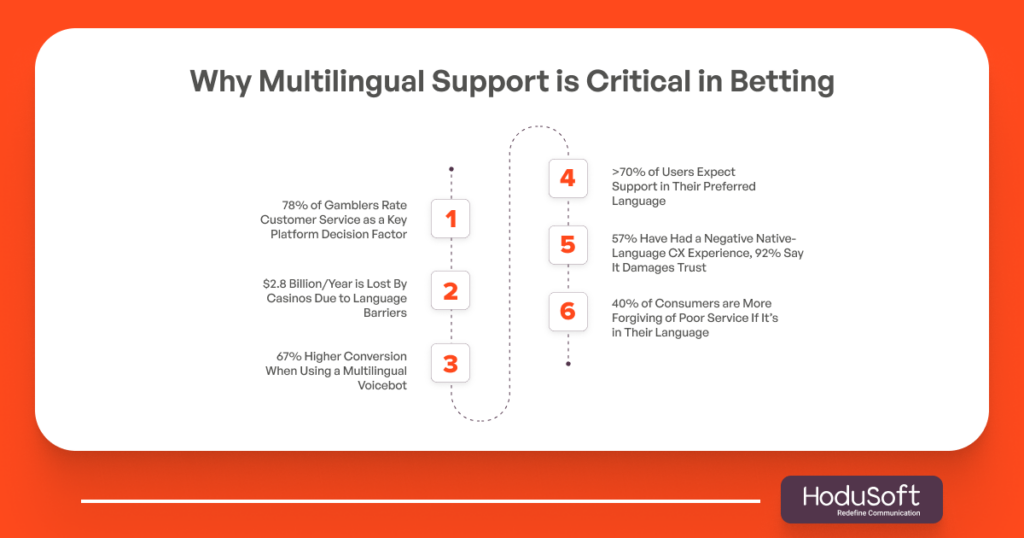
According to a report, over 70% of customers expect support in their preferred language. This means not having that support is a missed opportunity to build loyalty.
2. Improves Retention and Reduces Churn
Language barriers are a big friction point. Research in the gambling space suggests that a significant fraction of players abandon customer service interactions or even entire platforms because they can’t communicate clearly in their language.
On the flip side, when betting platforms adopt effective multilingual communication solutions, customer lifetime value (LTV) improves because players feel understood, respected, and confident that their issues will be addressed promptly.
3. Unlocks Global Markets & Revenue
As betting companies grow, they aim to enter new geographical markets. But each region brings its own linguistic landscape. By supporting multiple languages, you dramatically expand your potential user base.
Platforms that skip native-language service in key markets risk leaving billions of dollars on the table. For instance, one voice-AI provider for casinos estimates that language barriers cost global casinos $2.8 billion annually.
4. Ensures Compliance & Cultural Sensitivity
Some regulated markets require local-language support. Beyond legal compliance, speaking a user’s language demonstrates cultural sensitivity. Tailoring messages, support flows, and even promotions to local idioms and cultural norms goes a long way.
Plus, providing multilingual resources – FAQs, help centers, self-service portals- helps you reduce load on live agents and reduces the risk of miscommunication. Helpshift’s research shows that offering support in native tongues reduces misunderstandings and boosts efficiency.
5. Enhances Loyalty via High-Quality CX
Offering multilingual support isn’t just about translation; quality matters. According to Unbabel’s Multilingual CX Report, 57% of people have had a bad brand experience in their native language, and 92% say poor native-language customer service damages trust.
This means that simply offering support in many languages isn’t enough; you need high-quality, culturally aware, and consistent support.
Key Elements of Effective Multilingual Betting Support

To scale multilingual betting support, betting operators should build on several critical components.
A. Multilingual IVR System
An interactive voice response (IVR) system that supports multiple languages is a foundational piece of betting communication solutions. When a user calls, they can navigate menus in their own language, choose options, and even connect to agents who speak that language.
Why it matters:
- Reduces frustration from not understanding menu options
- Helps route users to the right team efficiently
- Gives a professional, localized feel from the very first touchpoint
As Qcall.ai’s case study shows, their multilingual voicebot supports 20+ languages with very high accuracy, leading to 67% higher conversion and improved satisfaction.
B. Omnichannel Contact Center Software for Betting
To truly manage multilingual customer service at scale, you need omnichannel contact center software for betting. This means a system where all channels (voice, chat, email, social) are integrated, and crucially, where language context travels across them.
- A customer who begins to chat in Spanish should be understood by voice agents if they call later.
- Unified historical data ensures more personalized, efficient responses.
- Agents don’t need to ask customers to repeat information when switching channels, improving first-contact resolution.
C. Multilingual Chatbot for Betting Apps
Chatbots are often the first line of support in-app. Having a multilingual chatbot for betting apps – powered by NLP and trained for betting-specific vocabulary can handle vast volumes of queries in a range of languages.
- Scales without linearly increasing agent headcount
- Provides 24/7 assistance for common issues (account balance, deposits, odds explanations)
- Frees up human agents for complex or emotionally sensitive interactions
Case in point: Betsson Group implemented Ada’s multilingual chatbot, automating content in English and translating into six other languages, helping them support a global audience with less friction.
D. Multilingual Self-Service Content & Knowledge Base
Self-service is a hugely underused lever in the betting industry. Users want FAQs, help articles, and knowledge bases, but not just in English. Localized self-service content (translated or native) means users can help themselves, reducing pressure on live support teams.
- Reduces ticket volume for routine issues
- Increases customer satisfaction and trust, they feel empowered
- When well translated or localized, it reduces misunderstandings better than machine-only translation
Help centers that are multilingual also allow for region-specific content – e.g., different regulatory rules, payment methods, and betting promotions tailored to language/market. Helpshift emphasizes localizing self-service for better efficiency and quality.
E. Multilingual Analytics & Quality Assurance
To maintain quality, you need to analyze and monitor interactions across languages. That means:
- Tracking KPIs like first contact resolution, CSAT (customer satisfaction) per language, and resolution time.
- Quality assurance with native or fluent evaluators to ensure translations or agent responses are correct and culturally appropriate.
- Feedback loops so that self-service content, IVR scripts, and chatbot replies are continuously improved.
- Without QA, even a “multilingual” service can feel broken or robotic
- Insights from language-specific metrics help you allocate resources smartly (which languages/times need more coverage)
- Helps avoid the trap of poor native-language service, which can damage trust more than not offering the language at all, as seen in the Unbabel report.
Challenges in Scaling Multilingual Betting Support and How to Overcome Them
Scaling such support isn’t trivial. Here are common challenges, and how to tackle them:
- Agent Recruitment & Training
- Challenge: Hiring native or bilingual agents is expensive and often difficult, especially for less common languages.
- Solution: Use a hybrid approach. Combine human agents for top-tier languages with AI-powered voicebots or chatbots for others. Use on-the-job training and translation tools to boost efficiency.
- Consistency Across Languages
- Challenge: Ensuring that terms, promotions, and rules remain consistent in translation. Mistranslated wagering terms can create legal risk or player frustration.
- Solution: Use a translation management system (TMS) and native-language reviewers. Establish style guides and glossaries for betting-specific terms.
- Cultural Nuances
- Challenge: Direct translation often fails to convey cultural context – idioms, tone, even humor can go wrong.
- Solution: Localize content (not just translate). Use native speakers in your localization team. Test with real users in different regions.
- Operational Cost
- Challenge: Budget constraints when expanding support in many languages.
- Solution: Start with languages that yield the highest return (market analysis). Implement AI tools first, scale human agents gradually. Use metrics to justify additional hiring.
- Regulatory Compliance
- Challenge: Betting regulations differ across regions; support must align with local legal requirements.
- Solution: Map regulatory requirements per locale. Train agents on local compliance. Include relevant policies in self-service content.
Real-World Evidence: Why It Works
- Retention & Revenue Boost: The Qcall.ai voicebot case (supporting 20+ languages) improved conversion by 67% and boosted customer satisfaction.
- Player Preference Stats: In the iGaming industry, 60% of players say multilingual customer support is desirable.
- Quality Matters: According to Unbabel’s report, poor native-language support damages trust, but high-quality, consistent multilingual CX can actually result in greater customer tolerance. Nearly 40% of consumers are likely to overlook poor service if it’s in their native language.
- Operational Efficiency: Helpshift found that multilingual support through real-time translation and AI reduces first response time by over 40%.
- Compliance & Speed: According to CCMA’s Good Practice Guide, only about one in five contact centers measure the quality of non-primary-language interactions, yet 75% of customers say they’d become repeat customers if they were served in their native tongue.
Scaling Strategy: A Step-by-Step Framework
Here’s a practical roadmap for betting businesses that want to scale multilingual CX:
- Market Research & Prioritization
- Identify top geographies by user volume, revenue potential, churn risk, and language demand.
- Prioritize languages with the highest ROI or regulatory necessity.
- Identify top geographies by user volume, revenue potential, churn risk, and language demand.
- Adopt a Hybrid Support Model
- Deploy voicebots and chatbots for broad language coverage.
- Hire native-speaking agents for key markets.
- Use betting communication solutions (IVR, chatbot, ticketing) in an integrated way.
- Deploy voicebots and chatbots for broad language coverage.
- Build an Omnichannel CX Suite
- Implement omnichannel contact center software.
- Ensure context continuity: chat → voice → email transitions don’t disrupt conversation.
- Integrate analytics so language-based insights are visible in one dashboard.
- Implement omnichannel contact center software.
- Design Multilingual Self-Service
- Localize your help center, FAQs, and knowledge base.
- Translate all key content: deposits, promotions, rules, payout processes.
- Use TMS and native-language experts to make translations precise and culturally relevant.
- Localize your help center, FAQs, and knowledge base.
- Quality Assurance & Continuous Improvement
- Establish QA processes with native speakers.
- Collect CSAT per language.
- Use user feedback to refine IVR scripts, chatbot responses, and knowledge base content.
- Establish QA processes with native speakers.
- Operational Scaling & Training
- Train support teams in both betting domain knowledge and language skills.
- Continuously update translation glossaries (e.g., “rollover,” “wagering requirement,” “parlay”) to ensure term consistency.
- Scale in phases: pilot in a few languages → measure → expand.
- Train support teams in both betting domain knowledge and language skills.
- Regulatory Alignment & Compliance
- Work with legal/compliance to ensure support meets local language disclosure laws.
- Translate or localize compliance documents (T&Cs, responsible gambling policies) properly.
- Work with legal/compliance to ensure support meets local language disclosure laws.
Conclusion
Language is mission-critical. Offering multilingual betting support through robust betting communication solutions, such as a multilingual IVR system, a multilingual chatbot for betting apps, and omnichannel support for betting, is key to winning trust, improving retention, and scaling across markets.
When you combine these tools within an omnichannel CX suite, backed with thoughtful localization, analytics, and quality assurance, you’re not just supporting a diverse player base; you’re building a competitive edge.
If you’re ready to scale your multilingual contact centre, we can help you with multilingual contact center software that can help you deliver world-class support without compromising on efficiency.
Ready to scale your betting support? Explore our multilingual CX solutions today.
FAQs
It depends on your market. Start by analyzing where you have the most users or the biggest growth potential. Prioritize languages based on volume, regulatory needs, and churn risk.
Not necessarily. A hybrid model, combining multilingual chatbots, voicebots, and native agents, often offers the best balance of cost and quality.
They help players navigate support menus in their own language, reducing frustration and routing them more efficiently to the correct team – whether it’s payments, technical help, or general queries.
Machine translation (especially with AI) can help scale, but it’s not enough on its own. You’ll need localization and native speaker review to ensure accuracy, especially for high-stakes or regulatory content.
Track KPIs like CSAT per language, first-contact resolution rate, average response time, and retention metrics. Use analytics in your contact center and feedback tools to continuously optimize.
