

How MSPs Can Reduce Ticket Volume with an Intelligent Contact Center Platform
Whenever clients face any issue with their Managed Service Providers (MSPs), they raise a support request, which is also known as ticket. Until and unless the issue is resolved, the ticket remains open.
For MSPs, the goal is to have as few tickets in the ‘Open’ status as possible. Customers expect fast responses. The issues must be resolved, and the open tickets should be closed, as fast as possible. If too many tickets begin to pile up in the portal, it can be overwhelming.
Just picture this: The phones ring incessantly. Alerts pile into the inbox. The ticket portal lights up. Every day feels like a sprint against time.
To address this, MSPs must rethink traditional call center setups and move toward intelligent contact centers powered by artificial intelligence, natural language processing, machine learning, and intelligent call routing systems.
Today’s most successful MSPs use intelligent routing, AI-powered solutions, and advanced routing systems to transform customer service operations.
In the blog post we will discuss why many MSPs struggle with high ticket volume, how MSPs can reduce ticket volume with an intelligent contact center platform, key features that help in reducing ticket volume.
Why MSPs Struggle with High Ticket Volume?
MSPs face a unique set of challenges that traditional contact centers and enterprises do not. Their customers rely on them for everything from device management to network health monitoring. This dependency produces a massive volume of customer interactions each day. Here are some reasons why MSPs struggle with high ticket volume:
1. Most customer calls are routine issues
MSPs deal with hundreds of routine customer queries such as password resets, MFA failures, Wi-Fi issues, and basic troubleshooting. These issues could be resolved through self-service but still consume human agents’ time. The lack of self-service features can overwhelm MSPs’ contact centers.
2. No intelligent call routing to filter low-value tickets
Without intelligent call routing systems or predefined routing rules, routing calls becomes inefficient. MSPs often connect callers to the wrong agent, leading to repeat customer conversations, longer call handling times, and unnecessary ticket creation.
3. Lack of real-time customer data during interactions
When center agents do not have access to real time data, caller data, or past interactions, they cannot diagnose issues quickly. This gap slows down customer service operations and increases the chance of multiple customer calls for the same issue.
4. Unfiltered alerts from RMM tools flood the call center
Many alerts that should be auto-resolved still generate tickets. Without AI-powered solutions or virtual agents to validate issues, these inbound calls and automated alerts push unnecessary load on human agents and affect overall agent efficiency.
5. Weak self service infrastructure and outdated IVR system
A basic Interactive Voice Response (IVR) system cannot handle complex customer questions. Without strong self service features, knowledge base articles, or intelligent contact routing, MSPs experience higher ticket volume and reduced customer satisfaction.
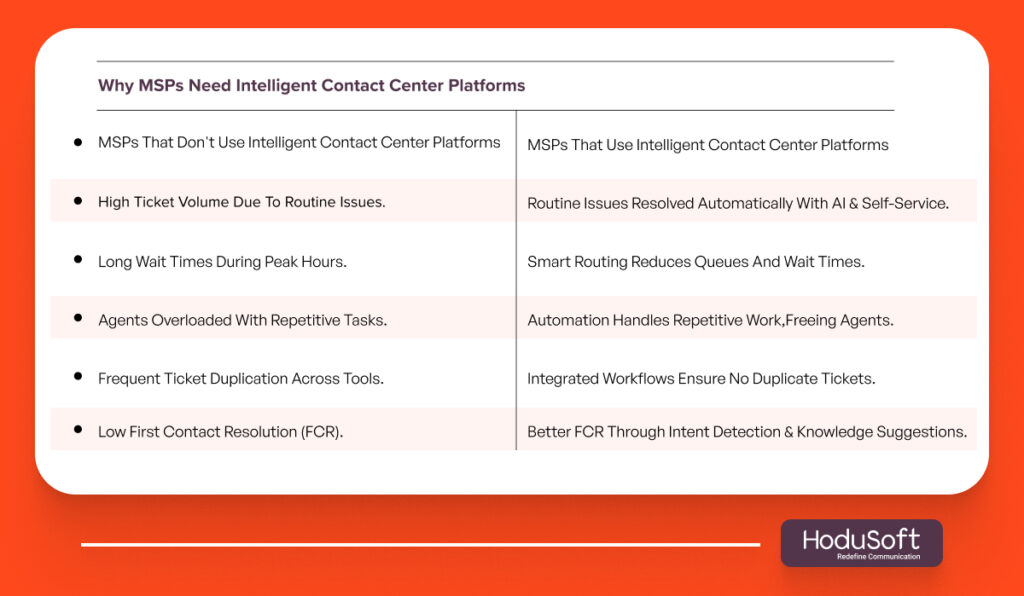
How Intelligent Contact Center Platforms Reduce Ticket Volume?
The right intelligent contact center platform can play a huge role in reducing an MSP’s ticket volumes. Here are some ways intelligent contact center platforms do that.
1. By solving routine issues before they become tickets
Most problems like password resets, VPN failures, or printer errors never reach a human. As per a study, AI-powered chatbots in intelligent contact center software can handle up to 70% of routine customer inquiries.
Did you know?
AI-powered chatbots and virtual agents now handle 60–80% of routine customer inquiries in many contact centers.
(Source: Zipdo)
2. By providing 24/7 customer self-service
For MSPs it’s important to serve customers across time zones who may have urgent issues after-hours. AI-powered IVR filters and resolves calls automatically. Instead of routing every call to an agent, the IVR system diagnoses the problem and offers automated steps. According to a recent stat, a growing number of contact centers expect that 75% of customer service interactions will be managed without human agents by 2027.
3. By understanding intent and sentiment
Intelligent contact center platforms detect urgency, frustration, and context. The AI sentiment and intent analysis can process 100% of conversations across channels continuously and in real time. With this insight, calls are routed to the most qualified agent. That reduces repeat calls and confusion.
4. By validating alerts before ticket creation
According to a recent study, organizations that use AI for ticket triage and classification see a jump from 20% to 80% in the share of tickets automatically classified and routed. Temporary spikes, auto-recovering outages, or system noise no longer create tickets. AI checks and confirms if the alert requires action.
5. By providing the right knowledge at the right time
According to recent data, companies with a well-designed knowledge base saw up to 40% reduction in support ticket volume after deploying it. It recommends precise knowledge base articles. Users fix issues themselves without waiting for help.
6. By handling repetitive tasks
As per latest data, AI-powered contact centers see a 14% increase in issues resolved per hour combined with a 9% drop in average handling time. When a majority of repetitive tasks happen without human effort, it results in faster resolution and fewer tickets. It means MSP agents can process more tickets in less time.
Many support teams are already seeing this shift in real life. As one Reddit user wrote “Supposedly these bots are already handling 70–80% of tickets instantly and leaving humans only the tricky stuff.”
Key Features that Help in Reducing Ticket Volume
Intelligent contact center platforms come equipped with a wide range of features. Here are some key features that help in reducing high ticket volumes.
1. Intelligent call routing systems
Intelligent call routing systems use predefined routing rules, caller data, and agent skills to route calls to the most qualified agent or virtual agent. This intelligent routing reduces misrouted customer calls and prevents low-value tickets.
2. AI-powered self service features
AI-powered solutions such as AI chatbots and virtual assistants enable customer self service across digital channels. By resolving common customer inquiries instantly, they drastically reduce inbound calls to human agents.
3. Advanced IVR systems
A modern IVR system uses interactive voice response to guide users through automated troubleshooting. It deflects routine inbound calls, enhances customer experience, and prevents unnecessary ticket creation.
4. Omnichannel routing
With omnichannel routing, MSPs can manage customer conversations from chat, email, smart speakers, and other digital channels in a single workflow. This unified approach helps route calls efficiently and minimizes duplicate tickets.
5. Real-time data analysis
Intelligent contact centers use real time data, customer data, and past interactions to analyze issues before escalating them. This prevents false alarms and reduces the number of tickets generated from temporary or self-resolving problems.
6. Virtual agents automating workflows
Intelligent platforms allow MSPs to create virtual agents capable of performing diagnostics, resetting accounts, checking outages, and answering customer questions.
7. Integration capabilities with other systems
Integration capabilities allow the contact center to sync with Remote Monitoring and Management (RMM), Professional Services Automation (PSA), Customer Relationship Management (CRM), and other systems. This ensures accurate customer data, enhances routing systems, and reduces manual work for center agents.
Did you know?
Contact centers using AI report up to 30% reduction in customer service costs and up to 35% lower operating costs overall. (Source: Gitnux)
Best Practices for Implementing Intelligent Routing
When it comes to implementing intelligent routing, MSPs may find it overwhelming where to start. Here are some best practices for implementing intelligent routing.
1. Define clear rules and intents
Start with simple routing rules. Keep every rule easy to follow. Sort requests by type, urgency, and user need. Mark what issues need fast help. Mark what issues can wait. Define clear escalation paths. This helps your intelligent contact center platform work better. It reduces confusion for agents. It keeps customer journeys smooth. And it cuts MSP ticket volume by sending issues to the right place instantly.
2. Use skills and AI together
Use skills-based routing for accuracy. Use AI routing for speed. Let AI detect intent fast. Match customers with the right engineer. Send basic issues to bots. Send complex issues to experts. This mix boosts first-contact resolution. It saves time for MSP teams. It improves customer experience. And it stops wrong tickets from entering the system, reducing overall support load.
3. Use real-time data always
Check live data every moment. Track queues in real time. Track agent availability too. Watch SLA timers closely. Let the routing engine change paths fast. This prevents long delays. It avoids bottlenecks. It sends work to free agents. It protects SLA goals. MSPs handle volumes better. Intelligent routing becomes smarter. And customers get faster help with fewer backlogs.
4. Integrate routing with ITSM tools
Connect routing with your tools. Use ServiceNow, Freshservice, or ConnectWise. Sync every ticket field. Sync user data too. Avoid duplicate entries. Avoid repeated updates. Keep everything in one flow. This helps agents work faster. It removes manual tasks. It reduces ticket noise. And it ensures your intelligent contact center platform supports your MSP workflow end-to-end.
5. Segment customers by SLA tiers
Group customers by SLA level. Mark VIPs clearly. Mark premium users too. Keep standard users separate. Route each tier differently. This protects service promises. It stops SLA breaches. It keeps high-value clients happy. MSPs stay compliant easily. Intelligent routing becomes fair. And it reduces escalations, which often create extra tickets and pressure on your support team.
6. Train AI often with data
Feed your AI real data. Use past tickets. Use chat logs too. Add notes from engineers. Add common issue patterns. Let AI learn trends. It improves intent detection. It improves routing accuracy. It reduces misrouted calls. It automates simple tasks. MSPs get fewer basic tickets. And customers get faster, more accurate answers with less effort.
7. Monitor routing performance weekly
Track how routing works. Check routing accuracy often. Watch transfer rates closely. Track average handling time (AHT) and first contact resolution (FCR) rate. Fix broken rules fast. Remove dead paths. Add better rules. Improve queues often. Keep reviewing trends. This builds a strong system. MSP teams stay efficient. Customers get better support. And ticket volume stays lower over time.
Ready to reduce ticket volume and deliver faster, smarter support?
Summing Up
Reducing ticket volume is no longer about adding more agents. It’s about using smarter systems. With AI-powered intelligent routing, MSPs can handle issues faster, avoid repeat tickets, and deliver consistent SLA-driven support.
HoduCC makes this shift easy. Its intelligent contact center platform uses AI, skills-based routing, real-time data, and deep ITSM integrations to streamline every customer interaction. MSPs can resolve more issues on the first try, reduce operational load, and create a smoother support experience for every client.
If your MSP is ready to cut ticket noise and boost efficiency, HoduCC is the platform that helps you get there.