

Future-Ready ISPs: Supporting AI-Driven Contact Center Operations
In an era where customer expectations are constantly evolving, Internet Service Providers (ISPs) must not only deliver fast and reliable connectivity but also provide outstanding support experiences.
As AI reshapes digital service delivery, ISPs that invest in smart, scalable architectures will gain an edge in delivering seamless, responsive support. In particular, supporting contact center operations is a key frontier: those with “future-ready” ISP solutions can empower their contact centers to run effectively, cost-efficiently, and intelligently.
In this blog, we’ll explore how ISPs can enable AI-driven contact center operations, the roles that contact center software and infrastructure play, and what the future of contact center technology holds.
What Is an AI Contact Center?
An AI contact center (or AI-driven contact center) is a customer support environment augmented by artificial intelligence and automation, where tasks like conversational routing, self-service, agent assistance, sentiment analysis, and predictive engagement are powered by AI models — reducing manual workflows and enhancing decision-making.
.
What “Future-Ready” Means in the ISP Context
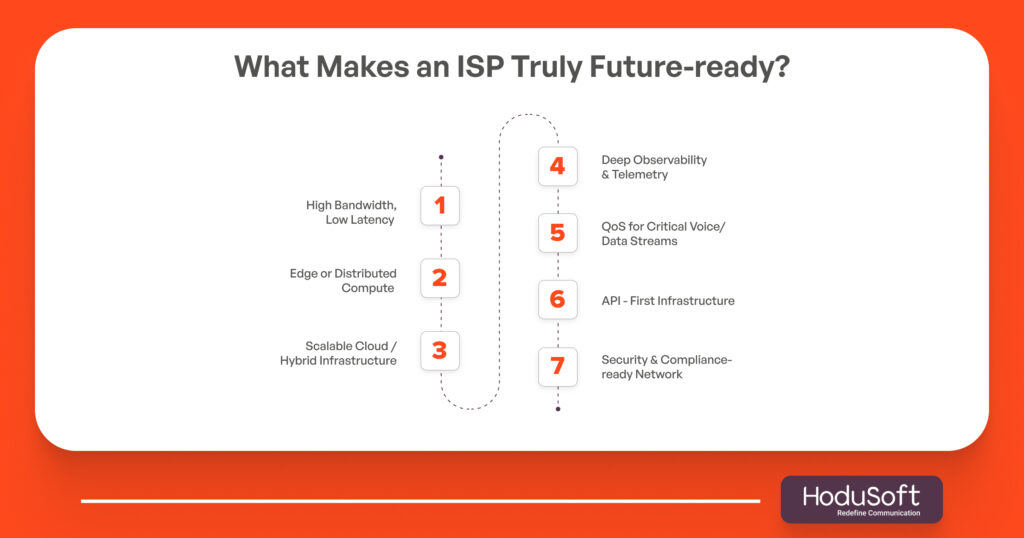
When we say “future-ready ISPs,” we’re referring to Internet Service Providers that design their networks, systems, and service models anticipating the growth of advanced, AI-powered services such as AI-driven contact center operations. These ISPs invest in:
- High bandwidth, ultra-low latency connectivity
- Edge compute or distributed compute nodes
- Scalable cloud or hybrid infrastructure
- Strong observability, telemetry, and APIs
- QoS (quality of service) guarantees for key flows (e.g., contact center voice/data)
- Seamless integration into cloud/contact center platforms
In other words, these ISPs are not just pipe providers; they are enablers of value-added digital services. The ones that “get ahead” will be those that see contact center operations as a strategic vertical in their client base.
The Role of the ISP in AI-Driven Contact Centers
At first glance, ISPs might view contact centers (or contact center software) as merely an overlay or client application. But in practice, the ISP’s network architecture, reliability, latency, and integration capabilities have profound impacts on performance, user experience, and cost.
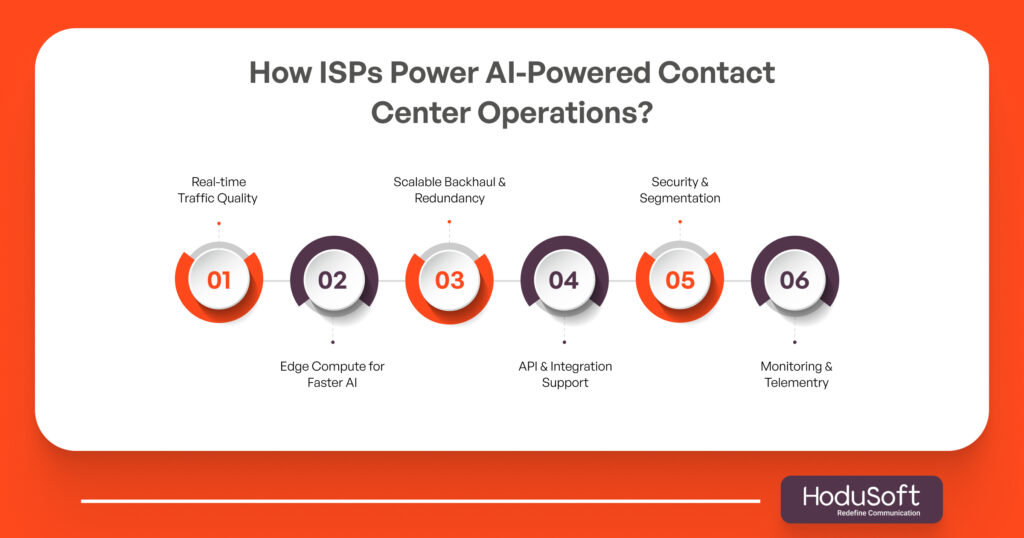
Here are several concrete ways in which ISPs act as critical enablers (or bottlenecks):
- Quality of Real-Time Traffic (Voice, Video, Chat)
AI-driven contact center software often involves real-time audio/video, chat, or screen share streams. Without robust QoS, jitter, packet loss, or latency can cripple effectiveness (e.g., voice drops, lag). An ISP that offers prioritization for contact center flows ensures higher SLA reliability. - Edge/Regional Compute to Support AI Services
Some AI services (speech transcription, sentiment models, local caching) benefit from being closer to the customer or data source (edge or regional data centers). ISPs that host or partner with edge facilities reduce round-trip time, making real-time features snappier. - Scalable Backhaul and Redundancy
A contact center may spike demand (e.g., during outages or campaigns). ISPs must architect backhaul and redundancy so that surges don’t degrade performance. A future-ready ISP anticipates bursts from AI-powered systems and allocates capacity dynamically. - API and Integration Capabilities
Modern contact center software often expects APIs or integration into network layers, e.g., to fetch IP allocation, device provisioning, or usage metrics. ISPs with flexible APIs and modular services make it simpler to coordinate contact center needs. - Security, Compliance & Segmentation
AI in customer support handles sensitive data (voice, PII). ISPs need to support segmentation (VPN, VLANs, secure tunnels), encryption, DDoS protection, and compliance with regional regulations to ensure trustworthiness. - Monitoring, Telemetry & Observability
For AI-powered contact center operations to be reliable, tight observability (metrics, logs, health) is essential. ISPs that expose useful telemetry to clients (e.g., latency graphs, packet loss) help contact center operators detect anomalies proactively.
In summary, contact center software doesn’t exist in isolation; the ISP layer must be aligned to ensure performance, scalability, reliability, and security.
The Push Toward AI in Customer Support Operations
Let’s explore the macro trends and incentives that are pushing ISPs and enterprises alike toward AI-driven contact center operations.
Market Growth & Adoption Trajectory
- The global call center AI market was estimated at USD 1,998.7 million in 2024 and is projected to reach USD 7,084.7 million by 2030 (CAGR ~23.5%).
- Another analysis expects the AI for customer service market to grow from USD 12.06 billion (2024) to USD 47.82 billion (2030) at 25.8% CAGR.
- Some forecasts project the global AI in contact center market to hit USD 12.1 billion by 2033, up from USD 1.9B in 2023 (CAGR ~20.4%).
These numbers underscore that AI in customer support is not a niche; it’s a fast-growing mainstream transformation.
From Automation to Personalization: How AI is Shaping the Future of CX
Drivers Accelerating the Shift
- Rising Customer Expectations
Customers now expect quick, personalized, and proactive service across channels. Legacy contact center setups struggle to scale. AI helps meet these high bar expectations seamlessly. - Cost & Efficiency Push
Labor is expensive. Automating repetitive tasks (e.g., FAQ resolution, routing) via AI frees agents to handle higher-value interactions. This tradeoff is a compelling ROI argument. - Omni-Channel Complexity
Modern customers use voice, chat, email, social media, etc. AI helps unify data across these channels and route intelligently based on content, sentiment, and history. - Data & Feedback Loop
AI systems thrive on data. Contact centers generate huge interaction logs. That data can be used for continuous learning, improving accuracy, personalization, fraud detection, etc. - Hybrid & Remote Work
Post-pandemic, many contact centers operate remote/hybrid models. AI assistance (agent assist, real-time guidance) helps maintain consistent quality across distributed agents. - Competitive Differentiation
For many businesses, customer experience is a strategic differentiator. Having an AI-powered contact center can be a marketing as well as operational advantage.
As a result, ISPs that accommodate these trends (e.g., providing robust networking, low latency, edge compute, secure integration) become essential partners.
Key Capabilities of a Truly AI-Powered Contact Center Software
When enterprises evaluate contact center software today, they increasingly demand AI capabilities baked in, not as add-ons. Let’s look at the essential pillars of AI-powered contact center software (or what makes a contact center “AI-driven”).
| Capability | Description |
| Conversational bots / virtual agents | AI agents handle routine queries (billing, password reset, status checks), reducing agent load. These bots route or escalate when queries are complex. This accelerates response time and reduces costs. |
| Natural Language Understanding & Speech Recognition | The system must understand customer intent (spoken or typed) accurately. That enables smooth transitions and context retention rather than disjointed menu systems. |
| Intelligent Routing / Predictive Routing | Beyond simple IVR branching, AI models can assign calls/chats to the best agent based on past performance, context, sentiment, and availability. This improves first-touch resolution. |
| Agent Assist / Real-Time Guidance | During an interaction, AI can suggest responses, knowledge articles, cross-sell opportunities, or detect sentiment issues. This empowers agents rather than replacing them. |
| Sentiment & Emotion Analytics | By analyzing tone, word choice, and pauses, AI can detect frustration or positive sentiment, triggering real-time escalation or service recovery. |
| Conversation Transcription & Analytics | Automated, accurate transcripts allow indexing, search, compliance audits, and coaching. Combined with analytics, managers can identify patterns, quality gaps, and trends. |
| Omni-Channel Integration | AI must unify context across voice, chat, email, SMS, WhatsApp, and social media. A customer’s conversation should fluidly transition across channels without losing context. |
| Predictive / Proactive Outreach | AI can anticipate issues (e.g. downtime, billing anomalies) and proactively reach out to customers, reducing inbound volume and improving satisfaction. |
| Continuous Learning & Model Refinement | The more data, the smarter the system. Models refine themselves over time based on feedback loops, improving accuracy and reducing human intervention. |
How ISP Solutions for Contact Centers Need to Evolve?
To support AI-powered contact center software, ISP solutions must themselves evolve. Let’s map what such evolution looks like.
1. Tiered, SLA-Backed QoS & Traffic Prioritization
Contact center traffic is sensitive to latency, jitter, and packet loss. ISPs must offer tiered service levels (e.g., “Contact Center Premium”) with guaranteed packet delivery, latency bounds, and automatic rerouting during failures. This ensures voice/data stays smooth even in congestion.
2. Edge Hosting & Regional Compute Nodes
AI inference tasks (speech-to-text, sentiment detection, model execution) can be offloaded to regional edge nodes. ISPs that host or partner with edge compute providers can reduce round-trip time and improve the responsiveness of AI features, especially for real-time tasks.
3. Elastic Bandwidth & Burst Handling
Contact center demand can surge (e.g., after network incidents, promos). ISPs should enable dynamic scaling (burst bandwidth) without manual intervention. This elastic model ensures that critical AI-driven operations don’t starve for bandwidth during peaks.
4. Network APIs & Programmability
Modern contact center platforms expect to integrate with networking (e.g., auto-provisioning, scaling, diagnostics). An ISP offering APIs (REST, gRPC) for network provisioning, monitoring, and teleportation makes integration seamless. This supports automation and DevOps in contact center ops.
5. Observability & Telemetry Sharing
To trust network health, contact center operators need visibility—packet loss trends, latency graphs, path traces, and congestion alerts. ISPs must expose dashboards or telemetry APIs so operators can correlate network anomalies with contact center KPIs.
6. Security, Segment Isolation & Compliance
AI in customer support handles sensitive data. ISPs must provide strong encryption, private connectivity (e.g., MPLS, VPN), isolation (VLANs, virtual circuits), DDoS protection, and adherence to local regulations (GDPR, CCPA, etc.). Without this, enterprises won’t deploy mission-critical contact center systems.
7. Integration & Partnership Ecosystems
ISPs that partner with contact center software providers (or host their clients’ compute) can offer managed bundles: connectivity + compute + AI capabilities. This “ISP + platform” model becomes compelling to enterprises looking to outsource complexity.
8. Flexible Service Models (On-Demand, Hybrid, Consumption-Based)
Instead of rigid long-term contracts, ISPs need to offer consumption-based, on-demand, or hybrid models (on-prem + cloud + edge). This flexibility aligns with how modern contact center software is consumed.
In short, for ISPs, the shift is from “dumb pipe” to “smart, orchestrated platform” – especially for contact center operations.
Challenges & Mitigation Strategies
Any transformation comes with friction. Let’s be honest about common challenges and possible mitigation strategies (especially for ISPs and contact center operators).
Challenge 1: Integration Complexity
Legacy contact center architectures may resist AI module integration. Bridging the gap between monolithic systems and modular AI capabilities can be complex.
Mitigation: Start with modular AI add-ons (e.g., bot engines, agent assist) and gradually migrate core functions. Use open APIs and middleware layers to bridge the legacy and AI worlds.
Challenge 2: Data Privacy & Compliance
Voice transcripts, recordings, and customer metadata are sensitive. Depending on the region, regulations may restrict where data resides or how it moves.
Mitigation: Utilize in-region compute, anonymization, encryption at rest/in transit, and strict access controls. ISPs must support segmented paths and regulatory control zones.
Challenge 3: Trust & Accuracy Concerns
Organizations may hesitate to rely fully on AI decisions (routing mistakes, misunderstanding speech, wrong guidance).
Mitigation: Always include human fallback paths, confidence thresholds, transparency in decision logic, and continuous feedback loops to refine models. Use AI as an assist, not a replacement, at first.
Challenge 4: Cost of Infrastructure
Edge nodes, scalable compute, and high-quality network SLAs require investment. For ISPs serving smaller clients, cost justification may be hard.
Mitigation: Offer tiered models: basic, advanced, premium. Phased rollout. Shared infrastructure models (multi-tenant edges). Use cloud and third-party partnerships rather than building everything in-house.
Challenge 5: Talent & Operational Expertise
Running AI systems, integrating, optimizing, DevOps, and continuous model management demand specialized skills.
Mitigation: Build partnerships, invest in training, and adopt managed AI/ML operations platforms. Use vendor support and third-party ecosystems.
Challenge 6: Changing Demand Patterns & Predictability
Contact center volumes, patterns, and failure modes can vary widely. ISPs must anticipate non-linear surges and handle anomalies.
Mitigation: Use historical forecasting, burst models, auto-scaling rules, and buffer capacity. Monitor real-time load and provision dynamically.
By acknowledging these challenges and planning for mitigation, ISPs and contact center operators can avoid common pitfalls.
The Future of Contact Center Technology: What to Watch
What lies ahead in the world of contact center operations, especially as it converges with sophisticated network infrastructure? Here are some emerging trends:
1. Agentic AI / Autonomous Agents
Next-gen systems will see agentic AI, independent AI agents that handle tasks end to end (not just assist). The agentic AI market is projected to grow explosively (one forecast suggests ~USD 190B by 2034, CAGR ~44.5%).
2. Generative AI & Conversational Intelligence
Rather than scripted bots, you’ll see generative AI (e.g., GPT-style models) powering dynamic, personalized conversations across voice and text channels. These systems can compose responses, suggest upsells, or even generate post-interaction wrap-up summaries.
3. Predictive & Prescriptive Support
Beyond reactive support, AI will increasingly predict customer issues before they arise (e.g., connectivity degradation, billing anomalies) and prescribe actions to reduce inbound load.
4. Self-Optimizing Networks & AI Co-Design
ISP networks and contact center operations may co-evolve: AI models may influence routing, infrastructure placement, or load balancing at the network level for optimal performance. The ISP + contact center becomes a jointly optimized system.
5. Multimodal & Contextual Interfaces
Conversations may not just be voice or text – images, video, AR/VR, and screen sharing may blend. AI must understand context across modalities.
6. Emotional AI & Behavioral Analytics
AI will detect subtle cues – mood, stress, urgency, and adapt tone, agent suggestions, or escalation dynamically.
7. Federated / Edge Learning
To preserve privacy, models may train in a federated fashion across distributed nodes or edges. The ISP architecture will need to support secure model synchronization and updates.
8. Composable & Microservices Architecture
Contact center software will increasingly be modular and composable. ISPs will benefit from offering platform-level integration to accelerate the deployment of new modules (bots, analytics, channels).
9. Outcome-Based and Performance-Based SLAs
Instead of bandwidth SLAs, ISPs may begin offering performance-based SLAs tied to contact center KPIs (e.g., average response time, drop rate). This aligns incentives.
10. Ethical & Explainable AI
As systems make decisions, explainability and auditability will be crucial (for compliance, trust, and bias mitigation). ISPs and contact center platforms must integrate visibility into model logic.
In short, the future is not incremental; it’s transformative. ISPs who understand the trajectory will position themselves as strategic partners, not just connectivity providers.
A Roadmap: How an ISP Can Become Future-Ready for AI-Driven Contact Centers
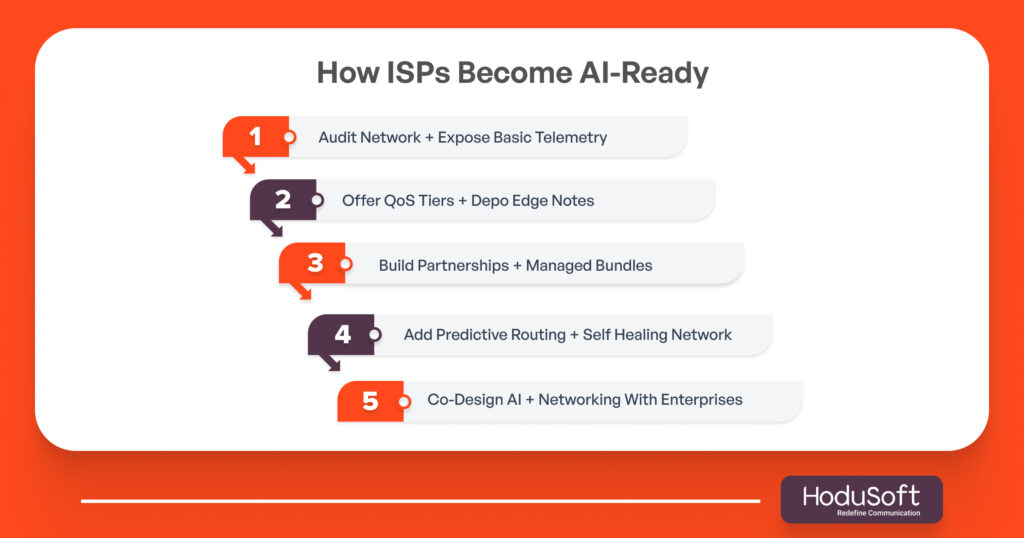
Here’s a suggested phased roadmap for an ISP that wants to support AI-driven contact center operations effectively:
Phase 1: Foundation & Awareness
- Audit existing network; identify latency/jitter/packet loss bottlenecks
- Segment network paths (e.g., for voice, data, AI traffic)
- Begin exposure of basic telemetry APIs
- Pilot connectivity + localized compute for a contact center client
Phase 2: Tiered Offerings & Edge Presence
- Define tiered service (standard, contact center premium)
- Deploy edge compute nodes in key geographies
- Provide QoS and failover for contact center flows
- Integrate network APIs for auto provisioning
Phase 3: Managed Bundles & Partnerships
- Partner with contact center software vendors: bundle connectivity + platform
- Offer orchestration between the network and application layers
- Expose the advanced observability dashboard to clients
Phase 4: Intelligence & Adaptive Infrastructure
- Use AI/ML internally to predict traffic surges and pre-allocate resources
- Build self-healing paths, auto-failover, predictive rerouting
- Offer outcome-based SLA contracts
Phase 5: Co-Optimized AI & Networking
- Collaborate with contact center clients to jointly optimize routing, edge placement, and AI model distribution
- Explore federated learning, embedded inference at network nodes
- Evolve toward an ISP + AI platform as a service
By following this roadmap, an ISP can evolve from a vanilla connectivity provider to a strategic enabler of next-gen contact center operations.
Conclusion
For contact centers to truly leverage conversational AI, real-time analytics, and predictive engagement, the underlying network must be resilient, low-latency, secure, and observable. That’s where ISP solutions for contact centers come into play.
To thrive, ISPs must move beyond “dumb pipes” and embrace programmability, edge computing, intelligent routing, and deep integration with contact center software architectures. The future of contact center technology largely depends on this tight coupling between network infrastructure and AI-enabled operations.
In that vein, HoduSoft’s contact center solution is built with many of these principles in mind: modular, cloud-native, API-first, with intelligent routing, omnichannel support, real-time analytics, and robust architecture designed to work with sophisticated ISP infrastructures.
Together, enterprises and ISPs can co-create AI-powered contact center systems that deliver superior customer experiences, operational efficiency, and competitive advantage.
Frequently Asked Questions
A traditional contact center relies heavily on human agents, rule-based routing, and manual workflows. An AI-driven contact center embeds automation, intelligent routing, agent assist, sentiment analysis, and continuous learning, reducing repetitive tasks and improving overall effectiveness.
Absolutely. Voice and chat traffic is sensitive to latency, jitter, and packet loss. If the ISP doesn’t prioritize or ensure high QoS for contact center flows, user experience suffers. Also, edge computing, security, and integration capabilities provided by the ISP directly influence the responsiveness of AI features.
Some major challenges include integration complexity with legacy systems, data privacy and compliance, accuracy/trust in AI decisions, infrastructure costs, and the need for specialized talent. Mitigations include phased rolls, fallback systems, strong governance, and partnerships or vendor support.
ISPs should offer elastic bandwidth, automated scaling, predictive provisioning based on historical trends, burst handling, and flexible contracts. Incorporating AI/ML internally to forecast usage helps proactively allocate resources before degradation occurs.
Not in the foreseeable future. AI is best positioned to augment humans, handling repetitive tasks, giving real-time suggestions, automating routing, and surfacing insights. Human agents will continue to manage complex, emotional, or ambiguous interactions. The real goal is a high-performing, hybrid team of AI + humans.